
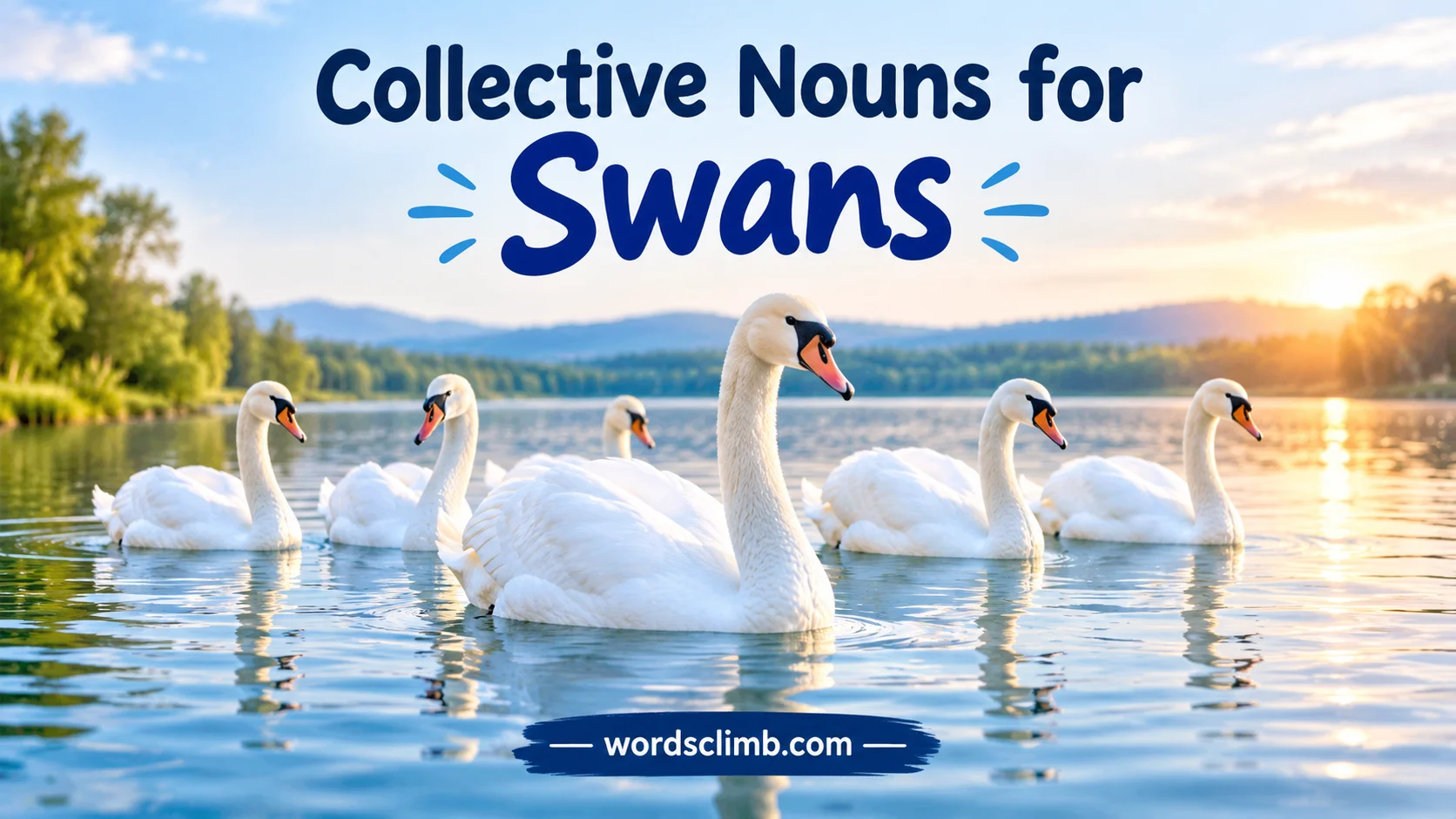
Collective Nouns for Swans describe the different words used for a group of these graceful birds. Common terms include flock, bevy, herd, wedge, and flight, with each word fitting a particular setting or behavior. Swans are known for their beauty, elegance, strength, and intelligence, making them one of the most admired waterfowl. They are also social birds that often gather together on lakes, rivers, and wetlands.
The names used for groups of swans can change depending on where the birds are and what they are doing. A flock or bevy may describe swans gathered on water, while a wedge or flight refers to swans traveling through the air. The term bank is also associated with swans resting near river or lake banks. Some collective terms have roots in medieval hunting traditions, although “flock” remains the most natural choice in everyday English. These words add interesting detail to the way we describe swans.
Collective Nouns for Swans
Several collective nouns can be used when describing swans. Some are common everyday terms, while others are more descriptive and traditional.
| Type | Simple Example |
| Bevy | A bevy of swans floated on the lake. |
| Flock | A flock of swans rested near the shore. |
| Herd | A herd of swans moved across the water. |
| Bank | A bank of swans gathered beside the river. |
| Wedge | A wedge of swans flew across the sky. |
| Flight | A flight of swans traveled south. |
1. Bevy of Swans
A bevy of swans is one of the best-known collective terms for a group of swans. It is especially suitable when several swans are gathered together on water or near a shoreline. The word gives the group a graceful and traditional feel.
Examples of Bevy
- A bevy of swans floated peacefully across the lake.
- We watched a bevy of swans near the riverbank.
- A bevy of swans gathered around the quiet pond.
- The children admired a bevy of swans from the bridge.
- A bevy of swans moved slowly through the water.
- The photographer captured a bevy of swans at sunrise.
- A bevy of swans rested beside the reeds.
- Tourists stopped to watch a bevy of swans swimming together.
- A bevy of swans appeared on the lake in the morning.
- The peaceful scene included a bevy of swans near the shore.
2. Flock of Swans
Flock is a general collective noun for birds and can also be used for swans. It is particularly useful when you want a simple, familiar term without emphasizing a specific behavior.
Examples of Flock
- A flock of swans rested on the lake.
- We saw a flock of swans near the meadow.
- A flock of swans crossed the river together.
- The photographer followed a flock of swans along the shore.
- A flock of swans gathered near the reeds.
- A flock of swans moved toward the center of the pond.
- The children counted a flock of swans on the water.
- A flock of swans flew over the wetland.
- We watched a flock of swans during our walk.
- A flock of swans disappeared behind the trees.
3. Herd of Swans
Herd is traditionally associated with groups of grazing animals, but it can sometimes be used descriptively for swans gathered together. It is less common than bevy or flock, so it works best when the context makes the meaning clear.
Examples of Herd
- A herd of swans gathered beside the lake.
- We noticed a herd of swans near the river.
- A herd of swans moved slowly through the shallow water.
- The guide pointed toward a herd of swans.
- A herd of swans rested near the grassy bank.
- The children watched a herd of swans from a distance.
- A herd of swans gathered around the pond.
- The photographer found a herd of swans near the wetlands.
- A herd of swans moved together across the water.
- We saw a herd of swans during our morning walk.
4. Bank of Swans
A bank of swans is a traditional and descriptive expression that can refer to swans gathered together, particularly around a body of water. The term creates a vivid picture of several swans resting or moving together near the water’s edge.
Examples of Bank
- A bank of swans rested beside the river.
- We saw a bank of swans near the lake.
- A bank of swans gathered along the shoreline.
- The children watched a bank of swans from the bridge.
- A bank of swans moved slowly through the water.
- The quiet river attracted a bank of swans.
- A bank of swans rested among the reeds.
- The photographer captured a bank of swans at sunset.
- A bank of swans gathered near the edge of the pond.
- We admired a bank of swans during our visit to the lake.
5. Wedge of Swans
A wedge of swans describes swans flying together in a characteristic V-shaped formation. This term is especially useful when describing their movement through the sky during migration or travel.
Examples of Wedge
- A wedge of swans flew across the evening sky.
- We watched a wedge of swans heading south.
- A wedge of swans appeared above the lake.
- The children pointed at a wedge of swans in the sky.
- A wedge of swans flew over the countryside.
- The photographer captured a wedge of swans during migration.
- A wedge of swans moved gracefully through the clouds.
- We heard a wedge of swans before seeing them overhead.
- A wedge of swans crossed the sky at dawn.
- The birds formed a wedge of swans as they traveled together.
Also Read This: Collective Nouns for Pheasants
Interesting Facts About Swans
Swans are among the largest and most graceful waterfowl, and their biology is just as fascinating as their appearance. Many swan species can live for well over a decade, and some individuals can reach several decades under favorable conditions. Their long necks contain numerous vertebrae, allowing them to reach vegetation beneath the water. Swans also have strong bodies, powerful wings, webbed feet, and specialized bills that help them feed efficiently. Their diets mainly include aquatic plants, grasses, algae, seeds, and other vegetation, although they may occasionally consume small aquatic animals and invertebrates. Many swans form strong pair bonds and cooperate in raising their young, making their social behavior particularly interesting to observe.
FAQs:
1. What is the most common collective noun for swans?
The most common collective noun for swans is flock. You can use “a flock of swans” when referring to several swans together.
2. What is a group of swans called?
A group of swans can be called a flock, bevy, herd, bank, wedge, or flight, depending on their location or activity.
3. What is a group of swans in flight called?
A group of swans flying together can be called a wedge or a flight. “Wedge” refers to their distinctive flying formation.
4. What is a bevy of swans?
A bevy of swans is a traditional collective expression for several swans gathered together, especially on water.
5. Can you call swans a herd?
Yes. Herd is sometimes used as a collective noun for swans, although flock is more common in everyday English.
6. What is a bank of swans?
A bank of swans is a traditional term for swans gathered near the bank of a river, lake, or other body of water.
7. Why are there different collective nouns for swans?
Different terms developed to describe swans based on their location, behavior, or movement. Some also come from historical traditions involving animal and bird names.
8. What collective noun should I use for swans in everyday English?
Flock is the safest and most natural choice. For example, “We saw a flock of swans swimming across the lake.”
9. Are collective nouns for swans still commonly used?
Some traditional terms, such as bevy, bank, wedge, and flight, are recognized in English, but they are less common in everyday conversation than “flock.”
10. Why do swans gather in groups?
Swans are social birds and may gather for feeding, resting, migration, breeding, or protection. Some species can form very large groups in suitable habitats.
Conclusion:
Swans are elegant and social birds with several interesting collective nouns. Flock is the most familiar term, while bevy, herd, bank, wedge, and flight can describe groups in different situations. Learning these terms can make your English vocabulary more precise and engaging. Whether swans are swimming peacefully on a lake or flying together in a beautiful formation, their group names reflect their behavior, movement, and surroundings.

Ruby Hart is a passionate writer who creates engaging, relatable, and easy-to-understand content. She loves turning everyday ideas into helpful and enjoyable stories for readers.
1 thought on “Collective Nouns for Swans”