
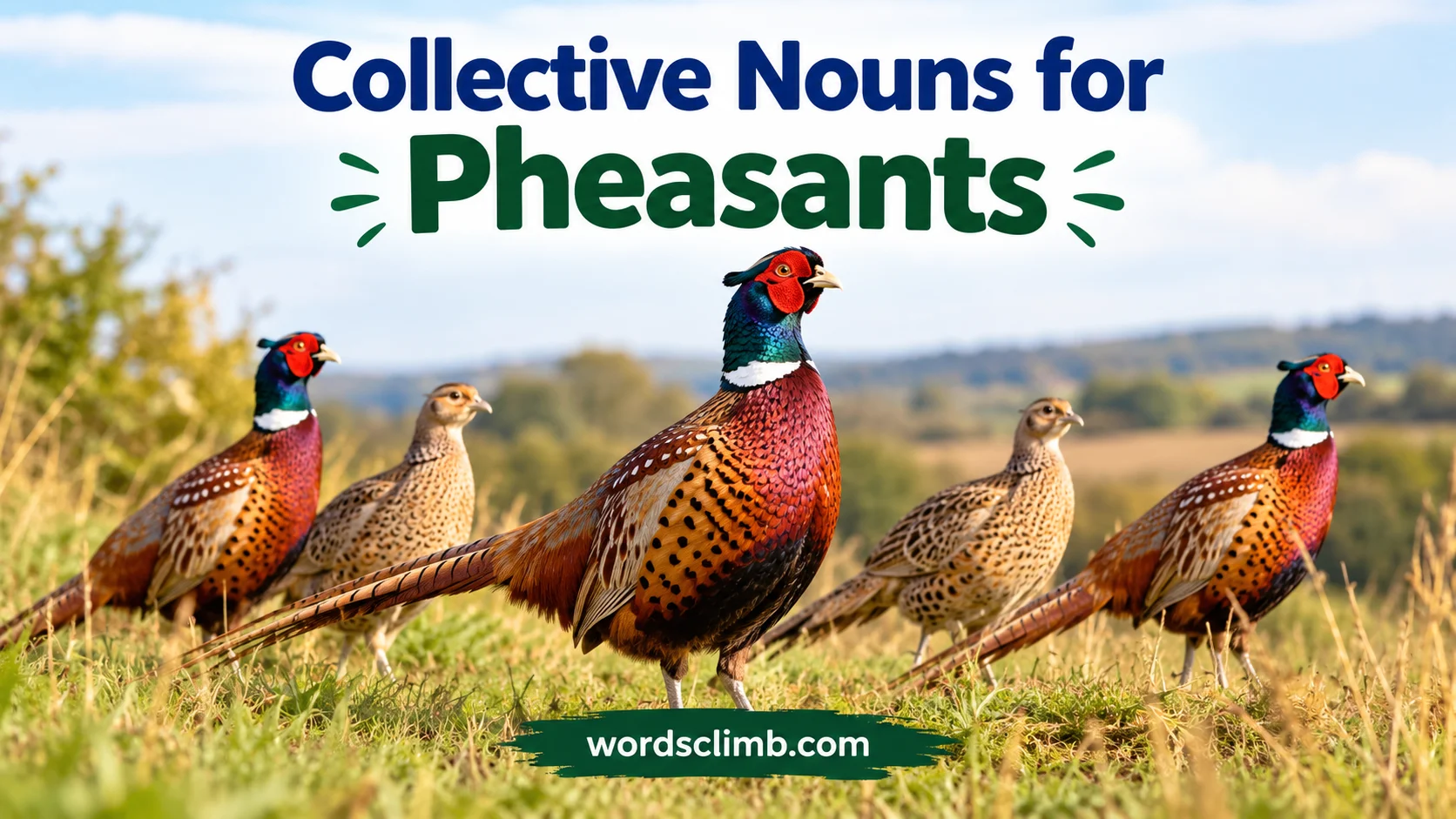
Collective Nouns for Pheasants help you describe groups of these beautiful birds in a more natural and interesting way. English uses special terms to name groups based on traditional usage, behavior, or appearance. Learning these expressions can improve your vocabulary, strengthen your writing, and make everyday sentences more precise. Whether you’re a student, teacher, writer, birdwatcher, or wildlife enthusiast, knowing the right collective noun can make your English sound more confident and polished.
A collective noun is a word that refers to a group of people, animals, birds, or things as one unit. For pheasants, traditional terms include covey, bouquet, and nye, although their popularity and usage can differ across sources. Some of these expressions have roots in medieval English and old hunting traditions, while flock remains a simple and familiar choice in modern English. Exploring these terms gives you useful insight into language, bird behavior, history, and vocabulary while adding variety to your descriptions.
Collective Nouns for Pheasants: Quick Overview
The table below provides a simple overview of commonly encountered collective nouns associated with pheasants.
| Type | Simple Example |
| Covey | A covey of pheasants crossed the field. |
| Bouquet | A bouquet of pheasants moved through the grass. |
| Nye | A nye of pheasants gathered near the woodland. |
| Brood | A brood of young pheasants followed their mother. |
These terms can be used to make descriptions more specific and interesting. Covey is one of the most recognizable terms for a small group of game birds, while brood is particularly useful when referring to young birds with a parent.
1. Covey of Pheasants
Covey is a traditional collective noun used for a small group of game birds, including pheasants. It is especially useful when describing several pheasants together in fields, grasslands, or woodland areas.
Example Sentences:
- A covey of pheasants walked across the field.
- We saw a covey of pheasants near the edge of the forest.
- The covey of pheasants disappeared into the tall grass.
- A farmer noticed a covey of pheasants near his crops.
- The covey of pheasants moved quietly through the bushes.
- Early in the morning, a covey of pheasants appeared near the woodland.
- The dog startled a covey of pheasants from the grass.
- A covey of pheasants searched for food under the trees.
- The photographer waited patiently for the covey of pheasants to appear.
- We watched a covey of pheasants move across the open land.
2. Bouquet of Pheasants
Bouquet is a colorful traditional expression sometimes associated with a group of pheasants. The word creates a vivid image because pheasants are known for their beautiful feathers and striking colors.
Example Sentences:
- A bouquet of pheasants gathered near the hedgerow.
- We spotted a bouquet of pheasants in the meadow.
- The bouquet of pheasants moved toward the trees.
- A bouquet of pheasants rested in the tall grass.
- The farmer saw a bouquet of pheasants near the field.
- A bouquet of pheasants suddenly flew into the woodland.
- The children quietly watched a bouquet of pheasants nearby.
- A bouquet of pheasants searched for seeds on the ground.
- The photographer captured a beautiful bouquet of pheasants.
- We noticed a bouquet of pheasants at the edge of the meadow.
3. Nye of Pheasants
Nye is an old and traditional collective term associated with pheasants. It is less common in modern everyday English, but it can appear in discussions of traditional bird terminology and historical hunting language.
Example Sentences:
- A nye of pheasants gathered near the woodland.
- The hunter noticed a nye of pheasants in the distance.
- A nye of pheasants moved through the field.
- We watched a nye of pheasants feeding near the bushes.
- The nye of pheasants scattered when they heard a noise.
- A nye of pheasants rested beneath the trees.
- The guide pointed toward a nye of pheasants across the meadow.
- A nye of pheasants emerged from the tall grass.
- The photographer carefully approached the nye of pheasants.
- At sunrise, a nye of pheasants appeared beside the woodland.
4. Brood of Pheasants
Brood is particularly appropriate when referring to young pheasants, especially when they are being raised by a mother. A brood emphasizes a family group rather than simply a gathering of adult birds.
Example Sentences:
- A brood of pheasants followed their mother through the grass.
- The mother pheasant protected her brood of pheasants.
- We saw a brood of pheasants near the hedgerow.
- The brood of pheasants searched for insects.
- A farmer noticed a brood of pheasants in the field.
- The young birds stayed close to their mother in the brood.
- A brood of pheasants disappeared into the vegetation.
- The mother led her brood of pheasants toward safer ground.
- We quietly watched a brood of pheasants feeding.
- The brood of pheasants moved together through the meadow.
5. Group of Pheasants
A group of pheasants is a simple and general expression for several pheasants together. Unlike traditional terms such as covey or nye, this phrase is easy to understand and works well in everyday writing. Pheasants may gather in open fields, grasslands, woodland edges, or areas where food and shelter are available.
Example Sentences:
- A group of pheasants walked across the field.
- We saw a group of pheasants near the woodland.
- The group of pheasants searched for food in the grass.
- A group of pheasants suddenly flew into the trees.
- The farmer noticed a group of pheasants near the crops.
- A group of pheasants moved quietly through the bushes.
- We watched a group of pheasants feeding in the meadow.
- The group of pheasants scattered when they heard a loud sound.
- A group of pheasants rested near the edge of the forest.
- The children quietly observed a group of pheasants from a distance.
Read This: Collective Nouns for Butterflies
Interesting Facts About Pheasants
Pheasants are fascinating birds with colorful appearances, distinctive body structures, and interesting feeding habits. Depending on the species and conditions, pheasants can live for several years in the wild, although survival is affected by predators, habitat quality, weather, disease, and human activity. Their most striking physiological feature is often the male’s brilliant plumage, which can include bright colors, patterned feathers, and a long tail. Males are generally more colorful than females, while females usually have brown or mottled feathers that provide excellent camouflage while nesting. Pheasants also have strong legs that help them walk and run through vegetation, and they can make surprisingly powerful short flights when startled. Their diet is varied and includes seeds, grains, berries, fruits, insects, leaves, and other plant material. Young pheasants depend more heavily on insects and other small invertebrates because they need protein for rapid growth. These feeding habits allow pheasants to adapt to fields, grasslands, woodland edges, and other suitable habitats.
FAQs:
1. What is the collective noun for pheasants?
The most commonly recognized collective noun for pheasants is covey. Other traditional terms include bouquet and nye, although these are less common in everyday English.
2. What is a group of pheasants called?
A group of pheasants can be called a covey. You may also find traditional terms such as bouquet or nye in historical and literary sources.
3. Is “flock” correct for pheasants?
Yes. Flock is a general collective noun that can naturally describe a group of birds, including pheasants. It is often easier and more familiar in modern English.
4. What does “covey of pheasants” mean?
A covey of pheasants means a small group of pheasants. The term is traditionally associated with groups of game birds.
5. What is a bouquet of pheasants?
A bouquet of pheasants is a traditional collective expression used for a group of pheasants. It is uncommon in everyday conversation but may appear in lists of traditional bird terms.
6. What does “nye of pheasants” mean?
A nye of pheasants is another traditional term for a group of pheasants. Like several old collective nouns, it is rarely used in ordinary modern speech.
7. Which collective noun for pheasants is most common?
Covey is one of the better-known traditional terms. However, flock is also perfectly understandable and natural when simply referring to several pheasants together.
8. Can I use “group of pheasants” in English?
Yes. Group of pheasants is completely correct and easy to understand. You do not always need a specialized collective noun, especially in simple or formal writing.
9. Why are there several collective nouns for pheasants?
English has many traditional collective nouns that developed through history, literature, and hunting traditions. Some became well known, while others remained rare or mainly historical.
10. Are collective nouns for pheasants commonly used today?
Some traditional terms are still recognized, but they are not commonly used in everyday conversation. In modern English, flock, group, and covey are generally easier for readers to understand.
Conclusion:
Learning the collective nouns for pheasants adds variety and precision to your English vocabulary. Terms such as covey, bouquet, and nye reflect the rich history of English, while flock remains a simple modern choice. Understanding when and how these words are used can help students, writers, teachers, birdwatchers, and wildlife enthusiasts describe groups of pheasants naturally and confidently.

Maya Rose is an English-language writer passionate about storytelling, personal growth, and everyday life. Her writing combines simplicity, warmth, and thoughtful perspectives that connect with readers.
1 thought on “Collective Nouns for Pheasants”