
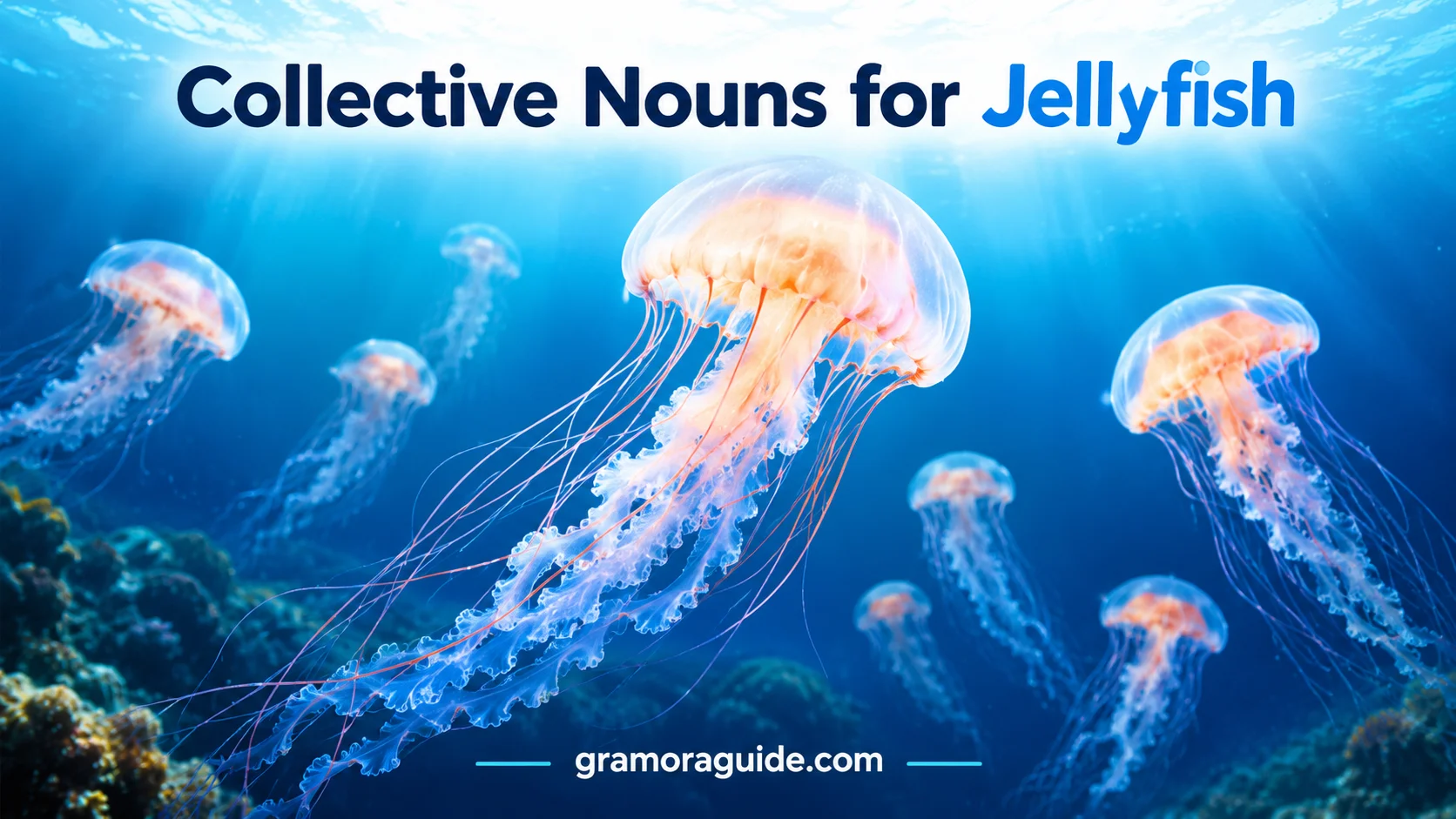
Collective Nouns for Jellyfish make learning about these fascinating ocean creatures more interesting. From a smack to a bloom, different terms describe groups of jellyfish. These unique expressions add color to English vocabulary and help you understand how marine animals gather in the sea. If you enjoy discovering unusual collective nouns, jellyfish offer a wonderful example of how language describes the natural world in creative and memorable ways.
Jellyfish are ancient marine animals made up of about 98% water. They have no brain and possess a simple nervous system that helps them sense changes around them. Although some drift alone, many gather in large groups called blooms or smacks. Their history stretches back hundreds of millions of years, making them older than dinosaurs. Exploring their collective nouns, habitats, and behavior reveals interesting connections between language and marine life.
What Is a Group of Jellyfish Called?
A group of jellyfish is commonly called a bloom or a swarm. The word bloom is particularly useful when large numbers of jellyfish appear in an area of the ocean. Scientists and marine observers also use terms such as aggregation to describe jellyfish gathered in one place.
The best collective noun depends on the situation. A bloom often refers to a large increase or concentration of jellyfish, while a swarm emphasizes a group moving or appearing together. The general word group is also correct when you simply want to describe several jellyfish without suggesting a particular behavior.
Common Collective Nouns for Jellyfish
Here are some terms you can use when describing multiple jellyfish.
| Type | Simple Example |
| Bloom | A bloom of jellyfish appeared near the coastline. |
| Swarm | A swarm of jellyfish drifted through the water. |
| Aggregation | An aggregation of jellyfish gathered near the surface. |
| Group | A group of jellyfish floated beside the reef. |
| Cluster | A cluster of jellyfish was visible beneath the boat. |
| Mass | A mass of jellyfish moved with the ocean currents. |
Important note: Bloom and swarm are especially useful terms for jellyfish gatherings. Aggregation, cluster, and mass are descriptive alternatives rather than exclusive or universally recognized jellyfish-specific collective nouns.
1. Bloom of Jellyfish
A bloom of jellyfish is one of the most useful expressions for describing a large concentration of jellyfish in a particular area. The term is widely used in marine science and environmental reporting, especially when jellyfish numbers increase noticeably.
Meaning of Bloom
The word bloom refers to a large gathering or sudden increase in the number of jellyfish in a body of water. Jellyfish blooms can occur naturally and may be influenced by food availability, ocean currents, water temperature, and other environmental conditions.
A bloom does not necessarily mean that every jellyfish is swimming in the same direction. Instead, it describes a noticeable concentration of these animals in one location.
Example Sentences
- A bloom of jellyfish appeared along the sandy coastline.
- Researchers studied a bloom of jellyfish near the harbor.
- The fishermen noticed a large bloom of jellyfish in the bay.
- Warm coastal waters sometimes support a bloom of jellyfish.
- A bloom of jellyfish attracted the attention of marine biologists.
- The beach was temporarily closed after a bloom of jellyfish was reported nearby.
- Ocean currents carried the bloom of jellyfish toward the shore.
- The research team photographed a bloom of jellyfish beneath the water.
- A bloom of jellyfish can affect local fishing activities.
- Scientists monitored the bloom of jellyfish to understand its development.
When to Use Bloom
Use bloom when discussing a large concentration of jellyfish, particularly in scientific writing, environmental news, or descriptions of coastal conditions. It is more specific than the general word group because it often suggests an unusually large number of animals in one area.
2. Swarm of Jellyfish
A swarm of jellyfish describes many jellyfish gathered or moving together in the water. It is an accessible and vivid expression that works well in everyday writing and descriptions of marine life.
Meaning of Swarm
A swarm usually refers to a large number of animals moving or gathering in the same area. When applied to jellyfish, the word emphasizes their presence in considerable numbers rather than a particular biological relationship between them.
Jellyfish do not necessarily coordinate their movements like a flock of birds. Ocean currents and water movement can bring many individuals together, making a swarm appear to travel as one mass.
Example Sentences
- A swarm of jellyfish drifted across the clear blue sea.
- The divers spotted a swarm of jellyfish near the reef.
- A swarm of jellyfish moved slowly beneath the research vessel.
- Tourists watched a swarm of jellyfish from the pier.
- Strong currents pushed a swarm of jellyfish toward the coast.
- The underwater camera recorded a swarm of jellyfish near the surface.
- A swarm of jellyfish made swimming unsafe in the affected area.
- Marine researchers observed a swarm of jellyfish during their survey.
- The boat passed carefully through the water surrounding the swarm of jellyfish.
- A swarm of jellyfish floated beneath the moonlit ocean surface.
When to Use Swarm
Use swarm when you want to emphasize the number of jellyfish or describe their visible movement through the water. It suits informal writing, nature articles, documentaries, and general descriptions of marine observations.
3. Aggregation of Jellyfish
An aggregation of jellyfish is a gathering of individuals in a particular area. This term is useful in scientific and educational writing because it describes the concentration without automatically suggesting that the animals are intentionally cooperating.
Meaning of Aggregation
In biology, an aggregation is a collection of organisms found close together. Jellyfish may aggregate because currents transport them into the same area or because environmental conditions favor their presence there.
An aggregation can contain many jellyfish, but the word itself does not establish that their population has suddenly increased. It simply describes their concentration in a location.
Example Sentences
- An aggregation of jellyfish formed near the ocean surface.
- Marine biologists examined an aggregation of jellyfish in the bay.
- The underwater survey revealed an aggregation of jellyfish near the reef.
- Currents contributed to the aggregation of jellyfish along the coast.
- An aggregation of jellyfish was visible from the research boat.
- Scientists recorded the size of the aggregation of jellyfish.
- The aggregation of jellyfish gradually spread across the surrounding waters.
- Researchers investigated why an aggregation of jellyfish appeared in the harbor.
- An aggregation of jellyfish provided an opportunity for underwater photography.
- The team mapped the aggregation of jellyfish before collecting further observations.
When to Use Aggregation
Use aggregation in scientific reports, academic assignments, marine biology articles, and formal descriptions. It is particularly helpful when you want to describe jellyfish gathered in one place without claiming that a bloom has occurred.
4. Group of Jellyfish
A group of jellyfish is the simplest and most general way to describe several jellyfish together. Unlike bloom or swarm, it does not imply a large concentration or any particular movement.
Meaning of Group
A group is a collection of individuals or objects considered together. In ordinary English, the term works perfectly well for jellyfish, regardless of their species, number, or location.
Although group is not a specialized marine term, it is often the clearest choice when writing for beginners or describing a small number of jellyfish.
Example Sentences
- A group of jellyfish floated near the sandy seabed.
- We saw a group of jellyfish during our boat trip.
- The marine guide pointed out a group of jellyfish in the water.
- A group of jellyfish passed beneath the glass-bottom boat.
- The students observed a group of jellyfish at the aquarium.
- A group of jellyfish appeared near the edge of the reef.
- The photographer captured a group of jellyfish against the blue water.
- A group of jellyfish drifted away from the rocky shoreline.
- The researchers counted each jellyfish in the group.
- A group of jellyfish moved through the water under the pier.
When to Use Group
Use group in everyday conversation, schoolwork, simple explanations, and situations where a more specialized term is unnecessary. It is an accurate and flexible alternative when you are unsure whether bloom or swarm fits the situation.
5. Cluster of Jellyfish
A cluster of jellyfish describes several jellyfish positioned close together. It is a descriptive expression rather than a uniquely established scientific collective noun.
Meaning of Cluster
A cluster is a collection of things that are close together. When jellyfish gather in a relatively small area, cluster can help readers picture their proximity.
However, a cluster does not necessarily mean the jellyfish are attached to one another. These animals usually remain separate individuals, even when water movement brings them close together.
Example Sentences
- A cluster of jellyfish appeared beside the underwater rocks.
- The diver noticed a cluster of jellyfish near the reef.
- A cluster of jellyfish floated beneath the fishing boat.
- The aquarium displayed a cluster of jellyfish in a large tank.
- Sunlight illuminated a cluster of jellyfish near the surface.
- The photographer waited for the cluster of jellyfish to move into view.
- A cluster of jellyfish gathered in a sheltered part of the bay.
- Researchers examined a cluster of jellyfish during their coastal survey.
- A cluster of jellyfish drifted past the submerged camera.
- The children watched a cluster of jellyfish from behind the aquarium glass.
When to Use Cluster
Use cluster when you want to emphasize that jellyfish are close together in a particular place. It works well in descriptive writing, travel articles, aquarium observations, and nature photography captions.
6. Mass of Jellyfish
A mass of jellyfish describes a large number of jellyfish concentrated in an area. The expression emphasizes their quantity and the visual impression they create.
Meaning of Mass
The word mass can refer to a large collection of things considered together. In descriptions of jellyfish, it may be used when many individuals fill a section of the water or gather near the coast.
The term is descriptive rather than a specialized biological label. Depending on the circumstances, bloom or aggregation may be more suitable in a scientific discussion.
Example Sentences
- A mass of jellyfish covered a large area of the water.
- The crew spotted a mass of jellyfish near the harbor.
- A mass of jellyfish drifted toward the sandy beach.
- The marine report described a mass of jellyfish offshore.
- A mass of jellyfish appeared beneath the research vessel.
- Ocean currents moved the mass of jellyfish along the coast.
- The divers kept their distance from the mass of jellyfish.
- A mass of jellyfish filled the underwater camera’s view.
- Scientists investigated the large mass of jellyfish in the bay.
- The tide carried the mass of jellyfish away from the beach.
When to Use Mass
Use mass when describing a large concentration that creates a noticeable visual presence. It can make a sentence more vivid, but it should not replace precise scientific terminology when discussing the causes or ecological effects of a jellyfish bloom.
Also Read This: Collective Nouns for Caribou
Interesting Facts About Jellyfish
Jellyfish are remarkable marine animals with adaptations that help them survive in different aquatic environments. Learning about their biology also helps explain why they sometimes gather in large numbers.
1. Jellyfish Are Not True Fish
Despite their common name, jellyfish are invertebrates belonging to the animal group Cnidaria. They do not have backbones, and their bodies are quite different from those of bony fish. Their familiar name comes from their gelatinous appearance and their life in water.
2. Their Bodies Contain a Lot of Water
Many jellyfish have bodies made up largely of water and a soft, jelly-like substance. Their bell-shaped bodies can contract to help propel them through the water, although ocean currents often influence where they travel.
3. Jellyfish Have Specialized Stinging Cells
Many jellyfish possess specialized cells called cnidocytes, which contain structures used to capture prey or provide defense. In many species, these structures can deliver venom through tiny, harpoon-like capsules called nematocysts. The strength and effects of a sting vary by species.
4. They Eat Different Kinds of Marine Organisms
Depending on the species, jellyfish feed on plankton, small crustaceans, fish eggs, fish larvae, and other small animals. Their tentacles help capture prey, which is then moved toward the mouth.
5. Jellyfish Blooms Have Several Possible Causes
Jellyfish blooms may be influenced by food supply, currents, temperature, reproduction, and other environmental conditions. The causes differ among species and locations, so a bloom should not automatically be attributed to one factor.
6. Not All Jellyfish Have the Same Life Cycle
Many jellyfish have a life cycle that includes a free-swimming medusa stage and a polyp stage attached to a surface. However, life cycles vary, and some species have unusual reproductive or developmental characteristics.
7. Some Jellyfish Can Glow
Certain jellyfish produce light through bioluminescence, while others may appear fluorescent under particular lighting conditions. These are different phenomena: bioluminescence involves light produced by a living organism, whereas fluorescence involves absorbing light and emitting it at another wavelength.
FAQs:
1. What is the collective noun for jellyfish?
The most common collective nouns for jellyfish are smack and bloom. Both terms describe a group of jellyfish swimming or drifting together in the ocean.
2. Is a group of jellyfish called a smack?
Yes, a smack of jellyfish is a recognized collective noun. It is one of the most familiar terms used to describe these fascinating marine animals.
3. Can a group of jellyfish be called a bloom?
Yes, a bloom of jellyfish describes a large gathering of jellyfish in one area. Blooms can occur when environmental conditions support their growth and survival.
4. Why do jellyfish gather in groups?
Jellyfish often gather because of ocean currents, water temperature, food availability, and breeding conditions. These factors can bring many jellyfish into the same location, even when they do not actively swim together.
5. Are jellyfish social animals?
Jellyfish are generally not considered social animals like dolphins or elephants. They often appear in groups because of environmental conditions rather than deliberate social interaction.
Conclusion:
Learning about collective nouns for jellyfish is a fun way to expand your vocabulary while discovering more about marine life. The terms smack and bloom are commonly used to describe groups of these fascinating ocean creatures. Although jellyfish have simple nervous systems and do not form social groups in the same way as many other animals, they can gather in large numbers because of ocean currents, food availability, and environmental changes. Understanding these collective nouns helps you use English more confidently while exploring the wonders of the underwater world.

Ruby Hart is a passionate writer who creates engaging, relatable, and easy-to-understand content. She loves turning everyday ideas into helpful and enjoyable stories for readers.
1 thought on “Collective Nouns for Jellyfish”