
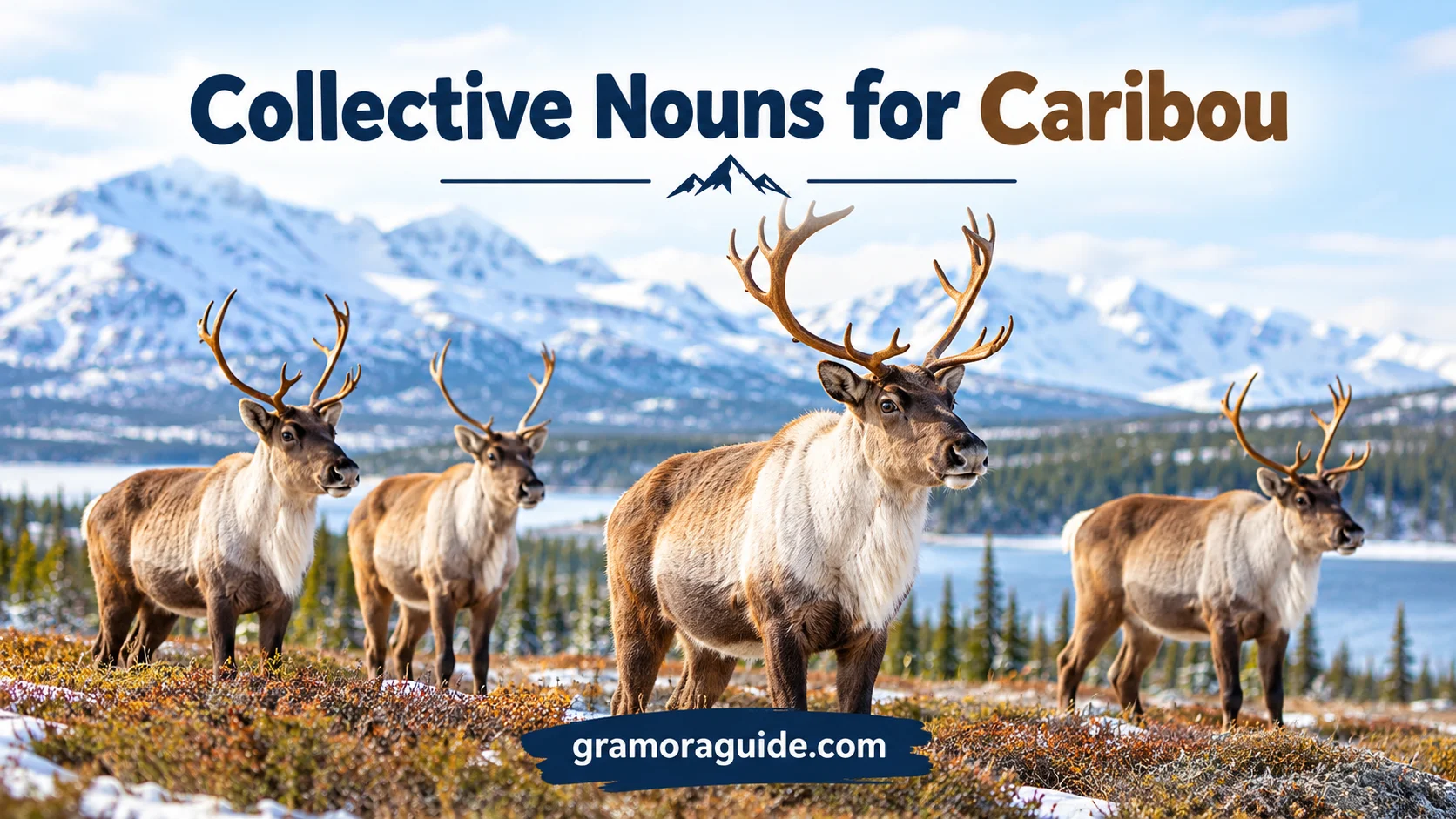
Collective Nouns for Caribou help you describe how these strong animals travel together in herds across cold northern regions. Caribou are known for their impressive antlers, seasonal migrations, and ability to survive in snowy environments.
Caribou live in Arctic and sub-Arctic regions, where they move across open tundra and northern forests in search of food. The word herd is commonly used for a group of caribou, while band may describe a smaller group. Learning these collective nouns, along with caribou behavior, feeding habits, and migration patterns, can improve your English vocabulary and make your wildlife writing clearer and more engaging.
What Is a Group of Caribou Called?
A group of caribou is most commonly called a herd. The word describes several caribou living, feeding, traveling, or migrating together. Caribou are social animals, and their groups can vary considerably in size depending on the season, habitat, and local population.
Other words, such as group and band, may also describe caribou collectively. However, these terms do not all have the same level of established usage. Group is a general word that works in almost any context, while band can describe a smaller or loosely associated collection of animals.
Caribou are called reindeer in many parts of the world, particularly in Eurasia. Both names refer to animals of the same species, Rangifer tarandus, although regional terminology and domestication practices differ.
Common Collective Nouns for Caribou
Several collective nouns can describe caribou, depending on the context. Some are widely used, while others are general descriptive terms rather than special names exclusive to this animal.
1. Herd of Caribou
Meaning: A herd is a group of animals of the same species that stay together while feeding, moving, or traveling.
A herd of caribou is the most natural expression for describing caribou gathered in the wild. These animals often form groups for migration, access to food, and protection against predators. Herd size may change throughout the year, and large migrating populations can form impressive aggregations.
Example sentences:
- A herd of caribou crossed the frozen valley before sunset.
- The photographer waited patiently for a herd of caribou to approach the river.
- A large herd of caribou moved across the tundra in search of food.
- The wildlife researchers observed a herd of caribou from a safe distance.
- A herd of caribou gathered near a patch of exposed vegetation.
- The guide spotted a herd of caribou on the distant hillside.
- During migration, a herd of caribou traveled across the open landscape.
- The young calves stayed close to the adults in the herd of caribou.
- A herd of caribou moved slowly through the snowy forest.
- The documentary showed a herd of caribou crossing a broad plain.
When to use it: Use herd when writing about caribou in wildlife documentaries, school assignments, nature articles, stories, and everyday conversations. It is the best general choice when you need a recognizable collective noun.
2. Group of Caribou
Meaning: A group is a general term for several animals gathered or considered together.
A group of caribou is an accurate and flexible expression. Unlike more specific collective nouns, group does not suggest a particular social structure or behavior. It works when you know several caribou are together but do not need to describe their relationship or activity in detail.
Example sentences:
- A group of caribou rested beside a quiet stream.
- The hikers noticed a group of caribou in the distance.
- A group of caribou searched the ground for edible plants.
- The ranger recorded the location of a group of caribou.
- A group of caribou moved between the trees.
- The children watched a group of caribou in a wildlife center.
- A group of caribou appeared on the ridge after the snowfall.
- The scientist photographed a group of caribou during the survey.
- A group of caribou gathered in an open meadow.
- The travelers saw a group of caribou while crossing the northern wilderness.
When to use it: Choose group when you want a simple, neutral description. It is particularly useful in scientific notes, educational writing, and situations where herd might imply more about the animals’ behavior than you intend.
3. Band of Caribou
Meaning: A band is a word used to describe a collection of individuals or animals associated or moving together. Its meaning depends on the context.
A band of caribou can describe a smaller or loosely associated group moving across the landscape. However, band is not as widely established as herd for ordinary references to caribou. It is best treated as a descriptive alternative rather than a universal or scientifically standardized collective noun.
Example sentences:
- A band of caribou moved quietly through the northern forest.
- The observer noticed a band of caribou near the rocky slope.
- A band of caribou crossed the open tundra in the early morning.
- The guide pointed toward a band of caribou in the distance.
- A band of caribou paused beside a patch of low-growing plants.
- The wildlife photographer followed the movement of a band of caribou from afar.
- A band of caribou traveled across the valley as clouds gathered overhead.
- The researchers recorded a band of caribou during their field survey.
- A band of caribou appeared between the distant hills.
- The travelers watched a band of caribou move toward the forest.
When to use it: Use band when you want a descriptive variation in narrative writing. For straightforward factual writing, herd or group is generally the safer choice.
Quick Comparison of Caribou Collective Nouns
The following table summarizes the main terms and shows how you can use each one in a sentence.
| Type | Simple Example |
| Herd | A herd of caribou crossed the tundra. |
| Group | A group of caribou rested near the river. |
| Band | A band of caribou moved through the valley. |
Remember: Herd is the most conventional choice. Group is a neutral alternative, while band is a less common descriptive expression. These terms should not be presented as equally established or as names with universally fixed meanings.
Read This: Collective Nouns for Ducks
Why Do Caribou Gather in Groups?
Caribou gather for several reasons, including seasonal migration, access to food, reproduction, and reducing the risk of predation. Their social behavior changes throughout the year, so the size and composition of a herd are not always the same.
Migration and Seasonal Movement
Many caribou populations travel long distances between seasonal ranges. They may move toward areas that provide suitable feeding grounds, favorable conditions for raising calves, or access to different vegetation as the seasons change.
During migration, large numbers of caribou may travel across open tundra, forests, and river valleys. These movements are important parts of their natural life cycle, although migration distances and patterns vary among populations.
Example sentences:
- A herd of caribou began its seasonal migration across the tundra.
- The animals traveled together toward their summer feeding grounds.
- The wildlife team monitored the movement of a herd across the northern landscape.
Protection Against Predators
Traveling in groups can help caribou detect potential threats. When many animals are present, individuals may benefit from having more opportunities to notice danger. However, gathering in a herd does not eliminate the risk of predation.
Wolves are among the important natural predators of caribou, and calves can be especially vulnerable. Caribou also use their senses, speed, and knowledge of their environment to respond to threats.
Example sentences:
- A herd of caribou became alert when wolves appeared nearby.
- The animals moved across the open ground after sensing danger.
- The calves stayed close to other caribou as the herd continued moving.
Feeding and Habitat
Caribou feed on a variety of plants, including lichens, grasses, sedges, leaves, and other vegetation. Their diet changes according to the season and what is available in their habitat. During winter, lichens can be an important food source for many populations.
A herd may spread out while feeding and gather again when the animals move to another area. This flexible behavior allows them to use different parts of their range as food availability changes.
Example sentences:
- A herd of caribou grazed across a patch of tundra vegetation.
- Several caribou searched beneath the snow for accessible food.
- The animals moved toward an area where vegetation was more plentiful.
Interesting Facts About Caribou
Caribou have several remarkable adaptations that help them survive in northern environments. Their physical features, seasonal movements, and feeding habits make them particularly interesting to wildlife enthusiasts.
1. Caribou Have Specialized Hooves
Caribou have broad, flexible hooves that help them travel over soft snow and uneven ground. Their hooves also provide support when moving across wet or marshy areas. The shape and function of their feet are useful adaptations for environments where snow and seasonal changes create challenging travel conditions.
2. Both Sexes Can Grow Antlers
Caribou are unusual among deer because both males and females can grow antlers. Antlers are shed and regrown, with the timing varying according to sex, age, and reproductive condition. This characteristic helps distinguish caribou from most other deer species, in which antlers are generally restricted to males.
3. Their Diet Changes With the Seasons
Caribou eat different types of vegetation depending on availability. During warmer months, they may feed on grasses, sedges, leaves, and other green plants. In winter, lichens can become especially important because many other food sources are less accessible.
4. Caribou Have Thick Coats
Their dense coats provide insulation against cold temperatures. The hairs help trap air, reducing heat loss in harsh northern conditions. This adaptation is particularly useful for caribou populations that experience long, cold winters.
5. Caribou and Reindeer Are the Same Species
Caribou and reindeer are regional names for Rangifer tarandus. In North America, the name caribou is commonly used for wild populations. In northern Europe and Asia, reindeer is more common and can refer to both wild and domesticated animals.
How to Use Collective Nouns for Caribou in Sentences
Choosing the right collective noun depends on what you want to communicate. In most everyday situations, herd is the clearest and most natural option. The word group works equally well when you want a general description without emphasizing the animals’ collective behavior.
Consider these examples:
- For wildlife writing: A herd of caribou traveled across the Arctic tundra.
- For a school assignment: A group of caribou was visible near the forest.
- For descriptive storytelling: A band of caribou appeared beyond the rocky ridge.
When using collective nouns, remember that the noun determines how the sentence is structured. In American English, a group can be treated as a single unit, so singular verbs are common: “The herd is moving.” When the focus is on the individual animals, writers may choose a plural construction in some varieties of English, especially British English.
For clear, consistent writing, use the singular form when describing the herd as one unit.
FAQs:
1. What is the collective noun for caribou?
The most common collective noun for caribou is herd. It describes a group of caribou traveling, feeding, or living together in their natural habitat.
2. Can you use the word herd for caribou?
Yes, herd is the standard and widely used term for a group of caribou. For example, a herd of caribou crossed the snowy tundra in search of food.
3. What is another word for a group of caribou?
Another term sometimes used for a smaller group of caribou is band. However, herd is the more familiar choice in everyday English and wildlife writing.
4. Why do caribou travel in herds?
Caribou travel in herds for several reasons, including seasonal migration, finding food, and protection from predators. Group movement also helps them travel across vast northern landscapes.
5. What is the difference between caribou and reindeer?
Caribou and reindeer belong to the same species, Rangifer tarandus. The name caribou is commonly used in North America, while reindeer is more common in Europe and Asia. Both animals can gather in herds.
Conclusion:
Learning the collective nouns for caribou helps you describe these fascinating animals accurately. Herd is the most common term for a group of caribou, while band may refer to a smaller gathering. Understanding these terms also helps you write more clearly about their migration, feeding habits, social behavior, and life in Arctic and sub-Arctic environments. Use these words in your sentences to build your English vocabulary and make your wildlife descriptions more engaging.

Maya Rose is an English-language writer passionate about storytelling, personal growth, and everyday life. Her writing combines simplicity, warmth, and thoughtful perspectives that connect with readers.
1 thought on “Collective Nouns for Caribou”