
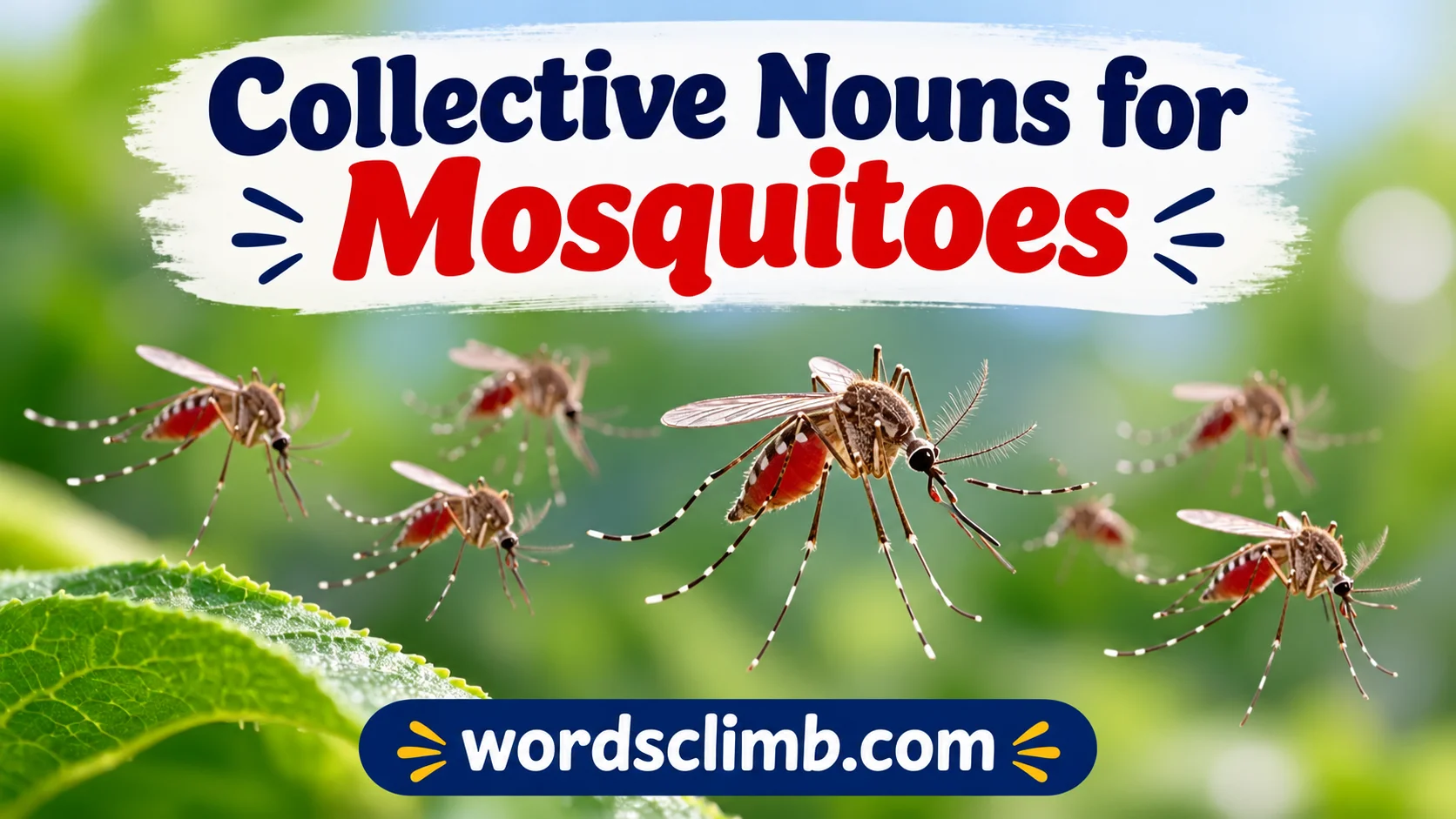
Collective Nouns for Mosquitoes help you describe a group of these tiny insects in a clear and interesting way. The most common term is swarm, which refers to many mosquitoes flying together. Other words, such as cloud and horde, can also describe a large gathering of mosquitoes. Learning these terms can improve your vocabulary and help you use more precise language when writing or speaking about insects.
Collective nouns are special words used to describe groups of people, animals, or things as a single unit. When mosquitoes gather, fly, or move together, these expressions make your sentences more natural and descriptive. You may also come across words related to insects, including their singular and plural forms and the names of their immature stages. Understanding these terms makes it easier to describe mosquito behavior and discuss different types of insect groups.
Collective Nouns for Mosquitoes
Different collective nouns can describe mosquitoes depending on their number, movement, or appearance. Some terms are commonly used in everyday English, while others are descriptive rather than established terms.
| Type | Simple Example |
| Swarm | A swarm of mosquitoes flew over the pond. |
| Cloud | A cloud of mosquitoes gathered near the water. |
| Horde | A horde of mosquitoes appeared at dusk. |
| Group | A group of mosquitoes hovered around the plants. |
| Cluster | A cluster of mosquitoes rested near the wall. |
1. Swarm of Mosquitoes
A swarm of mosquitoes is the most familiar expression for a large number of mosquitoes flying together. Mosquitoes may form noticeable groups, particularly around suitable breeding areas or during mating activity. The word swarm clearly gives the reader an image of many small insects moving through the air.
Examples:
- A swarm of mosquitoes gathered near the pond.
- We quickly moved away from the swarm of mosquitoes.
- A swarm of mosquitoes appeared after sunset.
- The campers noticed a swarm of mosquitoes near the trees.
- A swarm of mosquitoes hovered above the wet grass.
- The warm evening attracted a swarm of mosquitoes.
- A swarm of mosquitoes flew around the garden.
- The horse was bothered by a swarm of mosquitoes.
- A swarm of mosquitoes formed near the marsh.
- We used repellent to avoid the swarm of mosquitoes.
2. Cloud of Mosquitoes
A cloud of mosquitoes is a descriptive expression used when many mosquitoes are flying together and appear like a dark or moving cloud. This phrase is especially useful in descriptive writing because it creates a vivid picture for the reader.
Examples:
- A cloud of mosquitoes rose from the grass.
- We saw a cloud of mosquitoes near the lake.
- A cloud of mosquitoes surrounded the hikers.
- The wetland was filled with clouds of mosquitoes.
- A cloud of mosquitoes hovered above the water.
- The farmer walked through a cloud of mosquitoes.
- A cloud of mosquitoes appeared at sunset.
- The children ran away from the cloud of mosquitoes.
- A cloud of mosquitoes gathered around the lights.
- The forest became difficult to explore because of a cloud of mosquitoes.
3. Horde of Mosquitoes
A horde of mosquitoes is a vivid expression that emphasizes a large and troublesome number of mosquitoes. The word horde is not a specialized scientific collective noun for mosquitoes, but it can be used effectively in informal or descriptive writing.
Examples:
- A horde of mosquitoes attacked the campers.
- We noticed a horde of mosquitoes near the swamp.
- A horde of mosquitoes filled the area after the rain.
- The hikers tried to escape the horde of mosquitoes.
- A horde of mosquitoes surrounded the animals.
- The garden attracted a horde of mosquitoes.
- A horde of mosquitoes appeared beside the pond.
- The workers covered their arms against the horde of mosquitoes.
- A horde of mosquitoes flew through the open window.
- The rainy season brought a horde of mosquitoes to the area.
4. Group of Mosquitoes
A group of mosquitoes is a simple and general expression. Unlike more colorful terms such as swarm or cloud, group doesn’t describe how the insects are behaving. It simply indicates that several mosquitoes are together.
Examples:
- A group of mosquitoes rested on the leaves.
- We noticed a group of mosquitoes near the pond.
- A group of mosquitoes flew around the lamp.
- The scientist observed a group of mosquitoes in the laboratory.
- A group of mosquitoes gathered near the water.
- The researcher photographed a group of mosquitoes.
- A group of mosquitoes hovered above the grass.
- The wind scattered the group of mosquitoes.
- A group of mosquitoes appeared after the rain.
- The children saw a group of mosquitoes near the garden.
5. Cluster of Mosquitoes
A cluster of mosquitoes describes mosquitoes gathered relatively close together. It can be useful when describing mosquitoes resting on vegetation, walls, or other surfaces. Like cloud and horde, it is primarily a descriptive expression rather than a specialized scientific term.
Examples:
- A cluster of mosquitoes rested on the leaves.
- We found a cluster of mosquitoes near the window.
- A cluster of mosquitoes gathered around the plants.
- The researcher noticed a cluster of mosquitoes in the enclosure.
- A cluster of mosquitoes formed beside the pond.
- The light attracted a cluster of mosquitoes.
- A cluster of mosquitoes rested under the branch.
- The gardener spotted a cluster of mosquitoes near standing water.
- A cluster of mosquitoes moved away when the wind increased.
- The scientist examined a cluster of mosquitoes carefully.
Read This: Collective Nouns for Oxen
Interesting Facts About Mosquitoes
Mosquitoes are remarkably small insects, yet they have highly specialized bodies and behaviors. Their life span varies considerably depending on the species, sex, temperature, humidity, and environmental conditions. Many adult mosquitoes live for days or weeks, while some females can survive considerably longer under favorable conditions. Their slender bodies have six legs, wings, antennae, and a highly specialized mouthpart called a proboscis, which allows them to feed. Mosquitoes also use chemical signals, body heat, moisture, and other cues to locate potential hosts. An interesting dietary fact is that male mosquitoes feed mainly on plant nectar and other sugary liquids, while females also consume these foods but many species require a blood meal to obtain nutrients needed for producing eggs. Not every mosquito species bites humans, and both males and females play important roles in ecosystems as food for other animals and as pollinators.
FAQs:
1. What is the collective noun for mosquitoes?
The most common collective noun for mosquitoes is swarm. It describes a group of mosquitoes flying together in the air.
2. What are the common collective nouns for mosquitoes?
Common terms used to describe groups of mosquitoes include swarm, cloud, and horde. Among these, swarm is the most natural and widely understood choice.
3. Is swarm the correct word for a group of mosquitoes?
Yes, swarm is the most widely understood term for a group of mosquitoes moving or flying together. For example, a swarm of mosquitoes gathered near the pond.
4. Can cloud be used as a collective noun for mosquitoes?
Yes, cloud can describe a large group of mosquitoes that appears like a cloud in the air. For example, a cloud of mosquitoes hovered above the water.
5. Is horde a collective noun for mosquitoes?
Horde can describe a large gathering of mosquitoes. However, it is a general word for a large group rather than a term used exclusively for mosquitoes.
6. What is the plural form of mosquito?
The plural form of mosquito is mosquitoes. For example, one mosquito entered the room, while several mosquitoes gathered near the window.
7. What is a baby mosquito called?
An immature mosquito is called a larva during its larval stage. The plural is larvae. Mosquitoes pass through four main life stages: egg, larva, pupa, and adult.
8. Why do mosquitoes form swarms?
Mosquitoes may gather in swarms for mating and other behaviors. Their swarming patterns depend on factors such as species, weather, light, and environmental conditions.
9. How do you use a collective noun for mosquitoes in a sentence?
You can use swarm to describe mosquitoes as a group. For example, “A swarm of mosquitoes flew around the garden.” Other examples include “A cloud of mosquitoes hovered over the pond” and “A horde of mosquitoes gathered near the lights.”
10. Is there an official collective noun for mosquitoes?
There is no universally fixed or scientifically required collective noun for mosquitoes. Swarm is the most familiar choice, while cloud and horde are descriptive alternatives that can fit different contexts.
Conclusion:
Learning the collective nouns for mosquitoes can make your writing more descriptive and improve your vocabulary. Swarm is the most common term for mosquitoes flying together, while cloud and horde can also describe large groups. You can use these words in everyday conversations, school assignments, and creative writing to describe mosquitoes clearly and naturally. Understanding collective nouns is a simple way to make your sentences more engaging and precise.

Maya Rose is an English-language writer passionate about storytelling, personal growth, and everyday life. Her writing combines simplicity, warmth, and thoughtful perspectives that connect with readers.
1 thought on “Collective Nouns for Mosquitoes”