
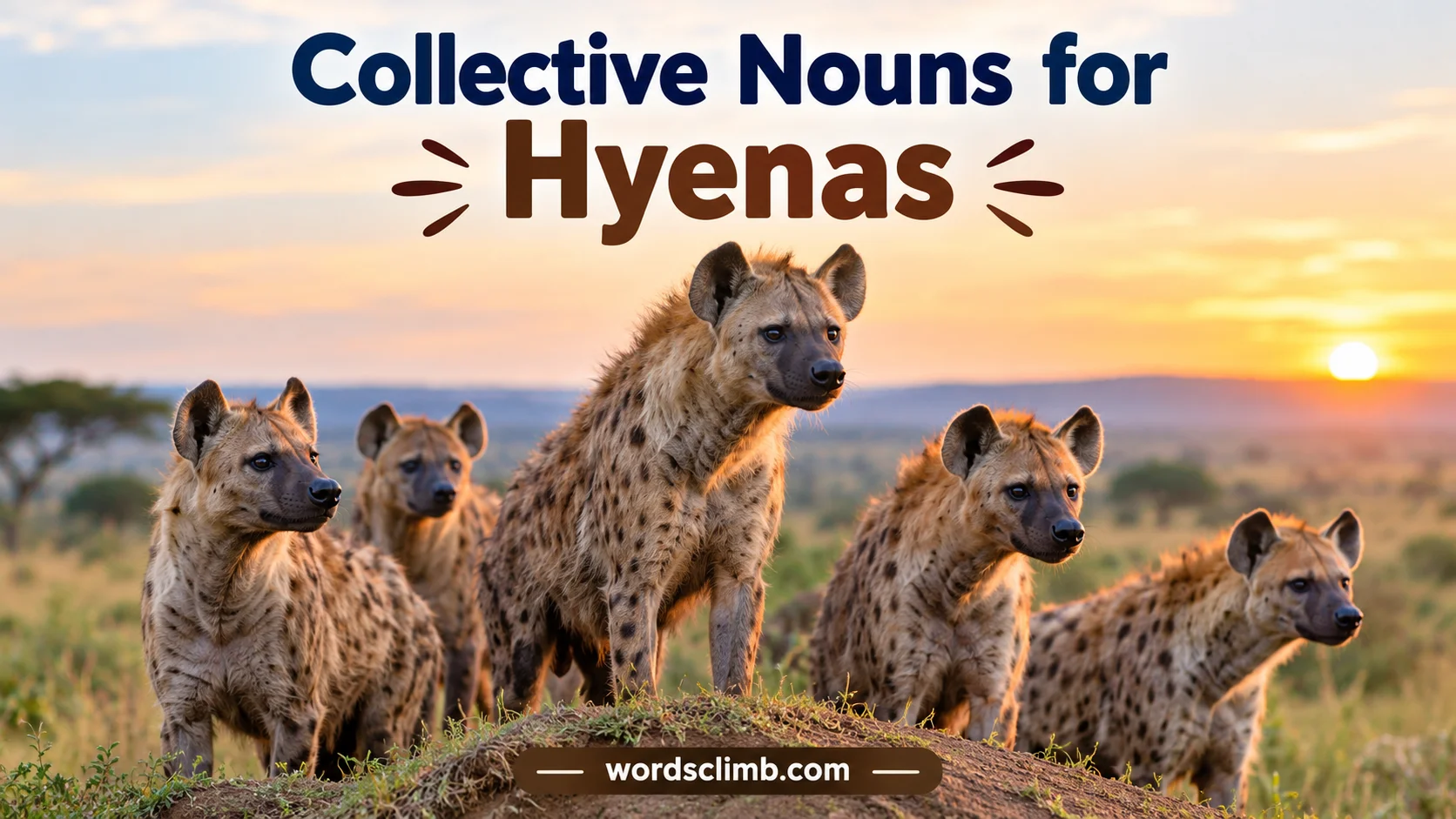
Collective Nouns for Hyenas help you discover the interesting words used to describe groups of these fascinating wild animals. From the African savannah to wildlife books, collective nouns make animal descriptions more engaging. The most common term is clan, especially for spotted hyenas, while other words include cackle and pack.
A clan of hyenas is known for its complex social structure, strong relationships, and clear hierarchy. These intelligent animals often live, hunt, and interact in organized groups. Learning their collective nouns can improve your English vocabulary and help you understand animal behavior. These descriptive terms also make your writing more accurate, interesting, and enjoyable for readers who love wildlife and language.
Collective Nouns for Hyenas
Here are some collective nouns that can be used for hyenas. Clan is the strongest and most widely recognized term, while some other words may be used descriptively depending on the context.
| Type | Simple Example |
| Clan | A clan of hyenas |
| Cackle | A cackle of hyenas |
| Pack | A pack of hyenas |
| Group | A group of hyenas |
| Troop | A troop of hyenas |
1. Clan of Hyenas
Clan is the best-known collective noun for hyenas, especially spotted hyenas. A clan can contain many individuals and has a strong social structure. Members cooperate, communicate, defend territory, and compete for food and status.
Example Sentences:
- A clan of hyenas gathered near the waterhole.
- We watched a clan of hyenas moving across the grassland.
- The clan of hyenas protected its territory.
- A large clan of hyenas rested under the shade.
- The clan of hyenas followed a herd of wildebeest.
- A clan of hyenas searched for food after sunset.
- The young hyenas stayed close to their clan.
- A clan of hyenas surrounded the remains of a carcass.
- The clan of hyenas communicated with different calls.
- Rangers observed a clan of hyenas from a safe distance.
2. Cackle of Hyenas
Cackle is a descriptive collective noun inspired by the distinctive sounds hyenas make. Their vocalizations include calls that can sound like laughter or cackling. Although “clan” is more appropriate for their social group, cackle can make wildlife writing more colorful.
Example Sentences:
- A cackle of hyenas could be heard across the savanna.
- We heard a cackle of hyenas after dark.
- A distant cackle of hyenas broke the quiet night.
- The cackle of hyenas echoed across the valley.
- A cackle of hyenas approached the watering hole.
- The travelers listened to a cackle of hyenas nearby.
- A loud cackle of hyenas came from the bushes.
- The photographer recorded a cackle of hyenas at night.
- A cackle of hyenas moved through the grassland.
- The unusual cackle of hyenas attracted everyone’s attention.
3. Pack of Hyenas
Pack is sometimes used informally for a group of hyenas, particularly when describing several animals moving or hunting together. However, clan is generally the more precise term for the social organization of spotted hyenas.
Example Sentences:
- A pack of hyenas moved across the open plain.
- We saw a pack of hyenas near the river.
- The pack of hyenas searched for food.
- A pack of hyenas traveled together at night.
- The pack of hyenas approached the remains of a carcass.
- A pack of hyenas crossed the road after sunset.
- The young animals followed the pack of hyenas.
- A pack of hyenas disappeared into the tall grass.
- The guide spotted a pack of hyenas in the distance.
- A pack of hyenas moved quietly through the darkness.
4. Group of Hyenas
Group is a general collective noun that can always be used when you simply want to describe several hyenas together. It is less specific than “clan,” but it is clear and grammatically correct.
Example Sentences:
- A group of hyenas rested beneath a tree.
- We spotted a group of hyenas on the savanna.
- The group of hyenas moved toward the water.
- A group of hyenas gathered around a carcass.
- The group of hyenas remained together during the night.
- A group of hyenas crossed the open grassland.
- The photographer followed a group of hyenas from a distance.
- A group of hyenas searched the area for food.
- The group of hyenas returned to its territory.
- We heard a group of hyenas calling nearby.
5. Troop of Hyenas
Troop is a general term sometimes used descriptively for a group of animals. It is not as specific or established for hyenas as clan, but it can appear in informal wildlife descriptions.
Example Sentences:
- A troop of hyenas moved through the grass.
- The troop of hyenas gathered near the water.
- We saw a troop of hyenas at sunset.
- A troop of hyenas searched the area for food.
- The troop of hyenas rested after feeding.
- A troop of hyenas crossed the dusty plain.
- The young animals stayed with the troop of hyenas.
- A troop of hyenas disappeared into the bushes.
- The guide noticed a troop of hyenas in the distance.
- A troop of hyenas moved toward its resting place.
Social Behavior of Hyenas
Hyenas are among Africa’s most fascinating social predators. Spotted hyenas, in particular, live in large and highly organized clans that can contain dozens of individuals. These clans have complex social rankings, and members recognize one another through vocalizations, scents, body language, and other signals. Their social lives help explain why clan is such a useful collective noun for hyenas.
Hyenas also communicate using a remarkable range of sounds. Their famous “laugh” is actually a type of vocalization that can communicate excitement, frustration, submission, or social information. They also use whoops, growls, squeals, and other calls. Their strong social bonds and sophisticated communication make them much more complex than their reputation as simple scavengers might suggest.
Also Read This: Collective Nouns for Mosquitoes
Interesting Facts About Hyenas
Hyenas have several remarkable biological traits. In the wild, spotted hyenas can live for around 12 years on average, while some individuals may survive considerably longer, and captive hyenas can live into their twenties. One of their most unusual physiological features is their powerful jaw and exceptionally strong teeth, which allow them to crush and digest bones that many other predators leave behind. Spotted hyenas also have an unusual reproductive system in which females possess an elongated clitoris that resembles a penis, making childbirth particularly challenging. Their digestive systems are highly specialized for processing tough animal remains. Although hyenas are famous as scavengers, spotted hyenas are also excellent hunters and can obtain a large portion of their food by actively hunting prey. Their varied diet can include meat, bones, skin, and other tough animal parts, demonstrating their important role in African ecosystems.
FAQs:
1. What is the collective noun for hyenas?
The most common collective noun for hyenas is clan. It describes a group of hyenas, especially spotted hyenas, that live together in a social community.
2. What is a group of hyenas called?
A group of hyenas is commonly called a clan. Other terms, such as cackle and pack, may also appear in informal writing, but clan is the most appropriate term for their social groups.
3. Why is a group of hyenas called a clan?
The word clan suits hyenas because they form complex social groups with established relationships and dominance hierarchies. Members often cooperate and interact within their community.
4. Is a cackle of hyenas a correct term?
Cackle of hyenas is sometimes used as a descriptive expression. The word cackle also refers to the distinctive vocal sounds hyenas make, although clan is the more widely recognized term for their social group.
5. Can we call a group of hyenas a pack?
Yes, pack of hyenas is understandable and sometimes used, but clan is generally more accurate, particularly when describing spotted hyenas and their organized social structure.
6. Do hyenas live in groups?
Yes, many hyenas live in social groups. Spotted hyenas are especially social and form clans that may include many individuals. However, social behavior varies among hyena species.
7. How do hyenas behave within a clan?
Hyenas within a clan interact through cooperation, competition, communication, and social bonding. Spotted hyena clans also have clear dominance hierarchies that influence relationships and access to resources.
8. What is the difference between a clan and a pack of hyenas?
A clan refers to the organized social community commonly associated with spotted hyenas. A pack is a more general term for a group of animals, but it does not describe hyena social structure as precisely.
9. Are collective nouns for hyenas used in everyday English?
Yes, collective nouns appear in wildlife books, educational articles, stories, and everyday writing. For example, saying “a clan of hyenas” makes a sentence more specific and descriptive than saying “a group of hyenas.”
10. How can I use the collective noun for hyenas in a sentence?
You can use clan of hyenas as a noun phrase in a sentence. For example: “A clan of hyenas gathered near the waterhole at sunset.” This sentence describes several hyenas as members of one social group.
Conclusion:
Learning the collective nouns for hyenas adds variety to your English vocabulary and helps you describe wildlife more accurately. The word clan is the most common choice, especially for spotted hyenas, because these animals live in organized social groups with complex relationships. You may also encounter expressions such as cackle of hyenas and pack of hyenas, though their usage is less standard. Understanding these terms makes your writing more engaging while giving you a better appreciation of the fascinating social behavior of hyenas.

Ruby Hart is a passionate writer who creates engaging, relatable, and easy-to-understand content. She loves turning everyday ideas into helpful and enjoyable stories for readers.
1 thought on “Collective Nouns for Hyenas”