
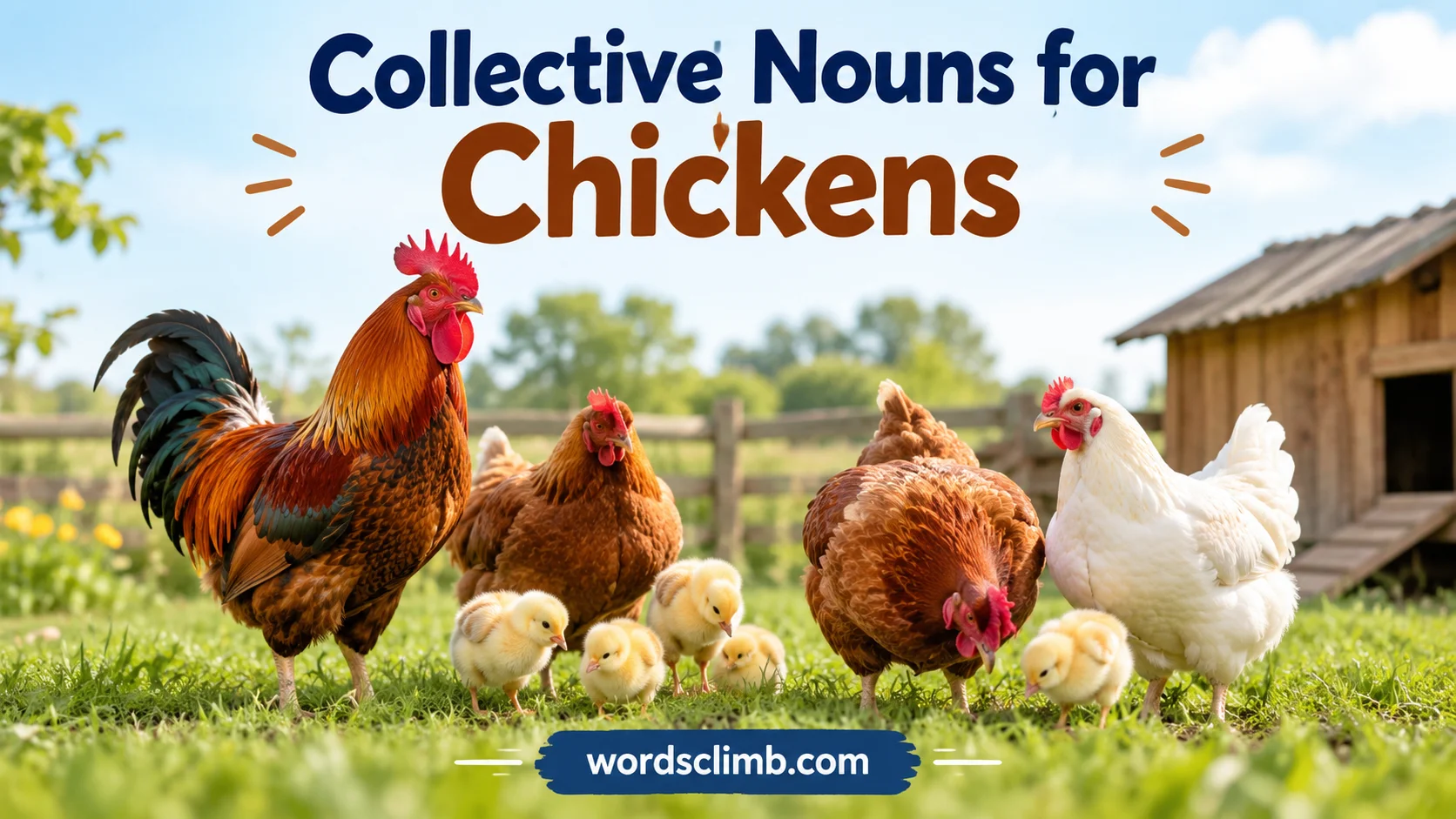
Collective Nouns for Chickens help you describe a group of chickens using clear and interesting group names. The most common term is flock, which refers to chickens living or moving together. Other terms include brood, often used for a hen and her young, and peep, which can describe young chicks. Learning these collective nouns can improve your English vocabulary while making your writing more natural, descriptive, and engaging when talking about chickens.
Chickens have lived alongside humans for thousands of years and are believed to have descended from the Red junglefowl of Southeast Asia. Today, they are found in many parts of the world and are known for their social behavior and organized groups. Chickens often live together in flocks and develop a clear pecking order. Understanding these terms can make it easier to describe their family groups, daily behavior, and social life.
Collective Nouns for Chickens
Here are the most useful collective terms associated with chickens. Remember that some terms describe chickens directly, while others describe young chickens or their eggs.
| Type | Simple Example |
| Flock | A flock of chickens |
| Brood | A brood of chicks |
| Clutch | A clutch of eggs |
| Peep | A peep of chicks |
| Group | A group of chickens |
Flock of Chickens
Flock is the standard and most widely used collective noun for chickens. It can describe a group of adult chickens living or moving together. You might see a flock walking around a farmyard, searching for food, resting, or returning to a coop.
Examples:
- A flock of chickens walked across the farmyard.
- We watched a flock of chickens searching for seeds.
- The farmer fed the flock of chickens early in the morning.
- A large flock of chickens gathered near the coop.
- The children saw a flock of chickens outside the barn.
- The flock of chickens moved toward the garden.
- A flock of chickens rested under the tree.
- The farmer counted every chicken in the flock.
- The flock of chickens returned to the coop before sunset.
- A noisy flock of chickens filled the farmyard with sounds.
Brood of Chickens
Brood is generally used for a group of young birds, especially chicks, associated with a mother hen. It is particularly useful when you want to emphasize the relationship between the hen and her young rather than simply describing adult chickens.
Examples:
- The hen stayed close to her brood of chicks.
- A brood of chicks followed their mother across the yard.
- The farmer watched the brood carefully.
- The mother hen protected her brood of chicks from danger.
- A small brood of chicks gathered under the hen.
- The brood of chicks searched for food beside their mother.
- The children quietly observed the brood of chicks.
- The hen called her brood when she found food.
- The brood of chicks stayed warm beneath their mother.
- Everyone enjoyed watching the hen lead her brood around the farm.
Clutch of Eggs
A clutch refers to a group of eggs laid by a bird, including a hen. It doesn’t normally mean a group of living chickens. This distinction is important when writing about chicken reproduction.
Examples:
- The hen laid a clutch of eggs.
- The farmer found a clutch of eggs in the nesting box.
- The clutch of eggs was kept warm by the hen.
- A small clutch of eggs rested in the nest.
- The farmer carefully checked the clutch of eggs.
- The hen returned to her clutch of eggs.
- The clutch of eggs contained several eggs.
- The farmer protected the clutch from predators.
- A new clutch of eggs appeared in the nesting area.
- The hen patiently sat on her clutch of eggs.
Brood of Chicks
Brood is a recognized term for a group of young chicks, especially when they are being cared for by a mother hen. It is one of the most useful terms when describing baby chickens.
Examples:
- A brood of chicks followed their mother.
- The hen protected her brood of chicks.
- A small brood of chicks rested under the hen.
- The farmer watched the brood of chicks carefully.
- The brood of chicks searched for food.
- The mother hen called her brood of chicks.
- A brood of chicks walked across the farmyard.
- The children watched the brood of chicks.
- The brood of chicks stayed close to their mother.
- The hen led her brood of chicks back to the coop.
Peep of Chicks
Peep is an informal or less common expression associated with young chicks. It reflects the soft peeping sounds that chicks make. You are more likely to encounter it in descriptive or literary writing than in everyday farm terminology.
Examples:
- A peep of chicks followed the mother hen.
- We heard a peep of chicks near the barn.
- The peep of chicks stayed close to the hen.
- A cheerful peep of chicks moved through the grass.
- The children watched the peep of chicks carefully.
- The peep of chicks made tiny sounds in the nest.
- A peep of chicks gathered around their mother.
- The farmer noticed a peep of chicks near the coop.
- The peep of chicks searched for insects.
- The mother hen called while the peep of chicks followed her.
Read More: Collective Nouns for Bats
Interesting Facts About Chickens
Chickens are much more fascinating than their familiar farmyard image might suggest. A healthy domestic chicken can commonly live for around 5–10 years, although lifespan varies considerably with breed, care, environment, and whether the bird is raised for commercial production. Chickens also have several unusual physiological features: they have excellent color vision, can distinguish many sounds, and use a flexible neck and specialized visual system to examine their surroundings.
Their digestive system is also well adapted to a varied diet. Chickens naturally eat seeds, grains, insects, plants, fruits, and other small food items, while domestic birds may also receive balanced commercial feed. They have a crop for temporarily storing food and a muscular gizzard that helps grind food, often with the help of small grit they swallow.
Chickens are also strongly social animals. They establish a recognizable social hierarchy, sometimes called a “pecking order,” which can influence access to food, resting places, and other resources. They communicate through many vocalizations and body movements. A hen can also recognize and respond to the calls of her chicks, while chicks begin communicating with their mother even before they hatch. These social behaviors help explain why words such as flock and brood are so useful when describing chickens.
FAQs:
1. What is the most common collective noun for chickens?
The most common collective noun for chickens is flock. You can say, “A flock of chickens crossed the farmyard.”
2. What do you call a group of chickens?
A group of chickens is commonly called a flock. The word group can also be used in general descriptions.
3. Is “flock of chickens” grammatically correct?
Yes, flock of chickens is grammatically correct and widely understood in everyday English.
4. What is a brood of chickens?
A brood usually refers to a group of young chickens or chicks cared for by a mother hen. It can also describe the offspring produced during one breeding period.
5. Can “brood” be used for adult chickens?
Brood is mainly associated with young birds or offspring, so flock is generally more appropriate when referring to adult chickens.
6. What is a group of baby chickens called?
A group of baby chickens is commonly called a brood of chicks. You can also simply say a group of chicks.
7. What is the collective noun for hens?
A group of hens can be called a flock of hens. The term flock is suitable when several hens are gathered together.
8. What is the collective noun for roosters?
A group of roosters can generally be described as a flock of roosters. In ordinary English, there is no single universally used special collective noun.
9. Why are collective nouns for chickens useful?
Collective nouns make English more concise and descriptive. Instead of saying “many chickens,” you can say a flock of chickens, which sounds more natural.
10. Which collective noun should I use for chickens?
Use flock for chickens in general, especially when several birds are together. Use brood when referring specifically to young chicks or offspring.
Conclusion:
Knowing the right collective nouns for chickens can make your English clearer, more varied, and more precise. Flock is the most common term for chickens gathered together, while brood is useful for young chicks or offspring. Understanding these simple terms helps students, writers, and English learners describe chickens naturally and confidently in different contexts.

Adam West is an English-language writer with a passion for storytelling, culture, and everyday life. His writing focuses on clear ideas, engaging narratives, and thoughtful perspectives that are easy for readers to connect with.
1 thought on “Collective Nouns for Chickens”