
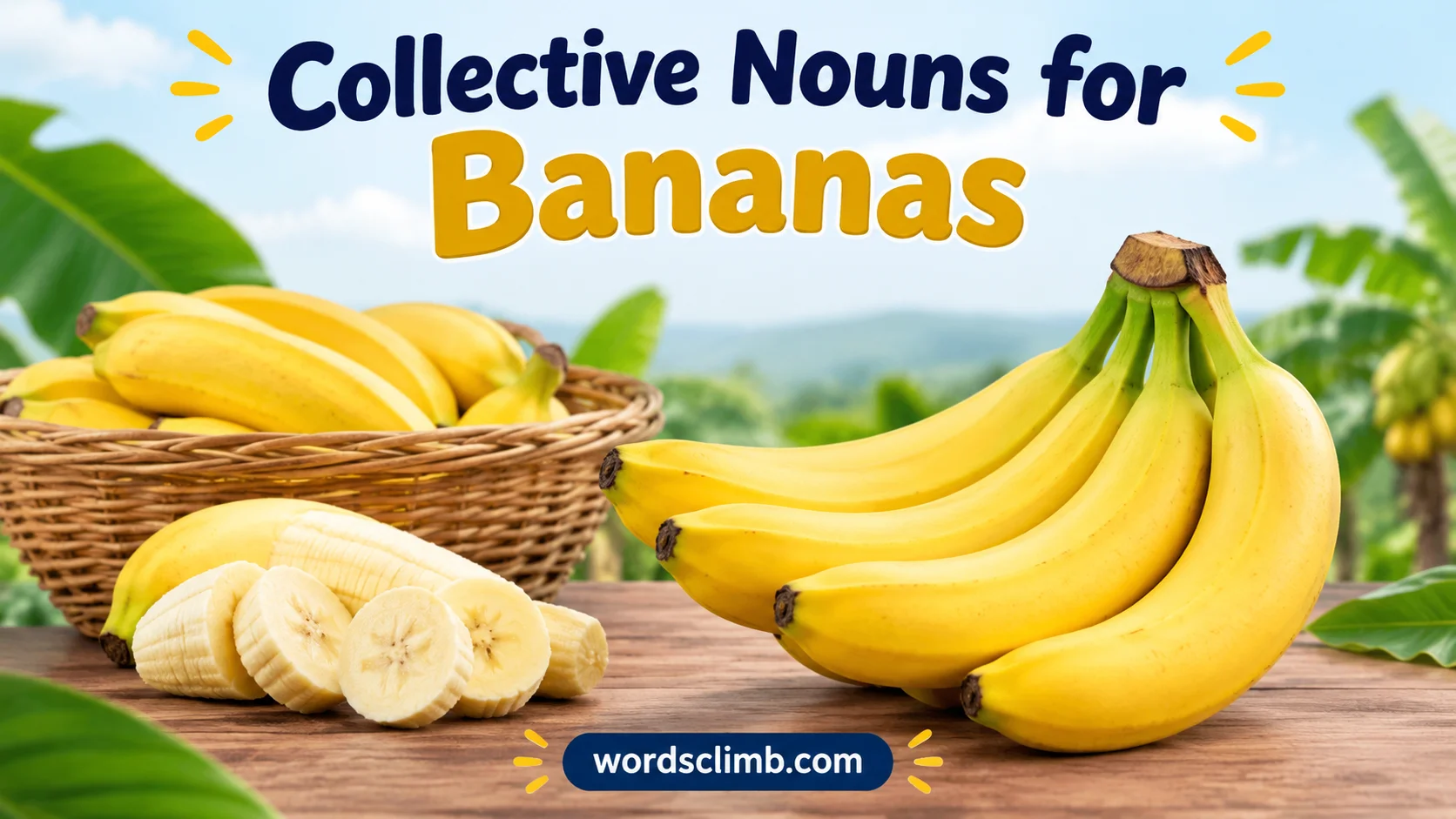
Collective Nouns for Bananas are special words used to describe a group of bananas as one unit. Instead of saying “a group of bananas,” you can use terms such as a bunch, cluster, or hand of bananas, depending on how they are arranged. These collective nouns make your writing more specific, natural, and descriptive. Understanding these terms can help students, writers, and English learners improve their vocabulary while describing bananas clearly in everyday sentences.
Bananas usually grow together in large clusters, which are made up of smaller hands of individual fruits. A bunch of bananas is one of the most common expressions used in everyday English. These terms can describe bananas on a plant, at a market, or gathered together in a kitchen. Learning the correct collective nouns gives you more ways to describe the fruit and makes your English writing more precise, engaging, and natural.
Collective Nouns for Bananas
Different collective nouns for bananas can describe how the fruit is naturally attached, gathered, or arranged. The most familiar term is bunch, which is commonly used for several bananas growing or hanging together. Hand is also important because a banana hand refers to a group of individual bananas attached together on the same stem.
| Type | Simple Example |
| Bunch | A bunch of bananas is on the table. |
| Hand | A hand of bananas hangs from the stem. |
| Cluster | A cluster of bananas grew together. |
| Comb | A comb of bananas was ready for harvest. |
| Load | A load of bananas was carried to the market. |
Bunch of Bananas
Bunch is probably the most familiar collective term for bananas. It can describe several bananas gathered or hanging together. You may hear this expression at home, in grocery stores, markets, and farms.
Example Sentences:
- A bunch of bananas is sitting on the kitchen counter.
- I bought a bunch of bananas from the market.
- The farmer carried a bunch of bananas from the field.
- We placed a bunch of bananas in the fruit basket.
- She shared a bunch of bananas with her family.
- The ripe bunch of bananas smelled sweet.
- He picked a bunch of bananas from the tree.
- There was a bunch of bananas near the refrigerator.
- The shop displayed several bunches of bananas.
- The children enjoyed eating bananas from the bunch.
Hand of Bananas
A hand is a more specific term used in banana production. A hand consists of several individual bananas attached together. Many banana hands grow as parts of a larger bunch.
Example Sentences:
- The farmer cut a hand of bananas from the larger bunch.
- A hand of bananas was hanging from the plant.
- We bought a fresh hand of bananas at the market.
- The worker inspected each hand of bananas carefully.
- A hand of bananas can contain several individual fruits.
- The green hand of bananas was not ready to eat.
- The farmer packed a hand of bananas for shipping.
- I noticed a small hand of bananas on the plant.
- The workers separated the hands of bananas during harvesting.
- The ripe hand of bananas was ready for sale.
Cluster of Bananas
Cluster describes bananas grouped closely together. It is useful when emphasizing the arrangement of several fruits rather than simply referring to the entire bunch.
Example Sentences:
- A cluster of bananas was growing on the plant.
- The farmer examined the cluster of bananas carefully.
- We saw a large cluster of bananas at the farm.
- The ripe cluster of bananas was ready to harvest.
- A green cluster of bananas hung from the plant.
- The workers carried clusters of bananas to the storage area.
- One cluster of bananas was larger than the others.
- The market received a fresh cluster of bananas.
- The leaves surrounded the cluster of bananas.
- The farmer protected the banana cluster from damage.
Comb of Bananas
Comb is another traditional term associated with bananas. It refers to a section or group of bananas growing together, particularly as part of the larger fruit structure. This word is less common in everyday conversation than bunch or hand, but it can appear in descriptions of banana cultivation.
Example Sentences:
- The farmer inspected a comb of bananas before harvesting it.
- A comb of bananas hung beneath the large leaves.
- The worker carefully carried the comb of bananas.
- We saw several combs of bananas at the plantation.
- The green comb of bananas needed more time to mature.
- The farmer separated a comb of bananas from the larger bunch.
- Each comb of bananas contained several fruits.
- The market received a fresh comb of bananas.
- The worker placed the comb of bananas in a storage area.
- A healthy comb of bananas can contain many individual fruits.
Load of Bananas
Load is a descriptive collective expression used when talking about a quantity of bananas being carried, transported, or delivered. It focuses more on the amount being moved than on the botanical arrangement of the fruit.
Example Sentences:
- The farmer carried a load of bananas to the market.
- A truck delivered a load of bananas to the store.
- The workers loaded a load of bananas onto the vehicle.
- The shop received a fresh load of bananas.
- He transported a load of bananas from the farm.
- The farmer sold a large load of bananas that morning.
- Workers carefully packed the load of bananas.
- The truck was filled with a load of bananas.
- The market displayed fruit from the banana load.
- A fresh load of bananas arrived before noon.
Read This: Collective Nouns for Chickens
Interesting Facts About Bananas
Bananas have fascinating biological features that make them much more interesting than an ordinary fruit might seem. A banana plant is actually a large herbaceous plant, not a true tree, because its apparent trunk is formed from tightly packed leaf bases. Banana plants can live and produce fruit for several years, while individual cultivated plants generally produce one main fruit crop before being replaced by new shoots called suckers. Bananas also have a distinctive curved shape that develops as the fruit grows upward toward sunlight, a process known as negative geotropism.
Bananas are also notable for their dietary value. They provide carbohydrates, natural sugars, fiber, vitamin B6, and potassium, making them a convenient energy-rich food. Green bananas contain more resistant starch, while ripening changes some of that starch into sugars and makes the fruit softer and sweeter. Bananas are eaten fresh and are also used in smoothies, breads, desserts, cereals, and many cooked dishes around the world. Their thick peel helps protect the soft fruit inside, while their convenient shape makes them easy to transport and eat.
FAQs:
1. What is the collective noun for bananas?
The most common collective noun for bananas is bunch. You can say, “A bunch of bananas is on the table.”
2. What are some collective nouns for bananas?
Common terms include bunch, cluster, and hand. The best term depends on how the bananas are arranged or grouped.
3. Is “bunch of bananas” correct?
Yes. Bunch of bananas is a very common and natural expression in everyday English.
4. Can I use “cluster” for bananas?
Yes. Cluster is useful when referring to bananas growing together closely, especially on a banana plant.
5. What is a hand of bananas?
A hand refers to a smaller group of bananas that grow together as part of a larger bunch or cluster.
6. What is the difference between a bunch and a hand of bananas?
A bunch generally refers to the larger collection, while a hand usually describes one smaller section containing several bananas.
7. Which collective noun is best for everyday English?
Bunch of bananas is usually the simplest and most natural choice for everyday conversations and writing.
8. Can “group” be used for bananas?
Yes. Group of bananas is grammatically correct, although bunch is more specific and commonly used.
9. How do I use a collective noun for bananas in a sentence?
You can say, “I bought a bunch of bananas from the grocery store,” or “A cluster of bananas was growing on the plant.”
10. Why are collective nouns for bananas useful?
They make your English vocabulary more precise and help you describe how bananas are naturally arranged or gathered.
Conclusion:
Learning the collective nouns for bananas gives you simple and useful ways to describe groups of this popular fruit. Bunch, cluster, and hand are helpful terms, with each one describing a slightly different grouping or arrangement. Among them, bunch of bananas is the most familiar expression in everyday English. Understanding these terms can improve your vocabulary, grammar, and writing skills while making your descriptions clearer and more natural.

Maya Rose is an English-language writer passionate about storytelling, personal growth, and everyday life. Her writing combines simplicity, warmth, and thoughtful perspectives that connect with readers.
1 thought on “Collective Nouns for Bananas”