
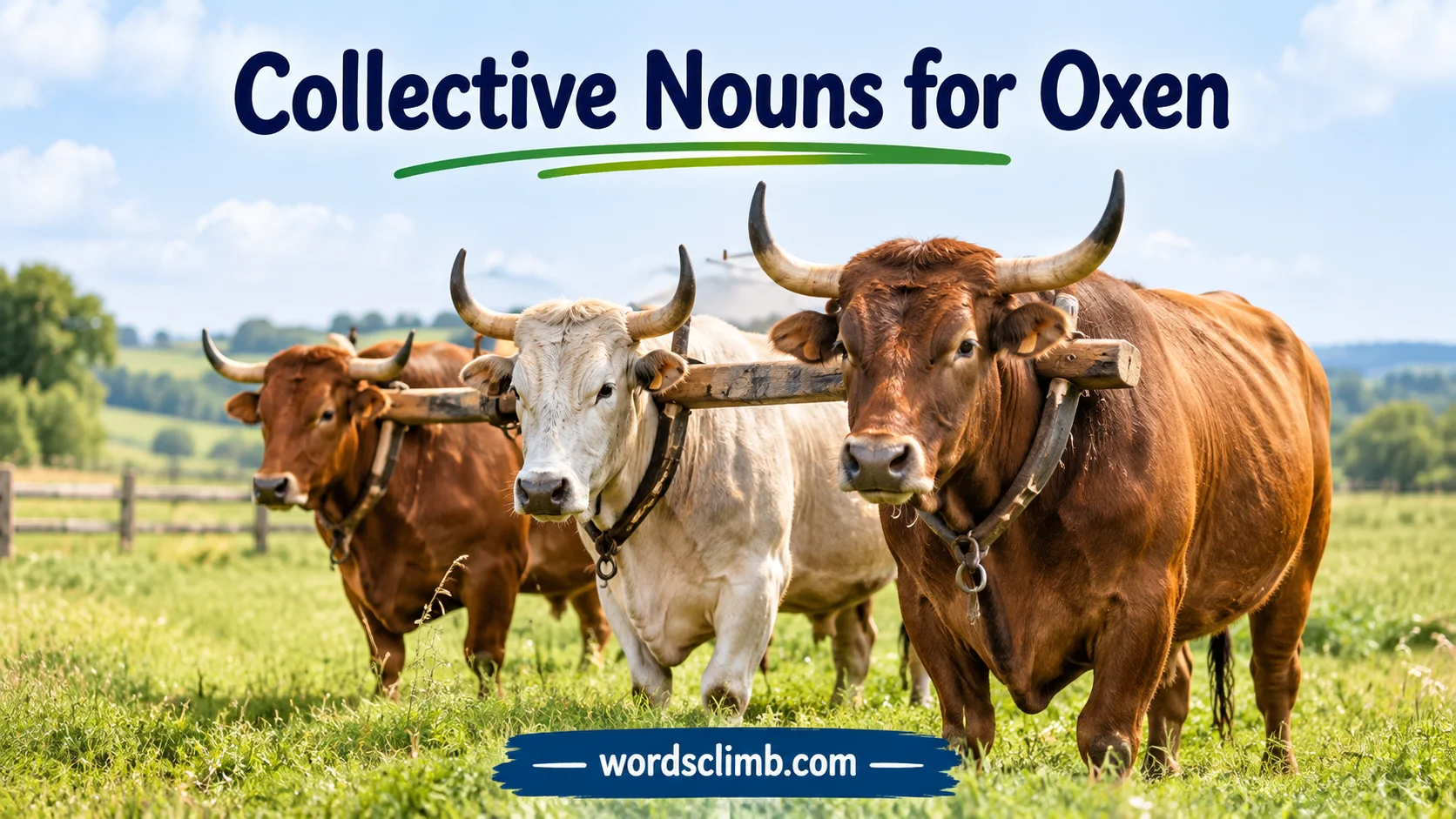
Collective Nouns for Oxen help you describe a group of oxen using the correct words in English. Instead of naming each animal separately, you can use a collective noun to describe them as a group. These terms make your writing more natural and help you improve your grammar, vocabulary, and understanding of animal group names.
In English, animal collective nouns can be common or unusual, with some terms dating back to medieval hunting traditions. While a herd of oxen is a familiar expression, learning about other group names can make your language more interesting. In this guide, you’ll discover useful terms, their meanings, and simple examples to help you use them confidently in everyday conversations and writing.
Collective Nouns for Oxen
There is no single collective noun that must always be used for oxen. Common terms include herd, team, yoke, drove, and span. Some describe oxen generally, while others refer to oxen working together or being paired for a task.
| Type | Simple Example |
| Herd | A herd of oxen |
| Team | A team of oxen |
| Yoke | A yoke of oxen |
| Drove | A drove of oxen |
| Span | A span of oxen |
1. Herd of Oxen
A herd of oxen is a simple and natural expression for a group of oxen. The word herd is commonly used for groups of large grazing animals. It works well when the oxen are together in a pasture, field, or other open area.
Examples
- A herd of oxen grazed quietly in the field.
- The farmer watched the herd of oxen near the barn.
- A large herd of oxen moved across the pasture.
- The children saw a herd of oxen during their farm visit.
- The herd of oxen rested under the trees.
- A herd of oxen gathered beside the water.
- The farmer counted every ox in the herd.
- The herd of oxen walked slowly toward the farm.
- A peaceful herd of oxen grazed on the grass.
- The shepherd guided the herd of oxen toward the field.
2. Team of Oxen
A team of oxen refers to oxen working together, especially when they are pulling a plow, cart, wagon, or other heavy equipment. Oxen have traditionally been trained to cooperate as working animals, making team an especially useful term in agricultural contexts.
Examples
- A team of oxen pulled the heavy cart.
- The farmer used a team of oxen to plow the field.
- A strong team of oxen carried the wooden wagon.
- The team of oxen worked steadily all morning.
- The farmer trained his team of oxen carefully.
- A team of oxen pulled the plow through the soil.
- The old team of oxen was strong and reliable.
- The farmer rested the team of oxen after the long journey.
- A team of oxen helped move the heavy load.
- The team of oxen followed the farmer across the field.
3. Yoke of Oxen
A yoke of oxen traditionally describes two oxen joined together by a yoke, a wooden or other rigid device placed around their necks or shoulders so they can work together. This expression is particularly associated with oxen used for plowing and pulling.
Examples
- A yoke of oxen pulled the farmer’s plow.
- The farmer guided a yoke of oxen across the field.
- A strong yoke of oxen moved the heavy cart.
- The yoke of oxen worked together peacefully.
- The farmer prepared a yoke of oxen for the day’s work.
- A yoke of oxen pulled the wooden wagon.
- The yoke of oxen slowly climbed the hill.
- The farmer rested the yoke of oxen after plowing.
- A trained yoke of oxen could pull a heavy load.
- The yoke of oxen followed the farmer’s commands.
4. Drove of Oxen
A drove is a traditional collective term for a group of animals being driven or moved together. Therefore, drove of oxen can be used when oxen are traveling together under the direction of a farmer or handler.
Examples
- A drove of oxen moved along the country road.
- The farmer led the drove of oxen toward the pasture.
- A drove of oxen crossed the open field.
- The drove of oxen walked slowly toward the village.
- The farmer carefully guided the drove of oxen.
- A large drove of oxen passed through the farm.
- The drove of oxen rested after traveling all day.
- The farmer watched the drove of oxen from a distance.
- A drove of oxen moved toward the watering place.
- The drove of oxen followed the narrow path.
5. Span of Oxen
A span of oxen traditionally refers to a pair of oxen trained or used together, particularly for pulling a load or working as a matched pair. The term highlights the close cooperation between the animals.
Examples
- A span of oxen pulled the heavy wagon.
- The farmer bought a strong span of oxen.
- A span of oxen worked together in the field.
- The span of oxen pulled the cart up the hill.
- The farmer trained the span of oxen to work together.
- A well-trained span of oxen could move heavy equipment.
- The span of oxen rested beside the barn.
- The farmer harnessed the span of oxen before sunrise.
- A powerful span of oxen pulled the wooden plow.
- The span of oxen moved steadily across the farm.
Read More: Collective Nouns for Flowers
Interesting Facts About Oxen
Oxen are usually domesticated cattle, particularly cattle trained to perform work such as plowing, pulling carts, and transporting heavy materials. With proper care, cattle can live for many years, although working life and lifespan vary according to breed, health, nutrition, and living conditions. One of their most impressive physiological features is their muscular build and remarkable strength, which allows trained oxen to pull substantial loads. Their broad bodies, powerful shoulders, sturdy legs, and specialized digestive system help them thrive on plant-based diets. Oxen are ruminants, meaning they have a complex four-compartment stomach that allows them to digest fibrous foods such as grass and hay efficiently. They chew food, swallow it, later regurgitate partially digested material as cud, and chew it again. This unusual digestive process allows cattle to make good use of vegetation that many other animals cannot digest efficiently.
Why Oxen Are Important
Oxen have played a major role in human agriculture for thousands of years. Before modern tractors became widespread, farmers depended on trained oxen to prepare fields, transport crops, and move heavy materials. They are valued for their strength, endurance, patience, and ability to work steadily. Even today, oxen remain important in some agricultural communities where their power and relatively simple maintenance make them practical working animals.
FAQs:
1. What is the collective noun for oxen?
The most common collective noun for oxen is a herd. For example, “A herd of oxen grazed peacefully in the field.”
2. What do you call a group of oxen?
A group of oxen is generally called a herd. This term is widely understood and is suitable for everyday speaking and writing.
3. Is “herd of oxen” grammatically correct?
Yes, herd of oxen is grammatically correct. The word “herd” refers to a group of animals, while “oxen” is the plural form of “ox.”
4. Can I use “group” as a collective noun for oxen?
Yes, you can use group of oxen in ordinary English. Although “herd” is more specific to animals, “group” is also correct and easy to understand.
5. What is the difference between ox and oxen?
An ox refers to a single animal, while oxen is the plural form. For example, “The ox is strong” describes one animal, whereas “The oxen are working together” refers to multiple animals.
6. What is the plural of ox?
The standard plural of ox is oxen. Unlike many English nouns that form their plurals by adding “s,” this word uses the ending “-en.”
7. How do you use “herd of oxen” in a sentence?
You can use the phrase as the subject or object of a sentence. For example, “A herd of oxen moved slowly across the farm.”
8. Are oxen and bulls the same?
No, they are not exactly the same. An ox is typically a bovine animal trained for work, while a bull is an adult male bovine that has not been castrated.
9. Why are collective nouns important in English?
Collective nouns help you describe several people, animals, or things with one expression. They make sentences shorter, clearer, and more natural.
10. Do all animal collective nouns have historical origins?
No, not all collective nouns have historical origins. Some traditional animal group names appear in medieval hunting lists, while others developed through ordinary language use. Their popularity and everyday use vary.
Conclusion:
Learning the collective nouns for oxen helps you improve your English grammar and vocabulary. The most familiar expression is a herd of oxen, which describes several oxen together. You can also use “a group of oxen” when you want a simple, general phrase. By understanding these terms and practicing them in sentences, you can make your writing clearer and your everyday communication more effective.

Adam West is an English-language writer with a passion for storytelling, culture, and everyday life. His writing focuses on clear ideas, engaging narratives, and thoughtful perspectives that are easy for readers to connect with.
1 thought on “Collective Nouns for Oxen”