
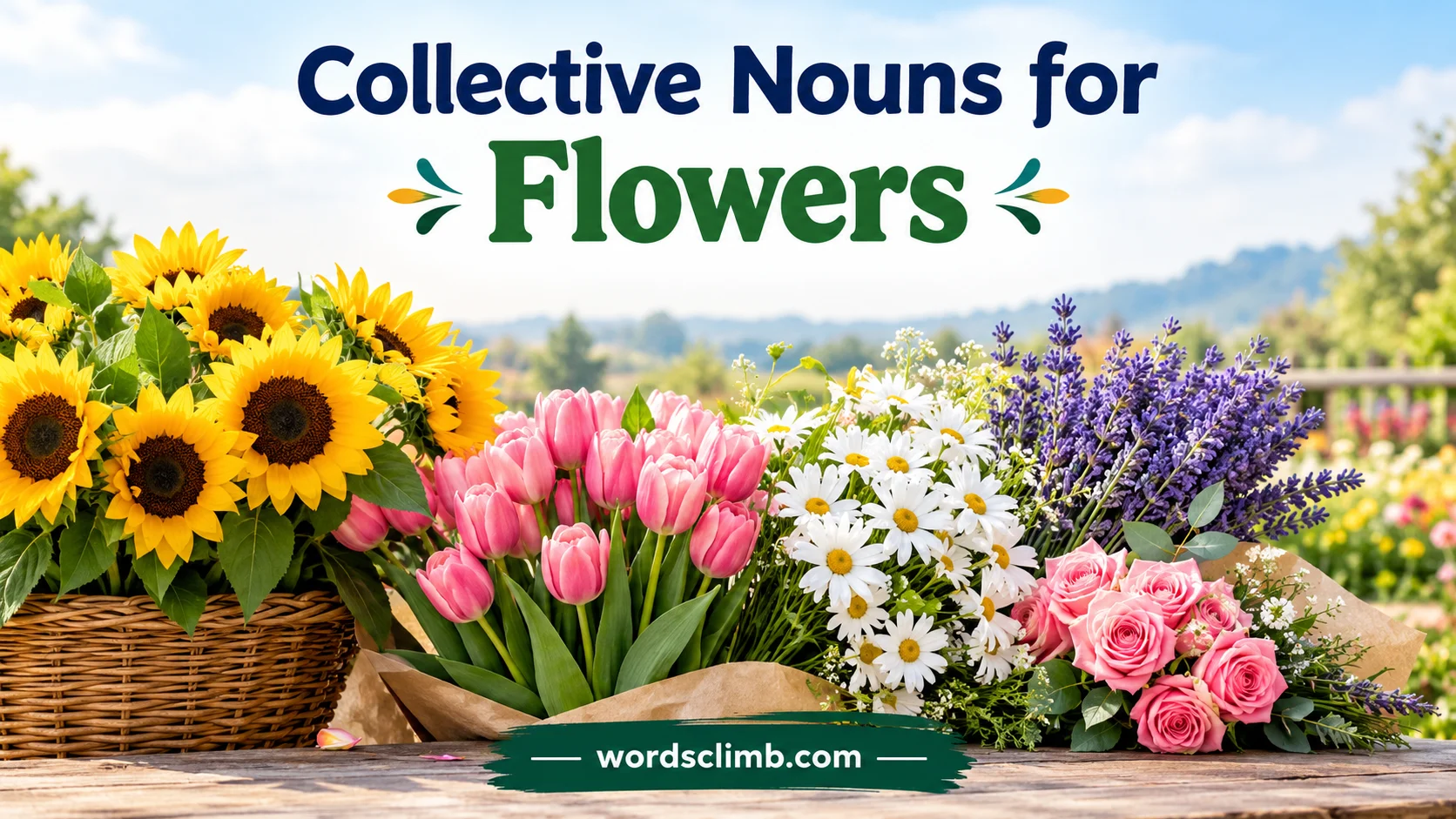
Collective Nouns for Flowers help you describe groups of blooms using simple and meaningful words. Common examples include bouquet, bunch, and bed, which make your writing clearer and more engaging. These terms help readers understand how flowers grow naturally or are gathered together for decoration, gifts, and special occasions.
Collective nouns also describe groups of people, animals, and things with one word. For plants and flowers, terms such as fields, forests, stands, copses, paddies, riparian zones, and cornucopias describe different groupings or growing environments. Learning these words expands your vocabulary, improves your grammar, and helps you write more naturally about flowers, gardens, and the beauty of nature.
Quick Table of Collective Nouns for Flowers
| Type | Simple Example |
| Bouquet | A bouquet of flowers |
| Bunch | A bunch of flowers |
| Bed | A bed of flowers |
| Border | A border of flowers |
| Arrangement | An arrangement of flowers |
1. Bouquet of Flowers
A bouquet is one of the most common collective nouns used for flowers. It usually refers to a carefully gathered group of flowers arranged together, often for decoration, celebrations, gifts, weddings, or special occasions. A bouquet can contain one type of flower or several different varieties.
Examples of Bouquet of Flowers
- She gave her mother a beautiful bouquet of flowers.
- The bride carried a colorful bouquet of flowers.
- He bought a fresh bouquet of flowers for the celebration.
- A lovely bouquet of flowers stood on the table.
- The florist prepared a large bouquet of flowers.
- Sarah received a fragrant bouquet of flowers.
- The children made a small bouquet of flowers.
- We placed the bouquet of flowers near the window.
- The artist painted a bright bouquet of flowers.
- She carefully arranged the bouquet of flowers in a vase.
A bouquet is especially useful when flowers are picked and arranged together. It is therefore a natural choice when describing flowers presented as a gift or used for decoration.
2. Bunch of Flowers
A bunch of flowers is another common expression for several flowers gathered together. Unlike a bouquet, a bunch can sound more casual and does not necessarily suggest a carefully designed floral arrangement.
Examples of Bunch of Flowers
- She picked a bunch of flowers from the garden.
- He brought a bunch of flowers home.
- The girl carried a small bunch of flowers.
- I found a colorful bunch of flowers at the market.
- The farmer collected a bunch of flowers.
- She tied the bunch of flowers with a ribbon.
- A bunch of flowers was placed beside the door.
- The children gathered a bunch of flowers during their walk.
- He gave his friend a simple bunch of flowers.
- We put the bunch of flowers into a glass vase.
The word bunch is useful in everyday English because it gives the idea of flowers being collected or held together without requiring a formal arrangement.
3. Bed of Flowers
A bed of flowers refers to an area of soil or garden space where flowers are planted and grown together. This expression is particularly common in gardening and landscaping.
Examples of Bed of Flowers
- A colorful bed of flowers brightened the garden.
- We planted roses in a large bed of flowers.
- The park has a beautiful bed of flowers.
- Bees were flying over the bed of flowers.
- She watered the bed of flowers every morning.
- The children walked past a bright bed of flowers.
- A fragrant bed of flowers grew beside the path.
- The gardener created a new bed of flowers.
- Butterflies visited the bed of flowers throughout the day.
- The yellow flowers made the bed of flowers look cheerful.
Unlike a bouquet or bunch, a bed of flowers normally describes flowers that are growing in the ground rather than flowers that have been picked.
4. Border of Flowers
A border of flowers describes flowers planted along the edge of a garden, walkway, lawn, or other area. Gardeners often use flower borders to add color and create a clear boundary between different parts of a landscape.
Examples of Border of Flowers
- A border of flowers surrounded the garden.
- The gardener planted a border of flowers beside the walkway.
- We admired the colorful border of flowers.
- A beautiful border of flowers lined the path.
- The house had a bright border of flowers.
- She created a border of flowers around the lawn.
- Bees moved from one flower to another along the border of flowers.
- The park featured a long border of flowers.
- A border of flowers made the entrance more attractive.
- They planted roses to form a border of flowers.
This expression is especially helpful when writing about gardens, parks, landscaping, and outdoor spaces.
5. Arrangement of Flowers
An arrangement of flowers refers to flowers that have been deliberately organized or displayed together. Florists commonly create arrangements for homes, events, weddings, restaurants, offices, and other special settings.
Examples of Arrangement of Flowers
- The florist created a beautiful arrangement of flowers.
- An elegant arrangement of flowers decorated the table.
- She placed an arrangement of flowers near the entrance.
- The wedding hall had several arrangements of flowers.
- He made a simple arrangement of flowers for his room.
- The colorful arrangement of flowers attracted everyone’s attention.
- We ordered an arrangement of flowers for the event.
- The vase held a fresh arrangement of flowers.
- Her arrangement of flowers included roses and lilies.
- The hotel displayed a large arrangement of flowers in the lobby.
The phrase arrangement of flowers emphasizes how flowers have been organized to create a particular appearance or design.
Also Read This: Collective Nouns for Events
Interesting Facts About Flowers
Flowers have many fascinating biological features that make them important parts of plant life. Their longevity varies greatly depending on the species and environment. Some flowers remain open for only a few hours or days, while others can stay attractive for weeks under suitable conditions. Certain flowers have unique physiological features, including specialized shapes, colors, scents, nectar-producing structures, and pollen designed to help with pollination. These adaptations can attract bees, butterflies, birds, bats, and other pollinators. Flowers do not have dietary habits like animals because they make their own food through photosynthesis. Their roots absorb water and minerals from the soil, while their leaves use sunlight, carbon dioxide, and water to produce energy-rich sugars. Some flowering plants also have unusual relationships with animals, such as carnivorous plants that capture insects to obtain nutrients that may be limited in their environment. Together, these features show why flowers are much more than beautiful decorations; they are highly adapted parts of complex plant ecosystems.
Why Learning Collective Nouns for Flowers Matters
Understanding collective nouns gives you more precise and interesting ways to describe flowers. Instead of repeatedly saying “many flowers,” you can choose bouquet, bunch, bed, border, or arrangement depending on the situation. These expressions help readers visualize whether flowers are being held together, growing in a garden, lining a pathway, or carefully displayed.
Collective nouns also make English more expressive. When you understand the difference between a bouquet of flowers and a bed of flowers, you can communicate a clearer picture with fewer words. Although flowers do not form social groups like birds or mammals, the language used to describe them reflects the way humans observe, organize, grow, and appreciate the natural world.
FAQs:
1. What is the collective noun for flowers?
The most common collective nouns for flowers are bouquet, bunch, bed, and cluster. The best choice depends on how the flowers are arranged or growing.
2. What is a group of flowers called?
A group of flowers can be called a bunch, bouquet, cluster, or bed. A bouquet usually refers to flowers gathered and arranged for decoration or gifting.
3. Is bouquet a collective noun for flowers?
Yes, bouquet is a collective noun for flowers. It describes a group of flowers arranged together, often tied with a ribbon or placed in a vase.
4. What is the difference between a bouquet and a bunch of flowers?
A bouquet is usually carefully arranged for beauty or a special occasion. A bunch is a group of flowers gathered or held together, whether arranged or not.
5. What do you call a group of flowers growing in a garden?
A group of flowers growing in a garden may be called a flower bed. This term describes an area of soil where flowers are planted and grown.
6. Is cluster a collective noun for flowers?
Yes, cluster can describe flowers growing or appearing close together. For example, a cluster of roses bloomed near the garden gate.
7. What is a field of flowers called?
A large area covered with flowers is often called a field of flowers or a meadow, depending on its setting. A meadow usually refers to open grassland that may contain wildflowers.
8. Can I use the word bunch for all types of flowers?
Yes, bunch is a general term that works for many types of flowers. You can use it for roses, tulips, daisies, and other blooms gathered together.
9. Are there special collective nouns for different flowers?
Some terms describe flowers in particular arrangements or settings, but most flowers do not have a unique collective noun. Words like bouquet, bunch, cluster, and bed are widely useful.
10. Why are collective nouns for flowers important?
Collective nouns help you describe flowers clearly and naturally. They improve your vocabulary, support better grammar, and make descriptions of gardens, floral arrangements, and nature more interesting.
Conclusion:
Collective nouns for flowers make it easier to describe groups of blooms in everyday conversations and creative writing. Words such as bouquet, bunch, cluster, and flower bed each convey a slightly different meaning, depending on how the flowers are gathered or where they grow.
Learning these useful terms can strengthen your English vocabulary and help you write more clearly about gardens, gifts, and natural landscapes. Whether you are describing a beautiful bouquet of roses or a field filled with wildflowers, choosing the right collective noun makes your sentences more vivid and precise.

Ruby Hart is a passionate writer who creates engaging, relatable, and easy-to-understand content. She loves turning everyday ideas into helpful and enjoyable stories for readers.
1 thought on “Collective Nouns for Flowers”