
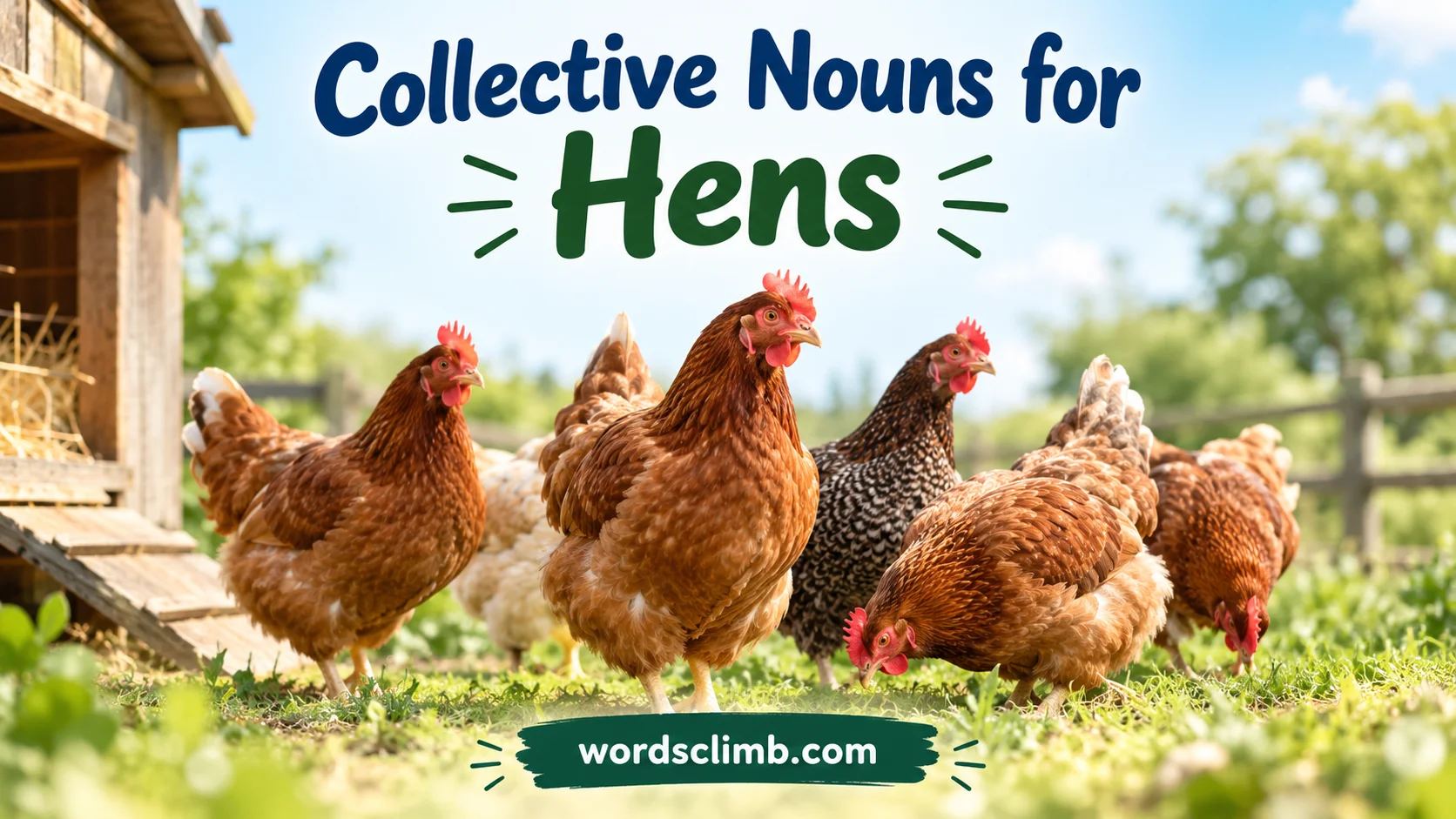
Collective Nouns for Hens are useful English grammar terms that describe a group of hens as one unit. The most common term is flock, while brood and peep can be used in specific situations. These words make sentences more natural and help English learners understand how groups of birds are described. Learning these collective nouns also adds useful vocabulary for students, teachers, writers, and anyone improving their English language skills.
Hens are social birds that often stay together, forage, communicate, and follow a clear social hierarchy within their group. A flock of hens usually refers to several birds living or moving together, while a brood can suggest a family group. Peep is commonly linked with young chickens because of their soft chirping sounds. In my experience, learners remember these terms more easily when they connect each collective noun with the behavior, age, or setting it describes.
Collective Nouns for Hens
Here are some collective nouns that can be used for hens. Flock is by far the most common and natural choice in everyday English. Other terms can have more specific meanings and should be used according to context.
| Type | Simple Example |
| Flock | A flock of hens |
| Brood | A brood of hens |
| Clutch | A clutch of hens |
| Covey | A covey of birds |
| Group | A group of hens |
1. Flock of Hens
Flock is the most common collective noun for hens. It refers to several hens living, moving, feeding, or resting together. You can use it in everyday writing and conversation when describing a group of chickens or hens.
Examples:
- A flock of hens walked across the farmyard.
- The farmer fed the flock of hens early in the morning.
- We watched a flock of hens searching for food.
- The flock of hens stayed close to the coop.
- A large flock of hens gathered near the fence.
- The children enjoyed watching the flock of hens.
- The flock of hens returned to the coop before sunset.
- A flock of hens moved slowly across the grass.
- The farmer counted every hen in the flock.
- The flock of hens became quiet when night arrived.
2. Brood of Hens
Brood traditionally refers to a group of young birds cared for by a mother bird. However, it can sometimes be used more broadly for a group of birds, particularly when the context involves nesting or raising young. For hens, brood is most appropriate when discussing a mother hen and her chicks rather than an ordinary group of adult hens.
Examples:
- The hen stayed close to her brood.
- A mother hen protected her brood from danger.
- The brood followed the hen across the yard.
- The farmer watched the hen care for her brood.
- The young birds stayed safely beside their brood mother.
- The hen called her brood when she found food.
- The brood rested under the shade of a tree.
- The mother hen kept her brood warm.
- The brood moved around the coop with the hen.
- Everyone admired the hen and her growing brood.
3. Clutch of Hens
Clutch is primarily used for a group of eggs laid by a bird, rather than as a standard collective noun for adult hens. It is therefore better to use clutch when talking about eggs produced or incubated by a hen. Still, understanding the term helps learners distinguish it from more common expressions such as flock of hens.
Examples:
- The hen laid a clutch of eggs in the nest.
- The farmer carefully checked the clutch.
- The hen sat on her clutch of eggs.
- A healthy hen can produce several eggs in a season.
- The clutch of eggs remained warm under the hen.
- The farmer protected the clutch from predators.
- The hen returned to her clutch after feeding.
- The children looked at the clutch of eggs from a distance.
- The clutch contained several clean eggs.
- The hen patiently guarded her clutch.
4. Covey of Birds
Covey is a traditional collective noun generally associated with certain groups of birds, especially game birds such as quail and partridges. It is not a standard collective noun for hens, so flock is a much better choice when you mean domestic hens. Knowing this distinction prevents incorrect usage.
Examples:
- A covey of birds moved through the grass.
- We spotted a covey near the edge of the field.
- The birds stayed together in a small covey.
- A covey of birds disappeared into the bushes.
- The farmer noticed a covey near the woodland.
- The covey of birds flew away suddenly.
- Several birds gathered into a covey.
- The covey remained hidden in the tall grass.
- We quietly watched the covey of birds.
- The small covey moved toward the trees.
5. Group of Hens
Group is a general collective noun that can describe almost any collection of hens. It is simple, correct, and easy to understand, although flock sounds more natural when specifically describing hens or chickens.
Examples:
- A group of hens gathered near the barn.
- The farmer watched a group of hens feeding.
- A group of hens crossed the garden.
- The group of hens stayed near the coop.
- We saw a group of hens walking across the field.
- The farmer gave food to the group of hens.
- A small group of hens rested under the tree.
- The group of hens made noise near the fence.
- Several hens formed a group beside the barn.
- The group of hens returned home before dark.
Also Read This: Collective Nouns for Moles
Social Behavior and Everyday Life of Hens
Hens are highly social birds and often live together in groups. Within a flock, they establish a social hierarchy commonly called a pecking order, which determines access to food, nesting spaces, and preferred resting areas. Hens communicate using many different calls, including sounds that can signal danger, food, or the presence of chicks. They also spend much of their day scratching the ground, pecking at objects, dust-bathing, resting, and searching for food.
Understanding these behaviors makes the word flock especially meaningful. A flock is more than simply several hens standing in the same place. The birds interact with one another, recognize members of their social group, and respond to changes around them. Their social behavior is one reason hens are such interesting domestic birds to observe.
Interesting Facts About Hens
Hens have several fascinating biological features. A domestic hen can live for many years when kept in safe and healthy conditions, although lifespan varies greatly depending on breed, environment, nutrition, disease, and whether the bird is raised for egg production. Hens have excellent vision and can see a broad range of colors, while their beaks are highly useful for pecking, grooming, and exploring their surroundings. Their feathers provide insulation and protection, and they can fluff them up to help regulate body temperature.
Hens are also omnivores, meaning their natural diet can include both plant and animal foods. They commonly eat grains, seeds, grasses, fruits, vegetables, insects, worms, and other small organisms. A hen’s instinct to scratch and peck helps her uncover food hidden in soil and leaf litter. They also swallow small stones or grit, which helps their muscular gizzard grind food because birds do not chew their food in the same way mammals do.
Another interesting fact is that hens can produce eggs without a rooster being present. Those eggs are unfertilized, so they cannot develop into chicks. When a hen does raise chicks, however, she can display strong maternal behavior, using different calls to communicate with them and keeping them close for protection and warmth.
FAQs:
1. What is the most common collective noun for hens?
The most common collective noun for hens is flock. You can say, “A flock of hens was feeding in the yard.”
2. What is a group of hens called?
A group of hens is commonly called a flock. Other terms, such as brood and peep, may be used in more specific contexts.
3. Can I use “flock of hens” in everyday English?
Yes. Flock of hens is natural and easy to understand in everyday English. It is the safest choice when describing several hens together.
4. What does “brood of hens” mean?
A brood generally refers to a family group of young birds, especially those cared for by a mother. It is more specific than the general term flock.
5. What does “peep of chickens” mean?
A peep of chickens is traditionally associated with young chickens or chicks. The term relates to the soft peeping sounds they make.
6. Are hens and chickens the same thing?
Not exactly. Chicken is the general name for the domestic bird, while a hen specifically means a female chicken, usually an adult female.
7. Why are collective nouns useful for English learners?
Collective nouns help learners describe groups more naturally and accurately. They also improve vocabulary, sentence structure, and overall English grammar skills.
8. Do hens live in groups?
Yes. Hens are social birds and commonly live in groups. They communicate, forage together, and develop social relationships and rankings within their flock.
9. Which collective noun should I use for hens in formal writing?
Flock is the best general choice because it is widely recognized and suitable for both everyday and formal writing.
10. What is the difference between a flock, brood, and peep?
A flock is a general group of birds, a brood often describes a family group, and a peep is traditionally associated with young chickens or chicks.
Conclusion:
Understanding collective nouns for hens makes your English more descriptive and natural. Flock is the most common and reliable term, while brood and peep can add more specific meaning in the right context. Learning these terms is a simple way to improve your English vocabulary and grammar while discovering more about the social behavior of hens.

Ruby Hart is a passionate writer who creates engaging, relatable, and easy-to-understand content. She loves turning everyday ideas into helpful and enjoyable stories for readers.
1 thought on “Collective Nouns for Hens”