
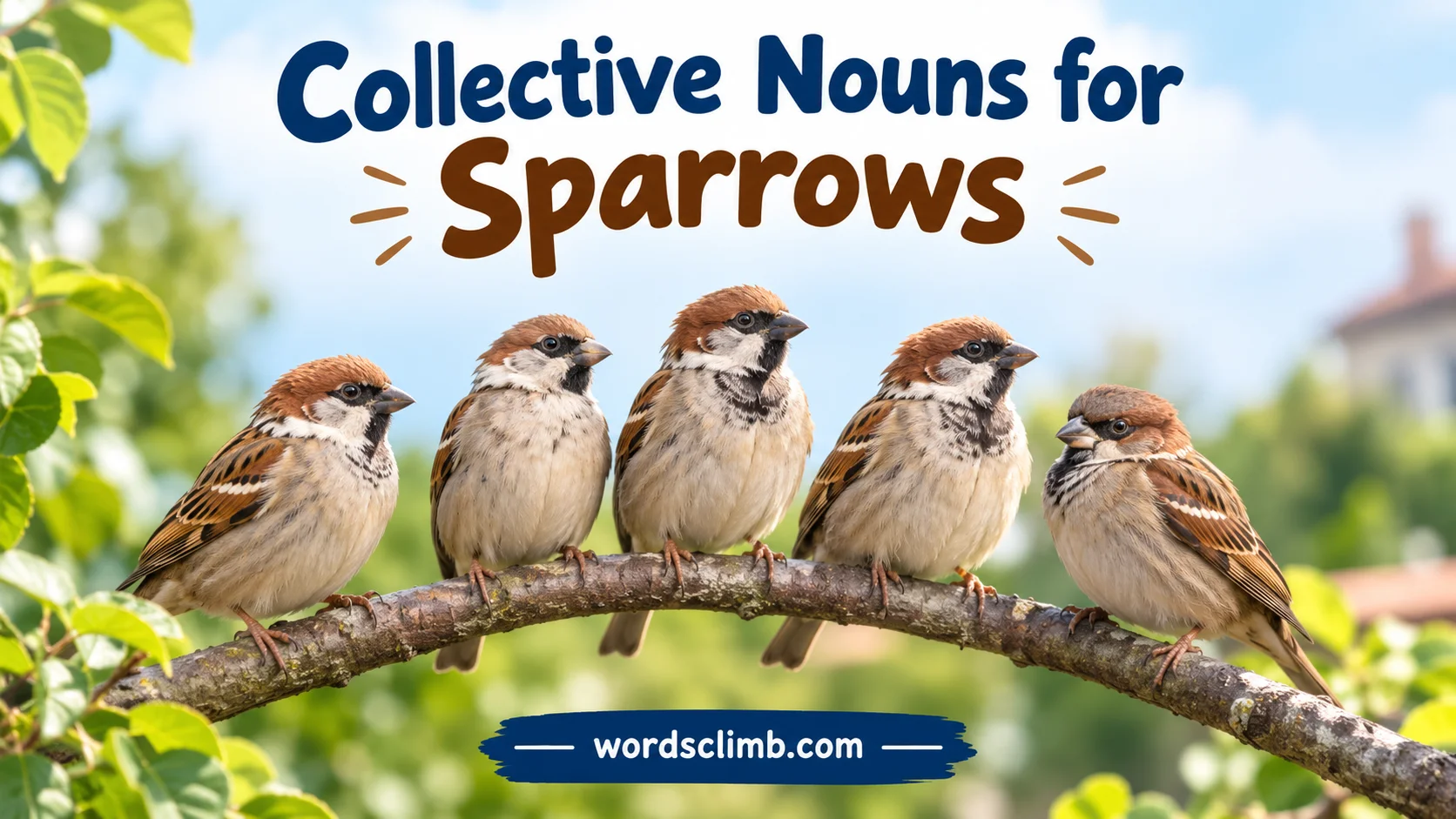
Collective Nouns for Sparrows make it easier to describe a group of sparrows in a clear and interesting way. These small birds often gather together in gardens, trees, parks, and urban areas. While flock is the most common term used in everyday English, other collective nouns can add variety to your writing. Learning these terms can improve your vocabulary, especially when discussing birds, nature, and animal groups.
Sparrows are active and social birds, so watching a group of sparrows can be lively and fascinating. English has developed many traditional terms for groups of birds, some dating back to older hunting and literary traditions. Although not every unusual term is commonly used today, understanding these expressions can make your writing more descriptive and engaging. They are also useful for students, teachers, writers, and English learners who want to use natural and accurate language.
Collective Nouns for Sparrows
There isn’t one single collective noun used exclusively for sparrows in modern English. Flock is the most common and natural term, while words such as host, company, and congregation can describe groups of birds in suitable contexts. Some older or literary bird-group terms may also be encountered.
| Type | Simple Example |
| Flock | A flock of sparrows |
| Host | A host of sparrows |
| Company | A company of sparrows |
| Congregation | A congregation of sparrows |
| Group | A group of sparrows |
These expressions can add variety to your writing. However, flock of sparrows is by far the clearest and most familiar choice for everyday English.
1. Flock of Sparrows
Flock is the most common collective noun for sparrows. A flock can contain several birds or a much larger gathering. Sparrows may form flocks while feeding, moving between locations, or gathering around food and shelter.
Examples:
- A flock of sparrows landed in the garden.
- We watched a flock of sparrows fly across the field.
- A large flock of sparrows gathered near the trees.
- The flock of sparrows searched for seeds.
- Several sparrows joined the flock before sunset.
- A flock of sparrows rested on the roof.
- The children saw a flock of sparrows near the park.
- A noisy flock of sparrows flew from the bushes.
- The farmer scattered grain for the flock of sparrows.
- A flock of sparrows disappeared into the trees.
2. Host of Sparrows
Host is a traditional collective noun that can be used for a large number of birds. It gives the sentence a slightly literary or descriptive feel. When many sparrows gather together, this term can emphasize the impressive size of the gathering.
Examples:
- A host of sparrows gathered around the field.
- We saw a host of sparrows near the trees.
- A host of sparrows filled the garden with chirping sounds.
- The host of sparrows flew over the village.
- A large host of sparrows searched for food.
- The farmer noticed a host of sparrows near the grain.
- A host of sparrows rested on the telephone wires.
- The morning sun revealed a host of sparrows in the garden.
- A host of sparrows suddenly rose from the grass.
- The host of sparrows moved toward the nearby bushes.
3. Company of Sparrows
Company can be used descriptively for a group of birds. It suggests several sparrows staying or moving together. Although it is less common than “flock,” it can make writing more varied and expressive.
Examples:
- A company of sparrows gathered beside the pond.
- We noticed a company of sparrows in the garden.
- A small company of sparrows searched for seeds.
- The company of sparrows flew toward the trees.
- A company of sparrows rested on the fence.
- The children watched a company of sparrows feeding.
- A cheerful company of sparrows chirped outside the window.
- A company of sparrows gathered near the bird feeder.
- The company of sparrows moved through the bushes.
- At sunrise, a company of sparrows became active.
4. Congregation of Sparrows
Congregation refers to a gathering or assembly and can be used creatively for birds that come together in one place. It is especially suitable for descriptive writing when many sparrows are gathered in a particular location.
Examples:
- A congregation of sparrows gathered beneath the roof.
- We saw a congregation of sparrows near the feeder.
- A large congregation of sparrows filled the tree.
- The congregation of sparrows became noisy at feeding time.
- A congregation of sparrows gathered in the courtyard.
- The gardener watched a congregation of sparrows eating seeds.
- A congregation of sparrows flew from the wall.
- The congregation of sparrows rested together after feeding.
- A noisy congregation of sparrows gathered near the bushes.
- We photographed a congregation of sparrows in the park.
5. Group of Sparrows
Group is a simple and completely understandable general term. It does not have the special character of “flock,” but it works well when you simply want to describe several sparrows together.
Examples:
- A group of sparrows landed in the garden.
- I saw a group of sparrows near the window.
- A group of sparrows was feeding on the ground.
- The group of sparrows flew into a tree.
- A small group of sparrows rested on the fence.
- We watched a group of sparrows searching for food.
- A group of sparrows gathered around the feeder.
- The group of sparrows became active in the morning.
- A group of sparrows flew across the road.
- The children counted a group of sparrows in the park.
Read More: Collective Nouns for Hens
Interesting Facts About Sparrows
Sparrows are small birds, but they have remarkable adaptations that help them survive in many environments. The house sparrow (Passer domesticus) is particularly well known for living close to people, although its typical lifespan in the wild is relatively short and many young birds do not survive their first year. Some individuals can live considerably longer under favorable conditions. Sparrows have compact bodies, strong conical bills, and powerful legs that help them hop and forage on the ground. Their feathers provide insulation and help regulate body temperature, while their quick movements help them escape predators.
Their diet is another fascinating feature of sparrow life. Sparrows commonly eat seeds and grains, but they can also consume insects and other small invertebrates. Insects are particularly important when adults are feeding growing chicks because they provide valuable protein. Sparrows often search for food on the ground, around vegetation, and in areas influenced by human activity. Their ability to use a wide range of food sources helps explain why they can thrive in gardens, farms, towns, and cities.
Faqs :
1. What is a group of sparrows called?
A group of sparrows is commonly called a flock of sparrows. This is the most natural and widely understood term in everyday English.
2. What is the most common collective noun for sparrows?
Flock is the most common collective noun used for sparrows. You can use it in both spoken and written English.
3. Can I say a flock of sparrows?
Yes. A flock of sparrows is grammatically correct and is the simplest way to describe several sparrows gathered together.
4. Why are sparrows called a flock?
The word flock is a general collective noun used for groups of birds. Since sparrows commonly gather, feed, and fly together, the term fits them naturally.
5. Do sparrows usually live in groups?
Sparrows are generally social birds and may gather in groups, particularly when feeding, resting, or moving between locations.
6. Where can you see groups of sparrows?
You may see groups of sparrows in gardens, parks, trees, fields, farms, and urban areas. They often gather where food, water, and shelter are available.
7. Are there unusual collective nouns for sparrows?
Some older or less common sources may associate special terms with groups of birds. However, flock remains the safest and most natural choice for sparrows.
8. Is “group of sparrows” grammatically correct?
Yes, a group of sparrows is completely correct. However, a flock of sparrows sounds more specific because flock is a traditional collective noun for birds.
9. Why should English learners learn collective nouns?
Learning collective nouns helps you build stronger vocabulary and describe people, animals, and objects more naturally. They can also make your writing more varied and precise.
10. What is the best collective noun to use for sparrows?
The best everyday choice is flock. It is clear, familiar, grammatically correct, and widely understood by English speakers.
Conclusion :
A flock of sparrows is the most natural and commonly used way to describe a group of these small, social birds. Although English contains many unusual and traditional collective nouns, not all of them are used regularly today. Understanding the difference between common and uncommon terms can help you choose the right expression for your writing. Whether you’re a student, teacher, writer, or English learner, using flock gives you a simple and reliable way to describe sparrows gathered together.

Adam West is an English-language writer with a passion for storytelling, culture, and everyday life. His writing focuses on clear ideas, engaging narratives, and thoughtful perspectives that are easy for readers to connect with.
1 thought on “Collective Nouns for Sparrows”