
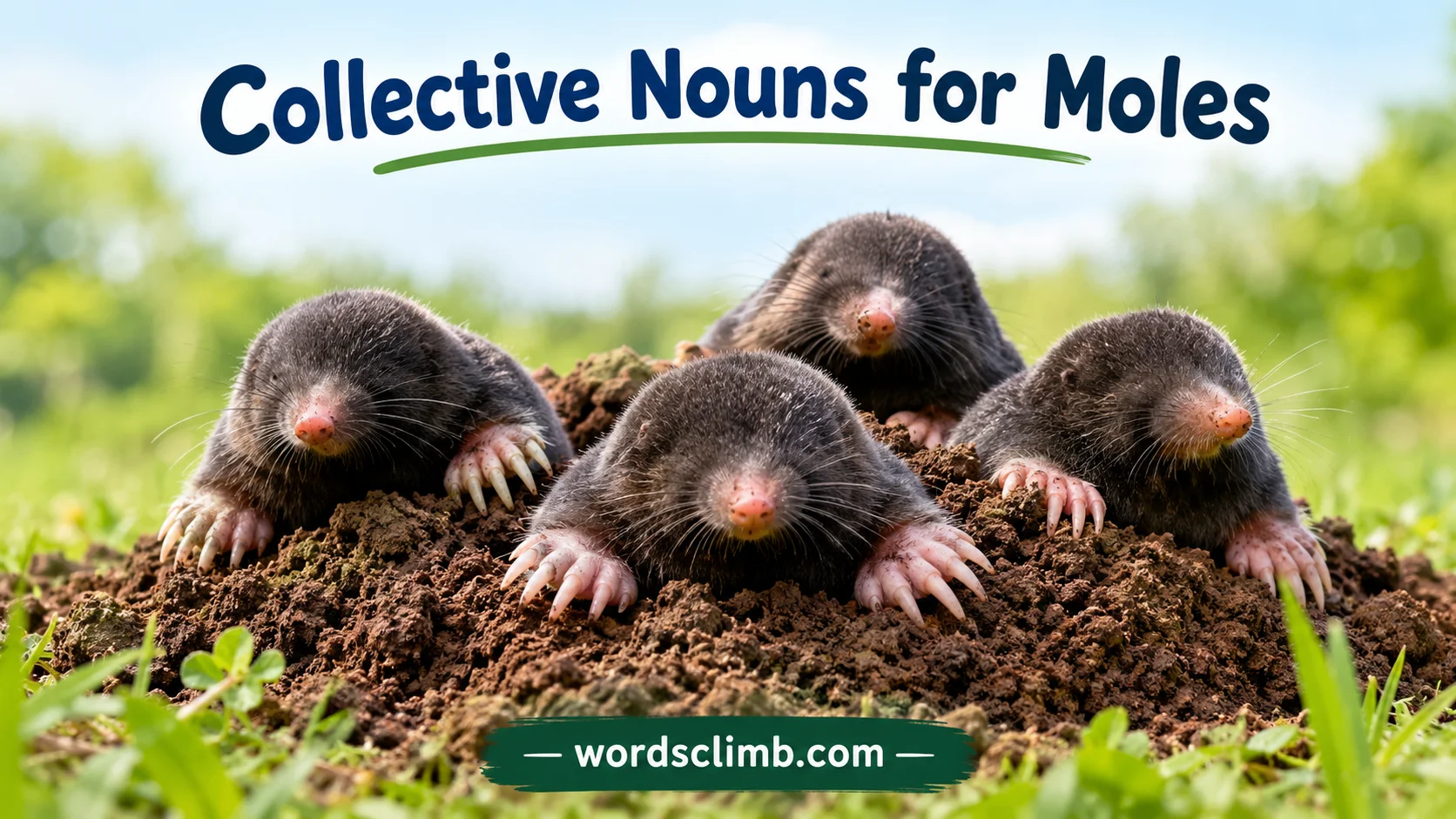
Collective Nouns for Moles help you describe a group of moles in a more interesting and natural way. Instead of simply saying “a group of moles,” you can use terms such as labour, company, or fortress. These unusual collective nouns are useful for students, teachers, writers, and anyone learning animal vocabulary. The term Labour of Moles is especially well known because it reflects the animals’ hardworking nature and their habit of digging and living underground.
Moles are small burrowing mammals with strong front feet, sensitive noses, and a fascinating underground lifestyle. They are often solitary, but several moles may live in the same suitable area when food and soil conditions allow. The phrase Labour of Moles creates an image of busy miners working beneath the ground. Other expressions, including lobar, company, and fortress, may also appear in traditional animal-name lists. Learning these terms can make your writing more vivid while improving your understanding of English grammar and vocabulary.
Collective Nouns for Moles
There is no single universally accepted collective noun for moles. Some terms appear in general animal-group vocabulary, while others describe a gathering based on context. The following words can help you describe moles naturally.
| Type | Simple Example |
| Labor | A labor of moles |
| Company | A company of moles |
| Group | A group of moles |
| Movement | A movement of moles |
1. Labor of Moles
“Labor” can be used to describe a group of moles, especially because moles spend much of their lives digging tunnels and searching for food underground. The word also creates an interesting connection with their hardworking digging behavior.
Example Sentences:
- A labor of moles was digging beneath the garden.
- We noticed a labor of moles near the edge of the field.
- The farmer discovered a labor of moles underground.
- A labor of moles had created several tunnels.
- The children learned about a labor of moles during their nature lesson.
- A labor of moles moved through the soft soil.
- The gardener spotted signs of a labor of moles nearby.
- A labor of moles had been active after the rain.
- Researchers studied a labor of moles in the woodland.
- The fresh tunnels suggested that a labor of moles was nearby.
2. Company of Moles
“Company” is another term that can be used for a gathering of moles. It is a general collective expression and can make descriptions sound more natural and varied.
Example Sentences:
- A company of moles lived beneath the meadow.
- We saw signs of a company of moles in the garden.
- A company of moles had made tunnels through the soil.
- The researcher observed a company of moles underground.
- A company of moles was active after the rainfall.
- The field contained evidence of a company of moles.
- A company of moles searched for worms beneath the ground.
- The gardener noticed tunnels made by a company of moles.
- A company of moles occupied different parts of the field.
- The soft earth revealed the presence of a company of moles.
3. Group of Moles
“Group” is the simplest and most widely understandable choice when you want to describe several moles together. It works well in everyday English, educational writing, and wildlife descriptions.
Example Sentences:
- A group of moles was found near the forest.
- We noticed a group of moles living in the area.
- The scientist studied a group of moles.
- A group of moles had created tunnels beneath the lawn.
- The children watched a group of moles from a safe distance.
- A group of moles searched the soil for food.
- The garden showed signs of a group of moles.
- A group of moles was active beneath the field.
- The farmer noticed a group of moles near the crops.
- A group of moles moved through the underground tunnels.
4. Movement of Moles
“Movement” can be used descriptively when referring to several moles or signs of mole activity. It is particularly suitable when the focus is on their underground activity, digging, or movement through soil.
Example Sentences:
- A movement of moles was noticed beneath the garden.
- The fresh tunnels showed a movement of moles.
- We detected a movement of moles under the soft soil.
- The farmer noticed a movement of moles across the field.
- A movement of moles created several new tunnels.
- The wet ground revealed a movement of moles.
- A movement of moles was observed after the rain.
- The researcher recorded a movement of moles underground.
- The raised soil suggested a movement of moles.
- A movement of moles could be traced through the meadow.
5. Colony of Moles
“Colony” can be used descriptively for moles living in the same general area, especially when discussing a population occupying interconnected or nearby underground spaces. However, moles are generally solitary animals, so this term should be used carefully rather than as a universal collective noun.
Example Sentences:
- A colony of moles lived beneath the meadow.
- The gardener noticed signs of a colony of moles nearby.
- A colony of moles had created many tunnels underground.
- Researchers studied a colony of moles in the woodland.
- The field appeared to contain a colony of moles.
- A colony of moles was active after the heavy rain.
- The farmer found evidence of a colony of moles beneath the pasture.
- A colony of moles occupied the soft soil near the forest.
- The fresh tunnels suggested a colony of moles was active.
- The wildlife expert explained how a colony of moles used the area.
Read This: Collective Nouns for Fairies
Interesting Facts About Moles
Moles are small mammals specially adapted to life underground. Their bodies are cylindrical, allowing them to move through narrow tunnels, while their powerful front feet are broad and shaped like digging tools. Their eyes are tiny and, in some species, partly covered by fur or skin because vision is less important in their dark underground environment. Instead, moles rely heavily on their sensitive noses and touch to detect their surroundings.
Moles are also remarkable for their energy demands and feeding habits. They have fast metabolisms and spend much of their time searching for food. Their diet mainly consists of earthworms, insects, larvae, and other small invertebrates found in soil. A mole can consume a substantial amount of food relative to its body size, which helps support its active lifestyle. Although their underground tunnels can sometimes appear social, many mole species are actually solitary and territorial, coming together mainly for breeding.
Their lifespan varies by species and environmental conditions. Many wild moles live for only a few years, although some individuals can survive longer under favorable conditions. Their specialized bodies, strong digging limbs, sensitive sensory systems, and efficient feeding strategies make them particularly well suited to their underground world.
Why Understanding Mole Collective Nouns Matters
Learning collective nouns is more than memorizing unusual vocabulary. It shows how the English language creates descriptive ways to talk about animals and their behavior. With moles, terms such as labor, company, group, and movement can add variety to wildlife writing while helping readers picture these fascinating underground mammals.
At the same time, studying moles reveals how their physical adaptations, feeding habits, and mostly solitary behavior shape their lives. Combining language with natural history makes these animals easier to understand and gives you a richer appreciation of both English vocabulary and wildlife.
FAQs:
1. What is the collective noun for moles?
The most commonly known collective noun for moles is labour. You can say a labour of moles when referring to a group of these burrowing animals.
2. Why are moles called a labour?
The word labour suits moles because they spend much of their time digging tunnels and searching for food underground. Their constant digging makes them appear like busy workers.
3. Can I use “a company of moles”?
Yes, a company of moles can be found in traditional collective-noun lists. However, a labour of moles is the more distinctive and commonly recognized expression.
4. What are some other collective nouns for moles?
Other terms that may appear in traditional lists include lobar, company, and fortress. Usage can vary, so these terms are less common in everyday English.
5. What is the meaning of “Labour of Moles”?
Labour of Moles refers to a group of moles. The term also creates a vivid image of moles working underground as they dig tunnels and search for food.
6. Are moles social animals?
Moles are generally solitary animals and often live and forage alone. However, several moles may occupy the same general area when suitable food and soil conditions are available.
7. How do I use “labour of moles” in a sentence?
You can write: “A labour of moles was busy digging through the soft soil.” This sentence uses the collective noun naturally while highlighting their burrowing behavior.
8. Is “group of moles” grammatically correct?
Yes. A group of moles is completely correct and easy to understand. Collective terms such as labour of moles simply provide a more specific or colorful way to describe them.
9. Why are collective nouns useful?
Collective nouns make your writing more vivid and interesting. They also help you expand your vocabulary and describe animals in a more precise and creative way.
10. What is the best collective noun to use for moles?
Labour of moles is the best choice if you want to use a traditional and distinctive collective noun. For simple everyday writing, a group of moles is also perfectly acceptable.
Conclusion:
The most interesting collective noun for moles is labour, giving us the phrase a labour of moles. It fits these hardworking burrowing mammals because they spend much of their lives digging tunnels beneath the soil. Other terms, such as company, lobar, and fortress, may also appear in traditional lists. Learning these unusual collective nouns can make your English vocabulary richer and your writing more engaging.

Maya Rose is an English-language writer passionate about storytelling, personal growth, and everyday life. Her writing combines simplicity, warmth, and thoughtful perspectives that connect with readers.
1 thought on “Collective Nouns for Moles”