
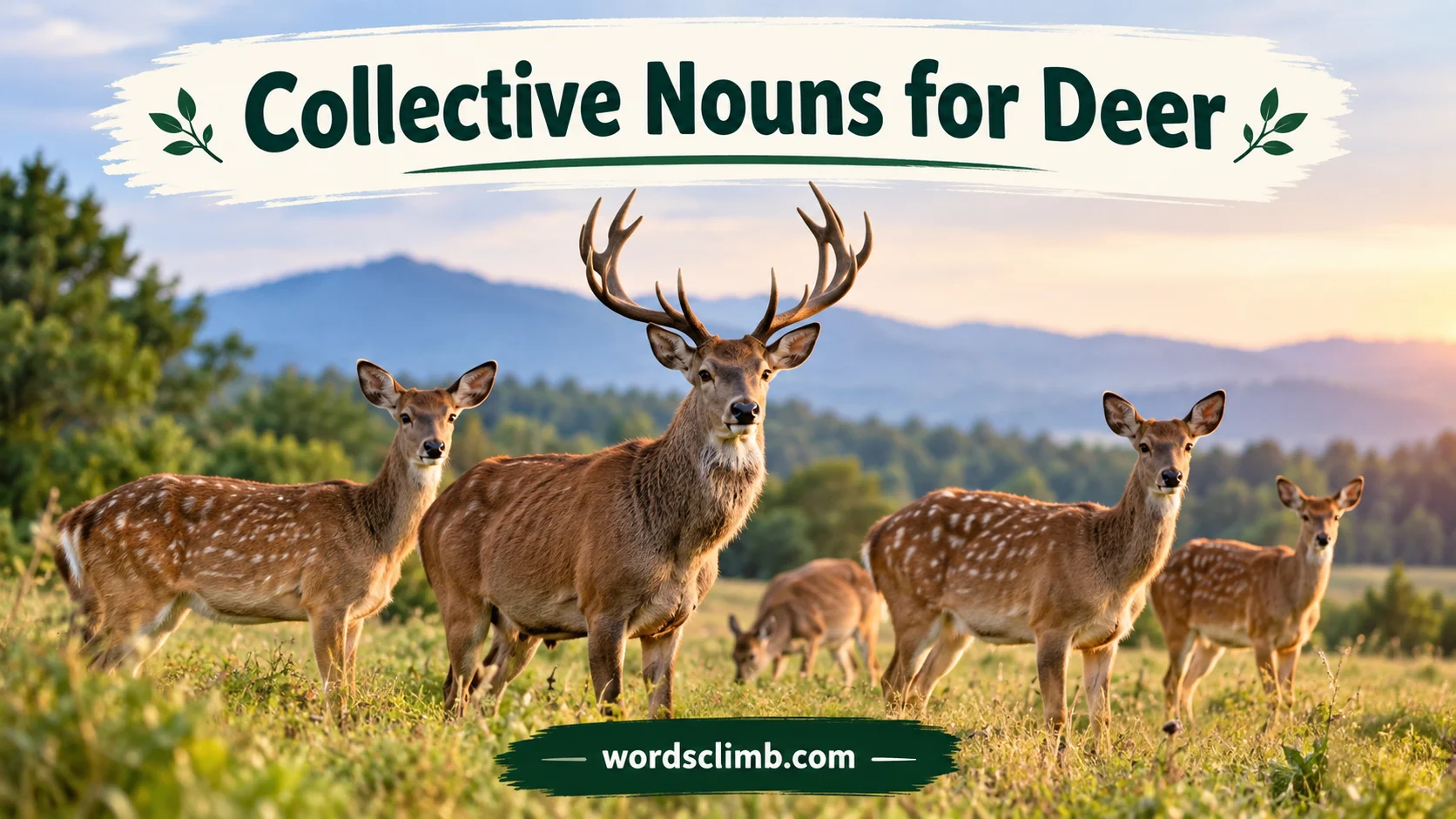
Collective Nouns for Deer show how English describes a group of deer with special words. The most common term is herd, used when deer live, travel, or feed together. However, English also has traditional terms such as parcel and leap, which add variety to descriptions. Learning these collective nouns can make your writing more precise, improve your vocabulary, and help you describe wildlife naturally in everyday conversations, schoolwork, and creative writing.
The word deer has the same form for one animal and several animals, which makes it an interesting part of English grammar. Some group names come from old terms of venery, a tradition connected with medieval hunting and animal vocabulary. While many of these expressions are uncommon today, they remain interesting linguistic terms. Understanding their meanings also shows how language, history, and nature have influenced the way people describe groups of animals.
Collective Nouns for Deer
Several collective nouns can be associated with deer. Some are common in modern English, while others are traditional or less frequently used terms. Herd is by far the most familiar choice in everyday writing and conversation.
| Type | Simple Example |
| Herd | A herd of deer crossed the road. |
| Bevy | A bevy of deer moved through the meadow. |
| Rangale | A rangale of deer rested near the trees. |
| Parcel | A parcel of deer grazed quietly. |
| Leash | A leash of deer traveled through the forest. |
Herd of Deer
Herd is the most common collective noun for deer. It refers to several deer living, feeding, or moving together. You’ll often see deer forming herds when searching for food or moving between safe areas.
Example Sentences:
- A herd of deer crossed the forest path.
- We saw a herd of deer near the river.
- The herd of deer was feeding in the meadow.
- A large herd of deer moved between the trees.
- The farmer noticed a herd of deer near his field.
- The herd of deer ran away when it heard a noise.
- We watched a herd of deer from a safe distance.
- A herd of deer gathered beside the woodland.
- The herd of deer disappeared into the forest.
- Several photographers waited for the herd of deer to appear.
Bevy of Deer
Bevy is another traditional collective noun that can be used for a group of deer. It’s less common than herd, but you may encounter it in literary, historical, or descriptive writing.
Example Sentences:
- A bevy of deer walked across the field.
- We spotted a bevy of deer near the woods.
- The bevy of deer moved quietly through the grass.
- A bevy of deer gathered under the trees.
- The children saw a bevy of deer from a distance.
- A bevy of deer crossed the open meadow.
- The bevy of deer quickly ran into the forest.
- We watched a bevy of deer feeding peacefully.
- A bevy of deer appeared near the stream.
- The bevy of deer rested in a quiet clearing.
Rangale of Deer
Rangale is a traditional term associated with a group of deer. It is rarely used in everyday conversation today, but it can add an interesting historical or literary touch to wildlife writing.
Example Sentences:
- A rangale of deer moved through the woodland.
- We noticed a rangale of deer near the hillside.
- The rangale of deer stopped to feed.
- A rangale of deer crossed the forest trail.
- The ranger watched a rangale of deer from afar.
- A rangale of deer gathered in the clearing.
- The rangale of deer disappeared behind the trees.
- We photographed a rangale of deer at sunrise.
- A rangale of deer rested beneath the shade.
- The rangale of deer moved toward the meadow.
Parcel of Deer
Parcel is another traditional collective noun used for deer. The word can mean a group or collection and appears in older vocabulary connected with groups of animals.
Example Sentences:
- A parcel of deer grazed in the meadow.
- We saw a parcel of deer near the forest edge.
- The parcel of deer moved toward the stream.
- A parcel of deer rested beneath the trees.
- The guide pointed toward a parcel of deer.
- A parcel of deer crossed the grassy field.
- The parcel of deer became alert after hearing a sound.
- We watched a parcel of deer from the hill.
- A parcel of deer wandered through the woodland.
- The parcel of deer quickly moved away.
Leash of Deer
Leash is a traditional collective term for deer. It is an uncommon expression today, so herd is generally the clearer choice for modern everyday English.
Example Sentences:
- A leash of deer moved through the forest.
- We saw a leash of deer near the valley.
- The leash of deer stopped beside the trees.
- A leash of deer crossed the narrow trail.
- The leash of deer gathered near the meadow.
- We quietly watched a leash of deer grazing.
- A leash of deer disappeared into the woodland.
- The photographer followed a leash of deer from a distance.
- A leash of deer rested in the shade.
- The leash of deer moved toward the water.
Read This: Collective Nouns for Keys
Interesting Facts About Deer
Deer are fascinating mammals found across many parts of the world, and their lives vary considerably by species. Some deer can live for many years in suitable conditions, although their longevity depends on species, habitat, food availability, predators, disease, and human activity. Their bodies also have remarkable physiological features. Most male deer grow and shed antlers each year, making them among the fastest-growing types of living bone. Deer also have specialized hooves that help them travel over uneven ground, while their strong legs allow many species to run and leap quickly when threatened.
Deer are mainly herbivores, meaning they depend on plant material for food. Their diets can include grass, leaves, shoots, flowers, fruits, twigs, and other vegetation. Many deer are ruminants, so they have a specialized digestive system that allows them to process fibrous plant foods efficiently. Deer may spend substantial parts of the day searching for and eating vegetation. Their feeding habits can change with the seasons because different plants become available throughout the year.
Deer also display interesting social behavior. Some species spend considerable time in groups, while others may be more solitary depending on their species, sex, age, season, and environment. Groups can provide opportunities for feeding and vigilance, while individuals may separate during particular periods. This variation helps explain why the familiar term herd is useful while also reminding us that deer behavior isn’t identical across every species.
FAQs:
1. What is a group of deer called?
A group of deer is most commonly called a herd. This is the standard term used when several deer live, travel, or feed together.
2. What are some collective nouns for deer?
Common and traditional terms include herd, parcel, and leap. Herd is the most familiar and widely understood in modern English.
3. Is “herd of deer” grammatically correct?
Yes. A herd of deer is a correct and natural phrase. For example, “We saw a herd of deer near the forest.”
4. Is the word “deer” singular or plural?
Deer can be both singular and plural. You can say “one deer” and “five deer” without changing the word.
5. What does “parcel of deer” mean?
A parcel of deer is a traditional collective noun for a group of deer. It is less common in everyday modern English than herd.
6. What does “leap of deer” mean?
A leap of deer is an old collective expression associated with deer. It refers to several deer considered as a group.
7. Can I use “group of deer” instead of “herd of deer”?
Yes. Group of deer is grammatically correct and easy to understand, but herd of deer is the more specific collective noun.
8. Are collective nouns for deer still commonly used?
Some, such as herd, are common today. Traditional terms like parcel and leap are much less frequent and are mainly found in historical, literary, or vocabulary contexts.
9. Where did traditional deer collective nouns come from?
Many traditional animal group names are connected with terms of venery, a vocabulary tradition associated with medieval hunting. Some were preserved through later dictionaries and books.
10. What is the best collective noun to use for deer?
For normal speaking and writing, herd is the clearest choice. Traditional terms can be useful when discussing historical English or adding variety to creative writing.
Conclusion:
Knowing the collective nouns for deer makes it easier to describe these animals accurately and naturally. Herd is the most familiar term, while parcel and leap represent older and more traditional vocabulary. These words also provide an interesting look at the connection between English language, wildlife, and history. Whether you’re a student, writer, or nature enthusiast, learning these expressions can expand your vocabulary and make your descriptions of deer more engaging.

Maya Rose is an English-language writer passionate about storytelling, personal growth, and everyday life. Her writing combines simplicity, warmth, and thoughtful perspectives that connect with readers.
2 thoughts on “Collective Nouns for Deer”