
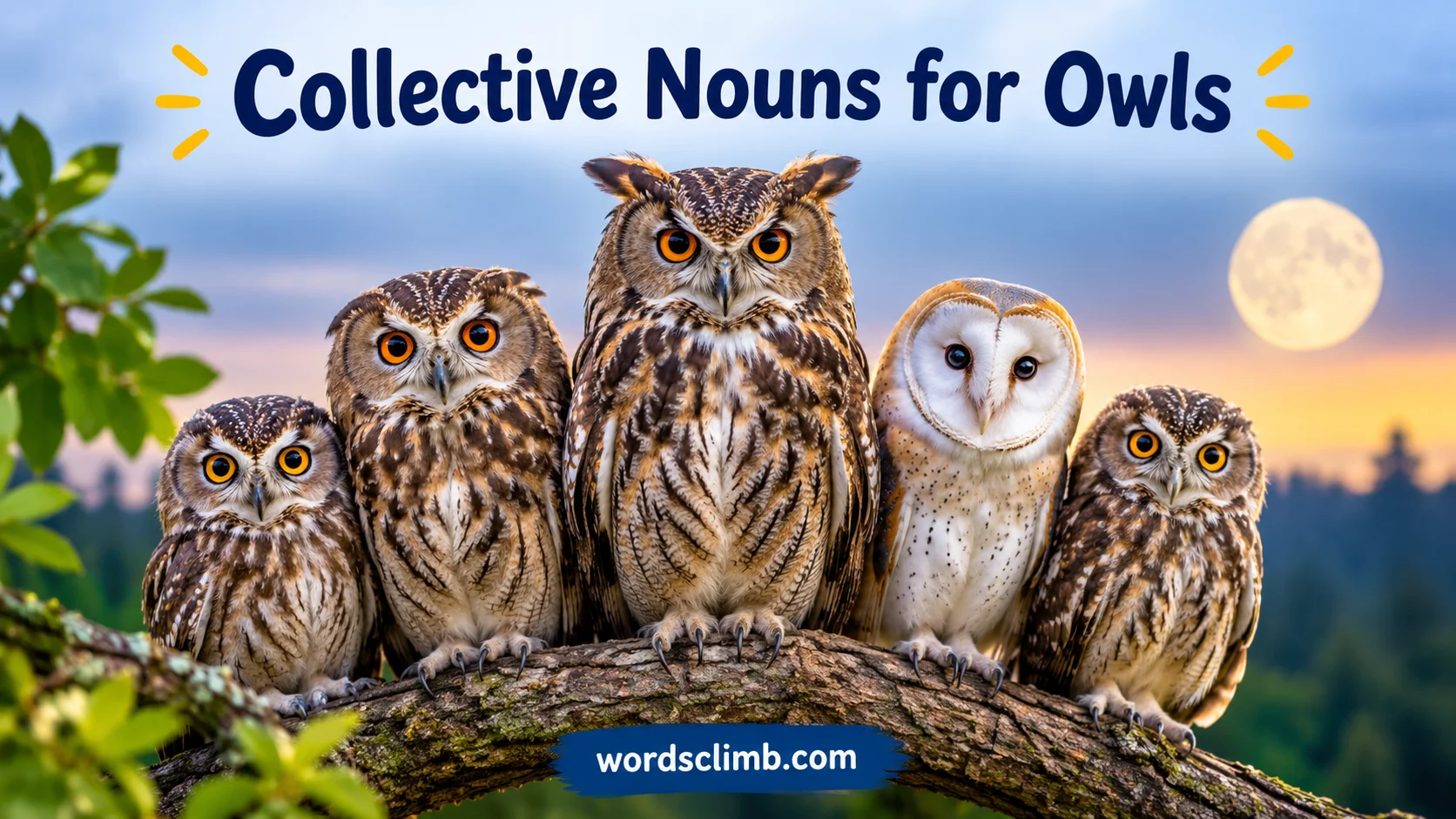
When you see several owls together, you may wonder what they are called. Collective Nouns for Owls help you describe these mysterious birds clearly while adding variety and interest to your English. Owls are usually solitary and nocturnal, but some gather while resting, hunting, migrating, or sharing a suitable habitat. Learning their group names can make your writing more natural and engaging.
The most famous term for a group of owls is parliament, a memorable expression often linked with their wisdom and intelligent appearance. However, flock can also be used as a general term for birds, including owls. These collective nouns have an interesting history, with some traditional animal and bird terms connected to medieval hunting lists and later English usage. Understanding these terms gives you a better look at both language and owl behavior.
Collective Nouns for Owls
Here are some terms used to describe a group of owls:
| Type | Simple Example |
| Parliament | A parliament of owls |
| Stare | A stare of owls |
| Wisdom | A wisdom of owls |
| Bazaar | A bazaar of owls |
| Hoot | A hoot of owls |
Among these terms, parliament of owls is by far the best-known expression. Some other terms appear in lists of traditional or creative collective nouns and may be much less common in everyday English.
1. A Parliament of Owls
Parliament is the most famous collective noun associated with owls. The expression creates an amusing image of several owls sitting together as though they were members of a serious meeting. It is especially popular in writing, educational material, and descriptions of wildlife.
Examples:
- A parliament of owls rested quietly in the old trees.
- We spotted a parliament of owls near the forest.
- A large parliament of owls gathered at dusk.
- The photographer captured a beautiful parliament of owls.
- A parliament of owls watched from the branches.
- The children were excited to see a parliament of owls.
- A parliament of owls roosted near the woodland.
- The ranger told us about a parliament of owls living nearby.
- At sunset, a parliament of owls became active.
- We quietly observed a parliament of owls in the forest.
2. A Stare of Owls
Stare is a descriptive collective noun that refers to the intense appearance of several owls watching their surroundings. Because owls have large forward-facing eyes and excellent vision, the word fits their striking appearance.
Examples:
- A stare of owls watched us from the branches.
- We noticed a stare of owls in the quiet forest.
- A stare of owls looked down from the trees.
- The guide pointed toward a stare of owls.
- A stare of owls remained silent throughout the evening.
- The photographer found a stare of owls near the woodland.
- A stare of owls observed the activity below.
- We saw a stare of owls at sunset.
- A stare of owls made the forest seem mysterious.
- The children were fascinated by the stare of owls.
3. A Wisdom of Owls
Wisdom is a creative collective noun connected with the long-standing cultural image of owls as wise and intelligent creatures. Owls have often appeared as symbols of knowledge, wisdom, and observation in stories and traditions.
Examples:
- A wisdom of owls rested in the trees.
- We watched a wisdom of owls at dusk.
- A wisdom of owls lived near the forest.
- The story described a wisdom of owls.
- A wisdom of owls watched silently from above.
- The children imagined a wisdom of owls holding a meeting.
- We discovered a wisdom of owls in the woodland.
- A wisdom of owls appeared as night began.
- The painting showed a wisdom of owls among the trees.
- A wisdom of owls added a magical feeling to the story.
4. A Bazaar of Owls
Bazaar is another uncommon and playful collective noun sometimes associated with owls. It gives a colorful image of several owls gathered together. This term is much less familiar than parliament and is generally more useful in creative or educational writing.
Examples:
- A bazaar of owls gathered in the woodland.
- We saw a bazaar of owls near the old barn.
- A bazaar of owls rested in the trees.
- The photographer found a bazaar of owls at dusk.
- A bazaar of owls filled the branches.
- The children enjoyed watching a bazaar of owls.
- A bazaar of owls appeared after sunset.
- The forest guide described a bazaar of owls.
- A bazaar of owls watched from the tall trees.
- We quietly observed a bazaar of owls in the distance.
5. A Hoot of Owls
Hoot is a natural-sounding term inspired by one of the most recognizable sounds associated with owls. Not every owl species hoots, but the word works well as a creative way to describe a group.
Examples:
- A hoot of owls called from the forest.
- We heard a hoot of owls after sunset.
- A hoot of owls filled the quiet woodland.
- The campers listened to a hoot of owls nearby.
- A hoot of owls became active during the night.
- We followed the sound of a hoot of owls.
- A hoot of owls could be heard from the trees.
- The guide pointed toward a hoot of owls.
- A hoot of owls echoed through the forest.
- We stopped walking when we heard a hoot of owls.
Read More: Collective Nouns for Swans
Interesting Facts About Owls
Owls are remarkable birds with adaptations that make them highly effective nighttime predators. Many owl species can live for many years, particularly when they survive their early stages of life and avoid predators, disease, and human-related threats. Some larger owl species can reach impressive ages in the wild, while individuals in protected environments may live even longer.
Their bodies are specially designed for hunting. Owls have exceptionally large eyes that help them gather light in low-light conditions, while their forward-facing eyes provide excellent depth perception. Unlike humans, many owls cannot move their eyeballs freely, so they compensate by rotating their heads dramatically. Their flexible necks allow some owls to turn their heads by roughly 270 degrees. Their specialized feathers also help them fly quietly, allowing them to approach prey with surprisingly little sound.
Owls have diverse diets depending on their species and habitat. Many eat mice, rats, voles, insects, small birds, reptiles, amphibians, and other small animals. Their sharp talons help them capture prey, while their hooked beaks allow them to tear food apart. Owls also produce pellets, compact masses containing indigestible materials such as fur, feathers, bones, and other parts of their meals. Scientists can examine these pellets to learn what owls have been eating.
FAQs:
1. What is a group of owls called?
A group of owls is commonly called a parliament. The term is a traditional and memorable collective noun associated with owls.
2. Why is a group of owls called a parliament?
The word parliament is traditionally associated with owls, possibly because these birds have long been connected with wisdom, intelligence, and careful observation.
3. Can you call a group of owls a flock?
Yes. Flock is a general collective noun for birds and can be used for owls. However, parliament is the more distinctive traditional term.
4. Are owls usually found in groups?
Most owls are solitary birds, especially when hunting. However, some may gather while roosting, migrating, or living in areas with suitable food and shelter.
5. What is the most famous collective noun for owls?
Parliament is the best-known collective noun for owls. It is widely recognized in English and is often used when discussing traditional animal group names.
6. Do all owl species live alone?
No. Although many owl species prefer a solitary lifestyle, their social behavior varies. Some may tolerate or form groups under certain environmental conditions.
7. Is “parliament of owls” a modern term?
No. The expression comes from traditional English collective-noun traditions. Many unusual animal group names became popular through historical lists and later writing.
8. Why are collective nouns used for animals?
Collective nouns make it easier and more interesting to describe groups of animals. They can also reflect traditional language, behavior, appearance, or cultural associations.
9. Is “congregation” a collective noun for owls?
Congregation has sometimes appeared in lists of collective nouns for owls, but parliament is much more widely recognized. In everyday English, flock is also a practical choice.
10. What should I use in everyday writing for a group of owls?
For a distinctive traditional expression, use a parliament of owls. If you want a simple and general term, a flock of owls also works naturally.
Conclusion:
Learning the collective nouns for owls adds variety to your vocabulary and gives you a more interesting way to describe these fascinating birds. Parliament is the most famous traditional term, while flock works as a general bird-group noun. Although owls are often solitary and nocturnal, some gather for roosting, migration, or other shared activities. Understanding these expressions also shows how language, history, and animal behavior can come together in everyday English.

Adam West is an English-language writer with a passion for storytelling, culture, and everyday life. His writing focuses on clear ideas, engaging narratives, and thoughtful perspectives that are easy for readers to connect with.
1 thought on “Collective Nouns for Owls”