
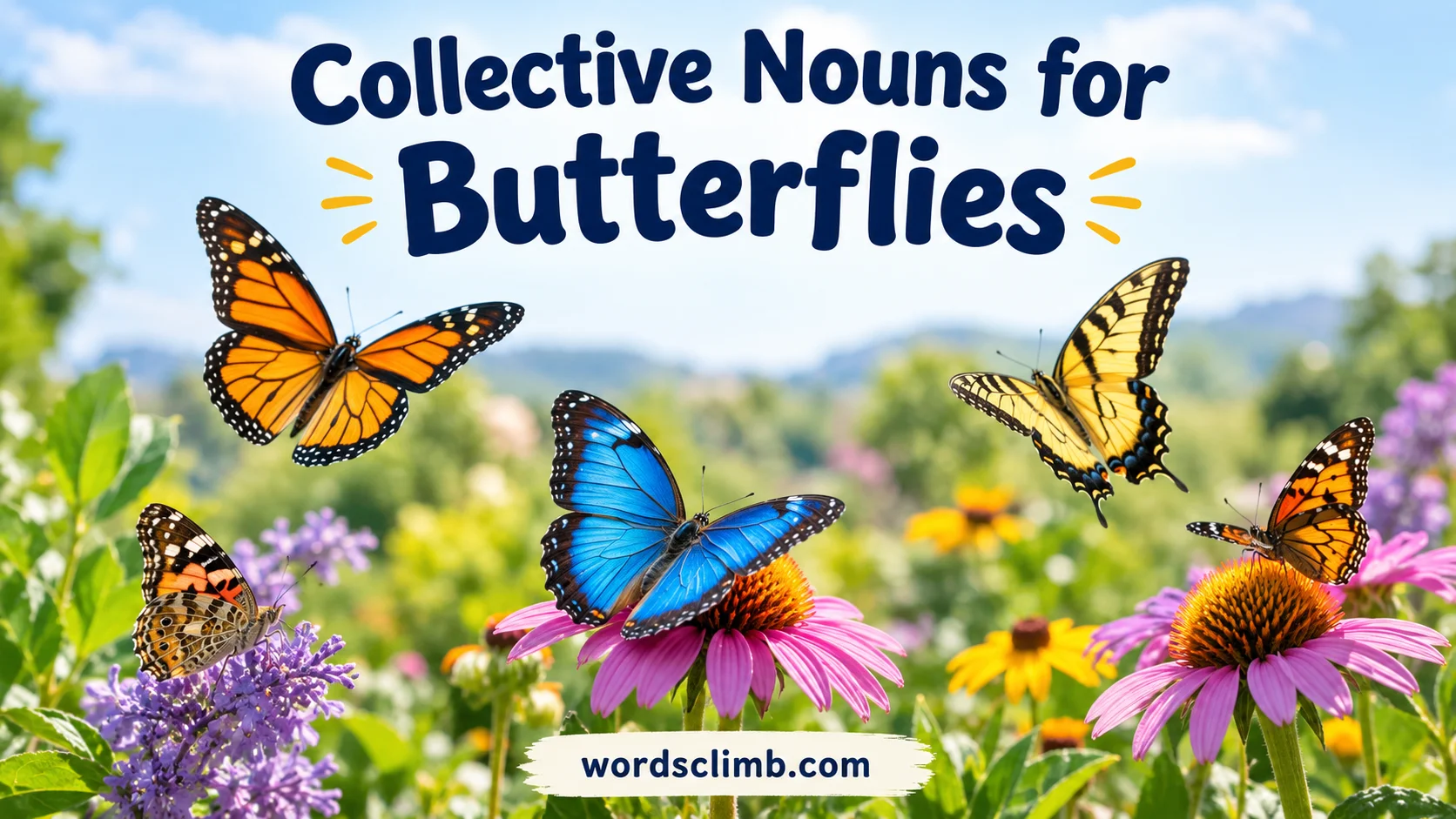
Collective Nouns for Butterflies include beautiful terms like kaleidoscope, swarm, and rabble. These names describe groups of butterflies when they gather together. Although most butterfly species are solitary, some come together during feeding, resting, or migration. The word kaleidoscope is especially fitting because it reflects the colorful patterns and graceful movements seen when butterflies gather.
There are nearly 20,000 butterfly species worldwide, with about 750 species found in the United States. Most butterflies live and migrate alone, but monarch butterflies gather along migration routes. At night, monarchs may form a roost in tree clusters. This behavior may help them stay safer from predators, especially when cool temperatures make them less active and more vulnerable.
Collective Nouns for Butterflies: A Quick Overview
| Type | Simple Example |
| Kaleidoscope | A kaleidoscope of butterflies flew over the garden. |
| Swarm | A swarm of butterflies gathered near the flowers. |
| Rabble | A rabble of butterflies moved across the meadow. |
| Flight | A flight of butterflies crossed the field. |
| Flutter | A flutter of butterflies rose from the plants. |
The word kaleidoscope is especially popular because a group of colorful butterflies can look like the changing patterns of a kaleidoscope. Swarm is a more general term for a large gathering, while flight emphasizes butterflies moving through the air.
A Kaleidoscope of Butterflies
Kaleidoscope is the best-known and most colorful collective noun associated with butterflies. It describes a group of butterflies, especially when many different colors and patterns can be seen together. The word is particularly fitting because butterflies can create a constantly changing display as they fly, land, and move their wings.
Examples of a Kaleidoscope of Butterflies
- A kaleidoscope of butterflies flew around the garden.
- We watched a kaleidoscope of butterflies near the flowers.
- A kaleidoscope of butterflies covered the sunny meadow.
- The children saw a kaleidoscope of butterflies in the park.
- A kaleidoscope of butterflies appeared beside the stream.
- The gardener noticed a kaleidoscope of butterflies among the plants.
- A kaleidoscope of butterflies moved from flower to flower.
- We photographed a kaleidoscope of butterflies in the garden.
- A kaleidoscope of butterflies filled the warm field.
- The colorful kaleidoscope of butterflies disappeared into the trees.
A Swarm of Butterflies
Swarm is a general collective noun that can describe a large number of flying insects moving or gathering together. Although butterflies are often described more poetically as a “kaleidoscope,” swarm of butterflies can be used when emphasizing a large gathering or mass movement.
Butterflies may gather in particular places because of food, sunlight, moisture, shelter, or seasonal movement. The word “swarm” focuses more on the size and movement of the group than on its colorful appearance.
Examples of a Swarm of Butterflies
- A swarm of butterflies gathered around the flowers.
- We saw a swarm of butterflies near the forest.
- A swarm of butterflies flew across the garden.
- The warm weather brought a swarm of butterflies outside.
- A swarm of butterflies settled on the plants.
- The children watched a swarm of butterflies above the meadow.
- A swarm of butterflies moved toward the sunny field.
- The photographer followed a swarm of butterflies through the garden.
- A swarm of butterflies appeared after the rain.
- The flowers attracted a swarm of butterflies.
A Rabble of Butterflies
Rabble is another traditional collective noun sometimes associated with butterflies. The word generally refers to a disorderly or loosely organized group. When used for butterflies, it can describe a group that seems to move in different directions rather than following a neat formation.
Unlike “kaleidoscope,” rabble does not focus on beauty or color. Instead, it highlights the lively, scattered movement of several butterflies.
Examples of a Rabble of Butterflies
- A rabble of butterflies danced above the meadow.
- We noticed a rabble of butterflies near the bushes.
- A rabble of butterflies flew in different directions.
- The field was filled with a rabble of butterflies.
- A rabble of butterflies moved among the wildflowers.
- A breeze disturbed the rabble of butterflies.
- A rabble of butterflies rose from the grass.
- The children followed a rabble of butterflies across the field.
- A rabble of butterflies gathered around the colorful flowers.
- The sunlight made the rabble of butterflies easy to see.
A Flight of Butterflies
Flight is a natural descriptive expression for butterflies when they are moving through the air. It emphasizes their flying behavior rather than simply referring to them as a stationary group.
A flight of butterflies can be particularly useful in nature writing because it creates an image of butterflies traveling together or appearing in the air at the same time. It is also easy for learners to understand because “flight” directly connects with the action of flying.
Examples of a Flight of Butterflies
- A flight of butterflies crossed the garden.
- We watched a flight of butterflies over the meadow.
- A flight of butterflies rose from the flowers.
- The wind carried a flight of butterflies toward the trees.
- A flight of butterflies passed over the path.
- The children pointed at a flight of butterflies in the sky.
- A flight of butterflies moved across the sunny field.
- We followed a flight of butterflies along the trail.
- A flight of butterflies appeared above the plants.
- The photographer captured a flight of butterflies in motion.
A Flutter of Butterflies
Flutter is a descriptive collective expression that focuses on the characteristic movement of butterfly wings. The word “flutter” means to move lightly and quickly, which makes it a natural way to describe several butterflies moving their wings together.
This expression is especially useful in creative or descriptive writing. While “kaleidoscope” is the more familiar collective noun, flutter creates a strong picture of delicate wings moving through the air.
Examples of a Flutter of Butterflies
- A flutter of butterflies appeared near the garden.
- We watched a flutter of butterflies among the flowers.
- A flutter of butterflies rose from the grass.
- The children enjoyed seeing a flutter of butterflies.
- A flutter of butterflies moved through the meadow.
- The garden became lively with a flutter of butterflies.
- A flutter of butterflies passed beside the trees.
- A flutter of butterflies surrounded the flowering plants.
- The photographer captured a flutter of butterflies in the sunlight.
- A flutter of butterflies disappeared into the bushes.
Read More: Collective Nouns for Balloons
Interesting Facts About Butterflies
Butterflies are among the most fascinating insects because their lives, bodies, and feeding habits are remarkably specialized. Their lifespan varies greatly by species and life stage. Some adult butterflies live for only a few days or weeks, while certain species can survive for several months, and some monarch butterflies that migrate can live much longer than typical summer generations. Their bodies have three main parts—head, thorax, and abdomen—along with six legs and four wings covered in tiny scales. These microscopic scales give butterfly wings their extraordinary colors and patterns. Butterflies also have a long, tube-like proboscis, which they use to drink liquid food such as flower nectar. Some species obtain nutrients from tree sap, rotting fruit, minerals in damp soil, or animal waste. Caterpillars have very different diets and usually eat plant leaves, meaning butterflies and their young often play different roles in an ecosystem.
FAQs:
1. What is a group of butterflies called?
A group of butterflies can be called a kaleidoscope, swarm, or rabble. The term kaleidoscope is especially popular because it describes the colorful appearance of many butterflies together.
2. What is the most common collective noun for butterflies?
Kaleidoscope is one of the best-known collective nouns for butterflies. It beautifully reflects their colors, patterns, and movement when they gather.
3. Are butterflies usually found in groups?
Most butterflies are solitary and spend much of their lives alone. However, some species gather for feeding, resting, migration, or shelter.
4. What is a group of monarch butterflies called?
A group of monarch butterflies may be described as a kaleidoscope or roost, depending on the situation. During the night, monarchs often gather together in sheltered tree clusters.
5. Why do monarch butterflies form roosts?
Monarchs may form roosts when temperatures become cool. Staying together can provide greater protection from predators and harsh conditions.
6. How many butterfly species are there in the world?
There are nearly 20,000 butterfly species around the world. Their wide variety makes butterflies one of the most fascinating groups of insects.
7. How many butterfly species live in the United States?
About 750 butterfly species are found in the United States. These species live in different habitats and have unique behaviors.
8. Do butterflies migrate together?
Most butterflies migrate alone, but some species, especially monarch butterflies, gather during migration. Their seasonal journeys can involve large numbers of individuals.
9. What does the word kaleidoscope mean for butterflies?
For butterflies, kaleidoscope describes a gathering that looks colorful and constantly changing, much like the patterns seen through a traditional kaleidoscope.
10. What are other collective nouns for butterflies?
Besides kaleidoscope, other terms include swarm, rabble, and roost. The most suitable term depends on how and where the butterflies are gathered.
Conclusion:
Butterflies may often live independently, but their gatherings have inspired some of the most beautiful collective nouns in the English language. Terms such as kaleidoscope, swarm, rabble, and roost describe different ways butterflies come together. Among these, kaleidoscope stands out for its vivid connection to their colorful wings and graceful movement. Learning these names not only improves your vocabulary but also gives you a deeper appreciation for the fascinating behavior of butterflies.

Adam West is an English-language writer with a passion for storytelling, culture, and everyday life. His writing focuses on clear ideas, engaging narratives, and thoughtful perspectives that are easy for readers to connect with.
1 thought on “Collective Nouns for Butterflies”