
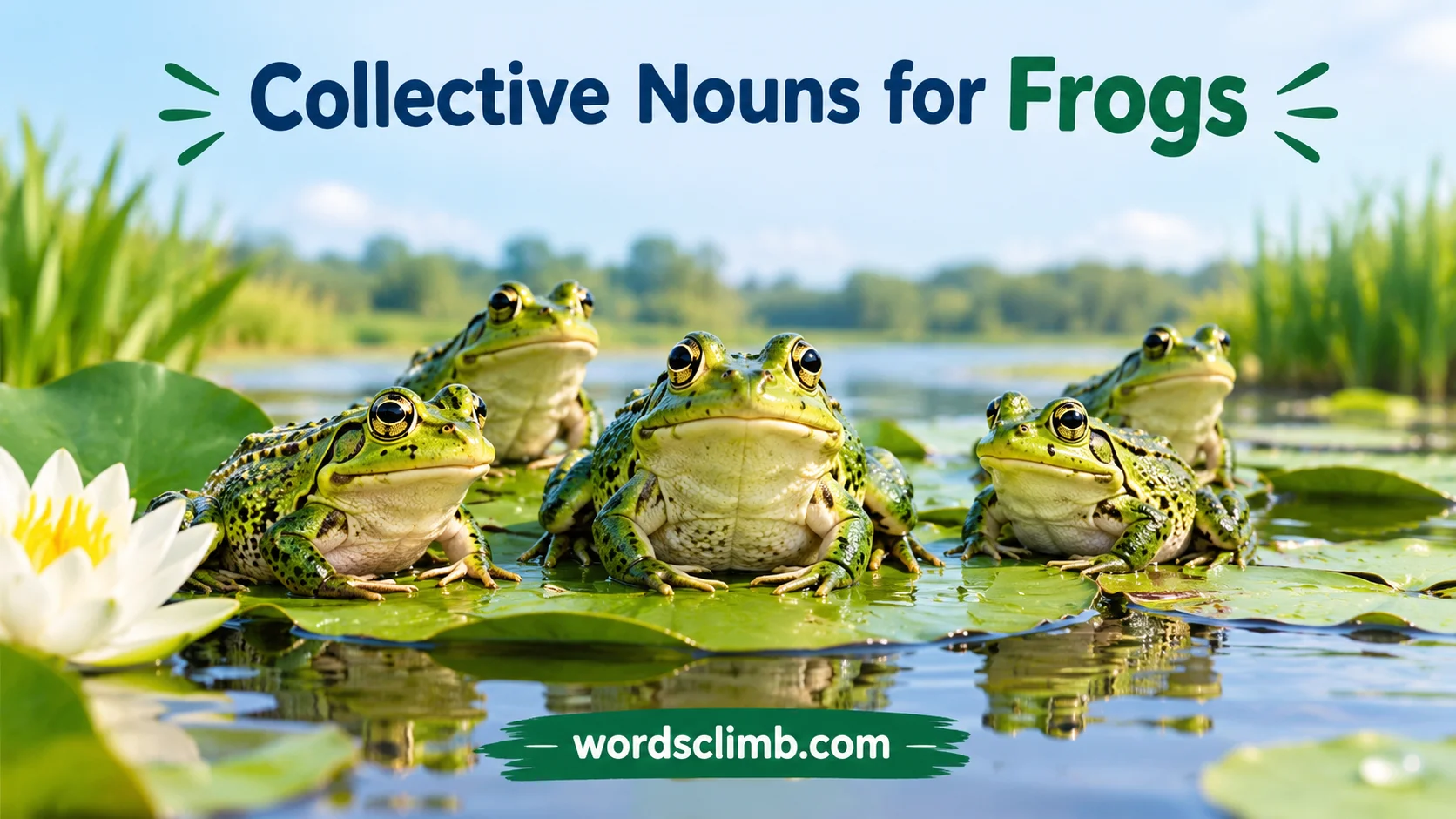
Collective Nouns for Frogs are special words used to describe a group of frogs gathered together. Learning these interesting terms can make your English vocabulary stronger and your writing more natural. Frogs are fascinating amphibians that live in ponds, rivers, forests, wetlands, and other moist environments. For students, teachers, writers, and wildlife enthusiasts, discovering these collective nouns adds an enjoyable way to learn about language and nature while understanding how frogs behave and gather in groups.
In English, animal groups often have unique names, such as a flock of birds or a pride of lions. Frogs are no different, and a group of frogs is commonly known as a knot. Other terms may also appear in different references, making these names especially interesting to explore. Understanding animal collective nouns not only improves everyday communication but also makes lessons about wildlife, animal behavior, and vocabulary more engaging, memorable, and useful for learners.
Collective Nouns for Frogs
Here are some terms that can be used to describe a group of frogs:
| Type | Simple Example |
| Army | An army of frogs gathered near the pond. |
| Colony | A colony of frogs lived around the wetland. |
| Knot | A knot of frogs rested beside the stream. |
| Group | A group of frogs jumped into the water. |
| Crowd | A crowd of frogs gathered after the rain. |
An Army of Frogs
“Army” is a colorful collective noun sometimes used for a large group of frogs. It creates a vivid image of many frogs moving or gathering together, particularly when they appear in large numbers after rain.
Example Sentences:
- An army of frogs gathered beside the pond.
- We saw an army of frogs near the wet grass.
- An army of frogs jumped into the water.
- The children watched an army of frogs crossing the path.
- An army of frogs appeared after the heavy rain.
- The pond attracted an army of frogs at night.
- An army of frogs filled the garden with croaking sounds.
- We noticed an army of frogs hiding among the plants.
- An army of frogs moved toward the shallow water.
- The wetland became home to an army of frogs.
A Colony of Frogs
A colony of frogs can describe frogs living together in the same general area or habitat. This term works especially well when discussing frogs that occupy a pond, wetland, marsh, or other suitable environment.
Example Sentences:
- A colony of frogs lived near the pond.
- We discovered a colony of frogs in the wetland.
- The colony of frogs became active after sunset.
- A colony of frogs gathered among the reeds.
- The pond provided shelter for a colony of frogs.
- Scientists observed a colony of frogs near the stream.
- A colony of frogs shared the damp habitat.
- The colony of frogs became noisy during the rainy season.
- We heard a colony of frogs calling from the marsh.
- The garden pond attracted a small colony of frogs.
A Knot of Frogs
The word “knot” gives the impression of frogs packed closely together. It can be useful when describing frogs gathered in a tight cluster, particularly around water or damp vegetation.
Example Sentences:
- A knot of frogs gathered beside the pond.
- We found a knot of frogs under the leaves.
- A knot of frogs rested near the stream.
- The rain brought a knot of frogs into the garden.
- A knot of frogs sat on the muddy bank.
- The children spotted a knot of frogs near the reeds.
- A knot of frogs moved through the wet grass.
- We watched a knot of frogs gathering after sunset.
- A knot of frogs hid beneath the plants.
- The photographer captured a knot of frogs beside the water.
A Group of Frogs
“Group” is the simplest and most widely understood expression. It does not describe a particular behavior, but it clearly tells the reader that several frogs are together.
Example Sentences:
- A group of frogs lived near the pond.
- We saw a group of frogs beside the stream.
- A group of frogs jumped into the water.
- The group of frogs became active at night.
- A group of frogs rested on the wet rocks.
- We heard a group of frogs calling from the garden.
- A group of frogs gathered after the rain.
- The children photographed a group of frogs.
- A group of frogs hid among the tall grass.
- The pond attracted a group of frogs.
A Crowd of Frogs
The word “crowd” is a descriptive expression for many frogs gathered closely together. It is especially useful in informal writing when a large number of frogs can be seen in one place.
Example Sentences:
- A crowd of frogs gathered near the pond.
- We saw a crowd of frogs after the rain.
- A crowd of frogs covered the muddy bank.
- The garden attracted a crowd of frogs at night.
- A crowd of frogs jumped into the water.
- We heard a crowd of frogs croaking loudly.
- A crowd of frogs gathered around the wet grass.
- The children watched a crowd of frogs near the stream.
- A crowd of frogs appeared when the weather became damp.
- The pond was surrounded by a crowd of frogs.
Also Read This: Collective Nouns for Bananas
Interesting Facts About Frogs
Frogs have fascinating bodies and lifestyles that make them unique among amphibians. Their longevity varies greatly by species: some frogs live only a few years, while certain species can survive for more than a decade under suitable conditions. Their physiology is also unusual because frogs breathe through their lungs and skin, and their moist skin allows gases and water to pass through it. This is one reason clean, damp environments are important for many frog species. Frogs also have powerful hind legs designed for jumping, while some species have specialized toe pads that help them climb smooth surfaces.
Frogs are mainly carnivorous and eat a wide variety of small animals. Their diets can include insects, spiders, worms, snails, and other small prey. Many frogs have long, sticky tongues that can shoot outward quickly to catch food. Larger frog species may even eat small vertebrates. Their feeding habits help control populations of insects and other small animals, making frogs an important part of many ecosystems.
FAQs:
1. What is the collective noun for frogs?
The most commonly mentioned collective noun for frogs is a knot. You can say, “A knot of frogs gathered near the pond.”
2. What is a group of frogs called?
A group of frogs is commonly called a knot. This is an interesting example of an animal collective noun in the English language.
3. Why are frogs called a knot?
The word knot is used as a collective term for frogs because it describes a group gathered closely together. It is one of the traditional terms used for groups of animals.
4. Can I use “knot of frogs” in a sentence?
Yes. For example: “A knot of frogs was sitting beside the quiet pond.” This sentence clearly shows how the collective noun is used.
5. Is “knot” the only collective noun for frogs?
Knot is the most commonly cited term, but different references may list other expressions. The terminology can vary depending on the source and context.
6. Where do groups of frogs usually gather?
Frogs often gather around ponds, wetlands, rivers, forests, and other moist habitats. They may come together for feeding, breeding, shelter, or suitable environmental conditions.
7. Are frogs amphibians?
Yes, frogs are amphibians. They generally spend parts of their lives in or near water and have adaptations that allow them to live in both aquatic and terrestrial environments.
8. Why should students learn collective nouns for frogs?
Learning collective nouns can improve vocabulary, writing, and understanding of English. It also introduces students to interesting connections between language, animals, and nature.
9. What is an example of “knot” used with frogs?
Here is a simple example: “We noticed a knot of frogs near the edge of the pond.” The word knot functions as the collective noun for the group.
10. Are collective nouns for frogs used in everyday English?
Some animal collective nouns, including knot, are less common in everyday conversation. However, they are useful in vocabulary lessons, educational writing, literature, and discussions about animals.
Conclusion:
Learning the collective nouns for frogs is a simple and enjoyable way to expand your English vocabulary. The term knot is commonly used to describe a group of frogs, especially when they gather together near suitable habitats such as ponds and wetlands. Understanding these unique animal collective nouns can make your writing more descriptive while giving you an interesting insight into the relationship between the English language and the natural world.

Ruby Hart is a passionate writer who creates engaging, relatable, and easy-to-understand content. She loves turning everyday ideas into helpful and enjoyable stories for readers.
1 thought on “Collective Nouns for Frogs”