
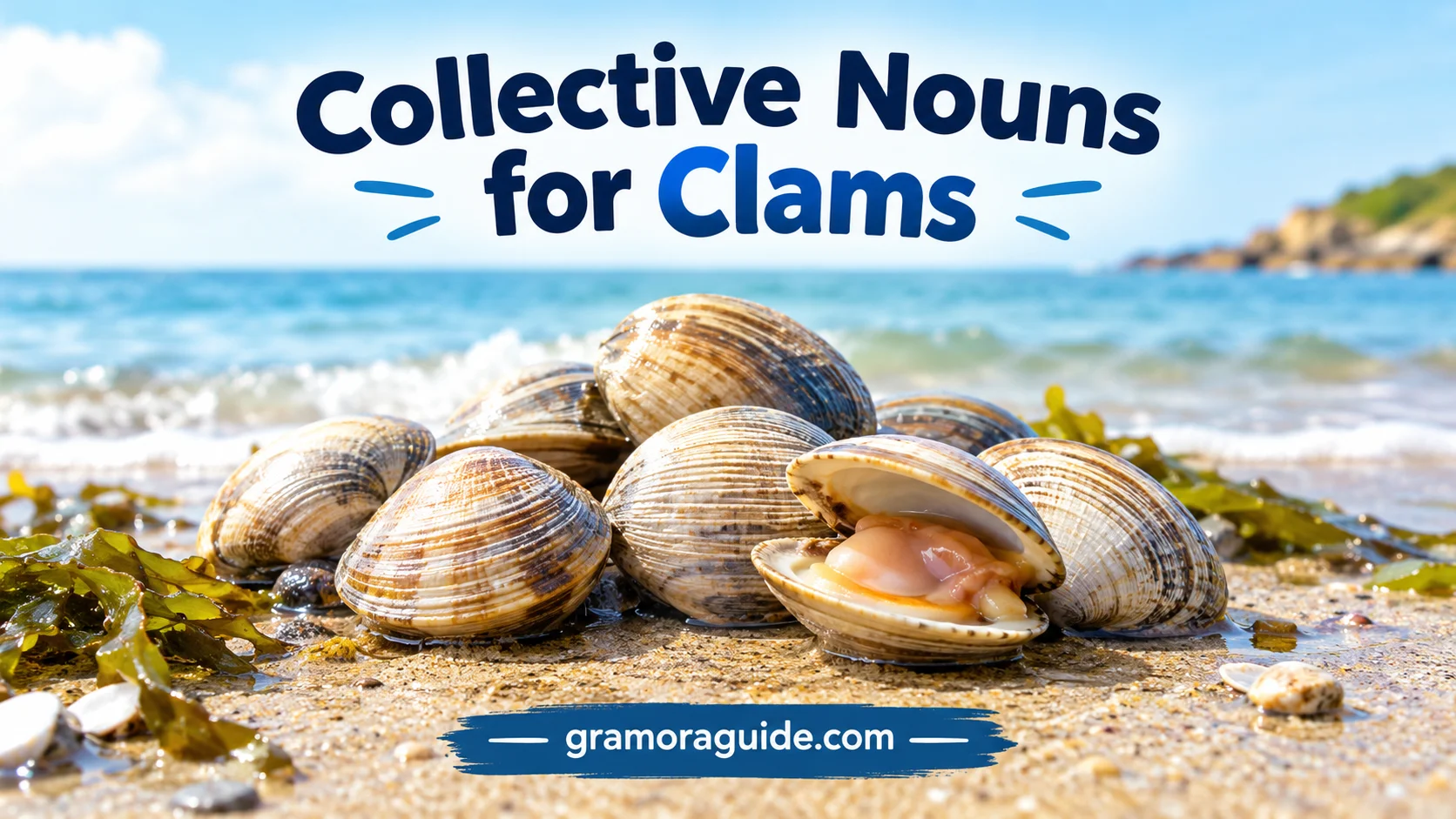
Collective Nouns for Clams help you describe these shellfish when they live together in oceans, rivers, and other aquatic habitats. The term bed of clams is commonly used for clams gathered in one area, making it useful for learning and writing about marine life.
Collective nouns make English more expressive by describing several individuals as one group. In this guide, you’ll discover useful terms like bed, bed of clams, and group of clams, along with simple examples. You’ll also learn about clam habitats, behavior, survival, and shells to improve your vocabulary and understanding of these fascinating shellfish.
What Is the Collective Noun for Clams?
The most useful collective expression for clams is a bed of clams. The word bed describes an area where numerous clams live together, particularly on or within a suitable underwater surface. You may also use a group of clams as a general expression when the exact setting does not matter.
Unlike some animal groups with widely recognized traditional collective nouns, clams do not have one universally established special term that must be used in every situation. The appropriate expression depends on the context.
Common Collective Expressions for Clams
| Type | Simple Example |
| Bed of clams | A bed of clams covered part of the sandy seabed. |
| Group of clams | A group of clams rested beneath the shallow water. |
| Colony of clams | A colony of clams occupied a suitable area of the ocean floor. |
| Cluster of clams | A cluster of clams was attached to the muddy substrate. |
| Collection of clams | The researcher examined a collection of clams in the laboratory. |
| Harvest of clams | The harvest of clams was transported to the processing facility. |
| Pile of clams | A pile of clams sat beside the fishing boat. |
Important distinction: These expressions are not equally specific. Bed of clams is useful when describing clams living in a particular area. Group is a general term, while collection, pile, and harvest describe clams according to how they are gathered or handled. Colony and cluster may be appropriate in particular contexts, but they should not be treated as universally recognized, clam-specific collective nouns.
1. Bed of Clams
A bed of clams is a concentration of clams living in a particular area of the seabed or another suitable aquatic habitat. This is one of the most useful expressions when discussing clams in their natural environment.
Clam beds can occur in sandy, muddy, or other suitable sediments, depending on the species. Some clams bury themselves beneath the surface, leaving only small openings or siphons exposed to the water. Others live in different habitats suited to their particular biology.
The word bed emphasizes the area occupied by the animals rather than simply counting them as a group.
Example Sentences
- A bed of clams stretched across the shallow coastal flats.
- The marine biologist studied a bed of clams during low tide.
- Fishermen discovered a healthy bed of clams near the estuary.
- A bed of clams provided food for several marine animals.
- The research team mapped the location of a bed of clams.
- Rising water covered the bed of clams along the shore.
- The environmental survey examined the condition of the clam bed.
- A bed of clams developed in an area with suitable sediment.
- The students learned how a bed of clams supports coastal ecosystems.
- Careful harvesting helped protect the remaining bed of clams.
When Should You Use This Expression?
Use bed of clams when discussing a natural concentration of clams, clam habitat, marine ecology, or commercial harvesting grounds. The expression is particularly useful in educational writing because it connects the animals with the area in which they live.
2. Group of Clams
A group of clams is a simple, general expression for two or more clams considered together. It is easy to understand and works in almost any situation.
Unlike bed of clams, the word group does not necessarily suggest a natural habitat. You can use it when discussing clams in an aquarium, a market, a research facility, or a container.
Example Sentences
- A group of clams lay beneath the clear water.
- The children observed a group of clams at the aquarium.
- A group of clams was examined for signs of disease.
- The researcher collected a group of clams for identification.
- A group of clams remained buried in the sediment.
- The diver photographed a group of clams on the ocean floor.
- A group of clams was placed in a suitable research tank.
- The students counted each clam in the group.
- A group of clams occupied the sheltered part of the shore.
- The marine survey recorded a group of clams near the inlet.
When Should You Use This Expression?
Choose group of clams when you want a clear, neutral description without implying that the clams form a natural bed or belong to a particular ecological community. It is an excellent choice for everyday conversation and beginner-friendly writing.
3. Colony of Clams
A colony of clams describes a population living in the same area, especially when the writer wants to emphasize the animals’ shared habitat or local population.
The term colony is used for various organisms that occupy a common area. However, clams are not all colonial animals in the biological sense. Many species live individually beneath the sediment even when large numbers occur in the same location.
For this reason, colony of clams is best used descriptively when the context supports it. In many ecological descriptions, clam bed or population of clams may be more precise.
Example Sentences
- A colony of clams occupied the sheltered coastal area.
- The scientist examined the colony of clams for changes in population size.
- A colony of clams lived in the region’s soft sediment.
- The survey recorded the location of a colony of clams.
- Researchers studied the colony of clams to understand local conditions.
- A colony of clams can be affected by changes in water quality.
- The conservation team monitored the colony of clams throughout the season.
- The students discussed how a colony of clams differed from a single clam.
- The environmental report described a colony of clams near the estuary.
- The team investigated whether the colony of clams had declined.
When Should You Use This Expression?
Use colony when describing a local population in an ecological or scientific context, provided the wording accurately reflects the situation. If you simply mean several clams in one place, group or bed will often be clearer.
4. Cluster of Clams
A cluster of clams refers to several clams located close together. The word cluster emphasizes their physical proximity rather than suggesting a formal biological relationship.
This expression can be useful when describing clams found close together in sediment, among rocks, or in a collected sample. However, it does not mean that all clam species naturally attach themselves to one another.
Example Sentences
- A cluster of clams rested in the shallow sediment.
- The diver spotted a cluster of clams near a rocky patch.
- A cluster of clams was visible beneath the clear water.
- The researcher photographed a cluster of clams for the report.
- Several small fish swam past a cluster of clams.
- The student carefully counted the clams in the cluster.
- A cluster of clams appeared in the collected sediment sample.
- The tide exposed a cluster of clams along the shoreline.
- The marine survey identified a cluster of clams in the study area.
- The children drew a cluster of clams for their science project.
When Should You Use This Expression?
Use cluster of clams when the important detail is that the animals are close together. It is especially useful in descriptive writing, observations, and explanations of where clams are located.
5. Collection and Harvest of Clams
The expressions collection of clams and harvest of clams describe clams according to how people gather or manage them.
A collection of clams may refer to specimens gathered for research, shells kept for display, or clams assembled for another purpose. A harvest of clams refers to clams gathered through fishing or aquaculture activities.
Neither expression necessarily describes a natural group of living clams. The difference lies in the context: collection emphasizes gathering or assembling, while harvest emphasizes obtaining a resource.
Example Sentences
- A collection of clams was prepared for the science exhibition.
- The researcher labeled each clam in the collection.
- The museum displayed a collection of clam shells.
- The students examined a collection of clams from different habitats.
- The local fishery recorded its harvest of clams.
- A carefully managed harvest of clams supported the coastal industry.
- The workers inspected the harvested clams before processing them.
- The seafood market received a fresh harvest of clams.
- The laboratory preserved selected clams from the collection for study.
- The fishing community discussed sustainable methods for harvesting clams.
When Should You Use These Expressions?
Use collection of clams for gathered specimens, assembled items, or research material. Use harvest of clams when discussing fishing, aquaculture, seafood production, or the amount of clams collected from a resource.
Also Read This: Collective Nouns for Dogs
Interesting Facts About Clams
Clams belong to the class Bivalvia, a group of mollusks characterized by two shell valves joined by a hinge. Their shells protect their soft bodies, while a muscular foot helps many species move through or burrow into sediment.
1. Clams Live in Different Habitats
Clams occur in marine, brackish, and freshwater environments. Many marine species live in sand or mud, while others occupy different aquatic habitats. Their preferred environments depend on the species, water conditions, sediment, and available food.
2. Many Clams Feed by Filtering Water
Many clams are filter feeders. They draw water into their bodies and use their gills to capture suspended food particles, including microscopic algae and other organic material. This feeding method connects them closely with the water quality and conditions of their habitat.
3. Clams Have Two Shells
A clam’s two shell halves are called valves. A hinge connects them, and strong muscles help close the shell. The shell provides protection from predators and physical disturbances, although its effectiveness varies with the species and circumstances.
4. Some Clams Can Live for Decades
Clam lifespan varies greatly among species. Some live for relatively short periods, while others can survive for decades. Certain long-lived marine bivalves have exceptionally long lifespans, so it would be inaccurate to assign one lifespan to all clams.
5. Clams Play a Role in Aquatic Ecosystems
By filtering water, processing organic material, and serving as prey for other animals, clams contribute to aquatic food webs. Their presence and abundance can also provide useful information about local environmental conditions.
6. Clams Do Not All Live in Large Beds
Although clam beds can contain many individuals, not every clam species forms dense concentrations. Distribution depends on factors such as reproduction, suitable sediment, food availability, water conditions, and interactions with predators.
FAQs:
1. What is the collective noun for clams?
The most useful collective noun for clams is bed. The phrase bed of clams describes a group of clams living together in the same area.
2. What is a group of clams called?
A group of clams is commonly called a bed of clams. You can also use the general phrase group of clams in everyday writing.
3. Is “bed of clams” the correct term?
Yes, bed of clams is a recognized expression, especially when describing clams gathered in their natural habitat. It is a useful term in discussions about marine life.
4. Can I use “group of clams” in a sentence?
Yes, group of clams is grammatically correct and easy to understand. For example: “A group of clams was found beneath the sand near the shore.”
5. Where do clams live together?
Clams live in aquatic environments, including oceans, rivers, and other bodies of water, depending on the species. Many marine clams burrow into sand or mud and may form beds of clams in suitable habitats.
Conclusion:
Learning about collective nouns for clams helps you describe these shellfish clearly and accurately. The expression bed of clams is especially useful when talking about clams living together in a natural habitat, while group of clams works well in general conversation. By understanding these terms and exploring clam habitats, behavior, shells, and survival, you can expand your vocabulary and write more confidently about marine life.

Ruby Hart is a passionate writer who creates engaging, relatable, and easy-to-understand content. She loves turning everyday ideas into helpful and enjoyable stories for readers.