
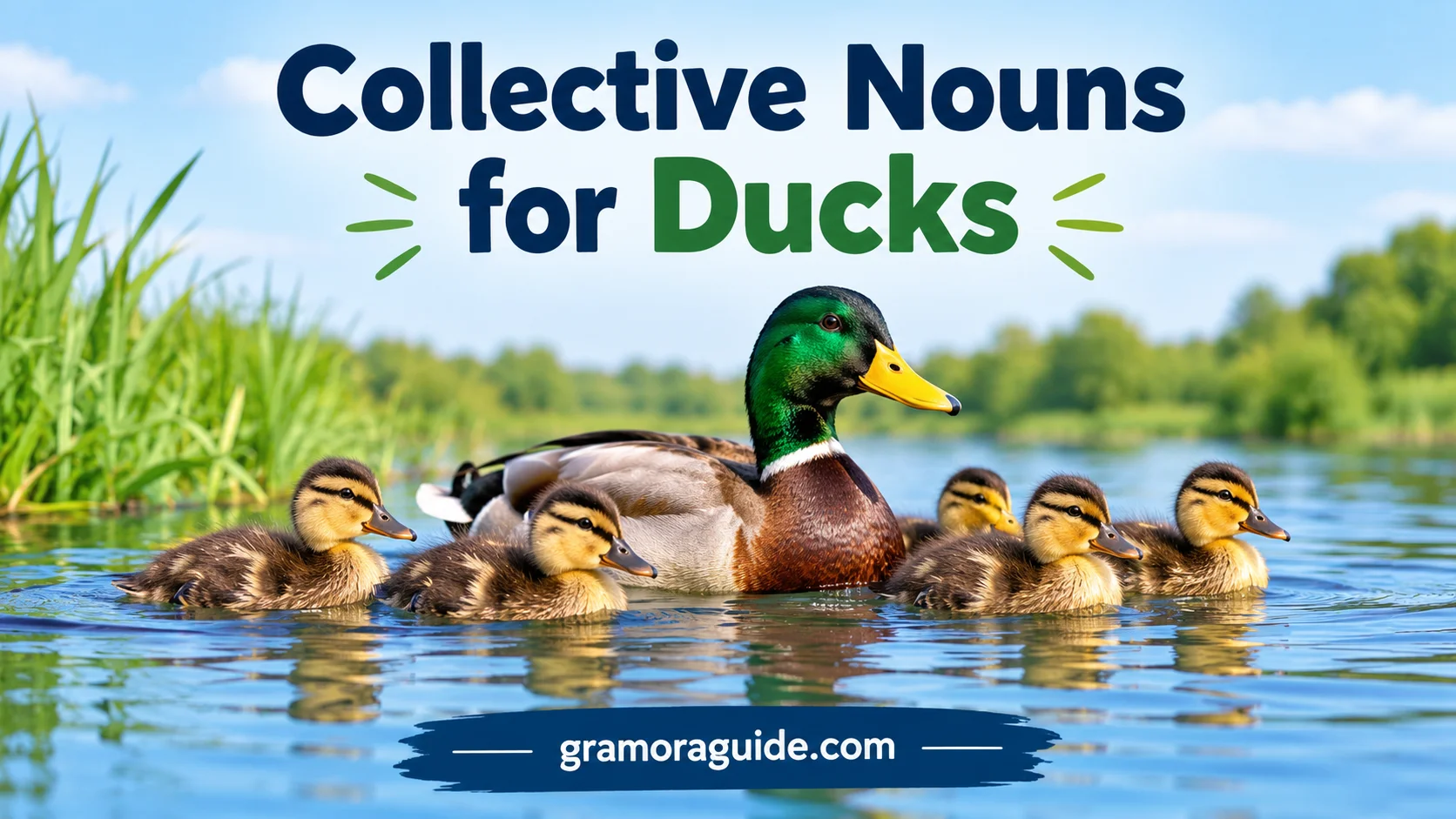
Collective Nouns for Ducks help you describe groups of these social birds in different settings. Common terms include a flock, raft, paddling, and flight, depending on whether ducks are swimming, flying, or gathering on land. Learning these expressions makes your writing more interesting and helps you describe ducks clearly in everyday conversations, school assignments, and nature articles.
Ducks often gather on ponds, lakes, rivers, and wetlands, where they swim, feed, and rest together. You may see ducklings following their mothers or large groups moving across the water. Other collective terms include team, brace, skein, sord, and badling, although their usage varies. Understanding these names helps you choose the right expression for different situations.
Common Collective Nouns for Ducks
Several collective nouns can describe groups of ducks. The best choice depends on whether the birds are swimming, flying, resting, or being discussed in a general sense.
| Type | Simple Example |
| Flock | A flock of ducks gathered near the pond. |
| Raft | A raft of ducks floated across the lake. |
| Paddling | A paddling of ducks moved through the water. |
| Brace | A brace of ducks rested near the riverbank. |
| Team | A team of ducks appeared in the farmer’s field. |
| Bunch | A bunch of ducks gathered beside the fence. |
| Pair | A pair of ducks swam beneath the bridge. |
Note: Flock, raft, and pair are useful, recognizable expressions. Brace is a traditional term associated particularly with two birds in hunting contexts, while team, bunch, and paddling may be used descriptively but are not equally established as standard collective nouns for ducks.
1. A Flock of Ducks
A flock of ducks is one of the most familiar ways to describe several ducks gathered together. It works well in everyday conversation, school assignments, wildlife descriptions, and general writing.
Meaning of a Flock of Ducks
A flock is a group of birds gathered or moving together. Ducks may form flocks while feeding, resting, migrating, or spending time in suitable habitats. The term does not specify a particular number of birds.
Example Sentences
- A flock of ducks swam across the quiet pond.
- We watched a flock of ducks searching for food near the shore.
- A flock of ducks rested beneath the willow trees.
- The children fed the ducks at the edge of the lake.
- A flock of ducks crossed the grassy field after the rain.
- Several ducks in the flock dipped their heads underwater.
- A flock of ducks gathered around the pond’s shallow end.
- The photographer captured a flock of ducks at sunrise.
- A flock of ducks moved toward the reeds as visitors approached.
- The farmer noticed a flock of ducks near the irrigation channel.
When to Use This Term
Use flock of ducks when you want a general expression that readers will immediately understand. It is suitable for both formal and informal writing and does not require the ducks to be swimming or flying.
2. A Raft of Ducks
A raft of ducks describes ducks gathered together on the water. It is particularly useful when you want to emphasize how the birds float close to one another on a pond, lake, or other body of water.
Meaning of a Raft of Ducks
In this expression, raft refers to a group of waterbirds floating together. It is especially associated with ducks gathered on the water’s surface rather than birds moving through the air or resting on land.
Example Sentences
- A raft of ducks floated near the middle of the lake.
- The children counted a raft of ducks from the wooden pier.
- A raft of ducks gathered where the water was calm.
- We spotted a raft of ducks beside the reeds.
- A raft of ducks drifted slowly toward the opposite bank.
- The morning sunlight illuminated a raft of ducks on the pond.
- A raft of ducks rested together after feeding.
- The fisherman noticed a raft of ducks near the boat.
- A raft of ducks moved away from the noisy shoreline.
- The nature guide pointed out a raft of ducks during the lake tour.
When to Use This Term
Choose raft of ducks when describing birds floating together on water. It gives readers a clearer picture than the general term flock when the aquatic setting matters.
3. A Paddling of Ducks
A paddling of ducks is an expressive phrase that suggests ducks moving through water with their webbed feet. It can make descriptions of ponds, streams, and wetlands feel lively.
Meaning of a Paddling of Ducks
The word paddling describes the action of moving through water using feet or paddles. When applied to a group of ducks, it emphasizes their movement rather than a universally established biological group category. It is best treated as a descriptive expression rather than the standard term in every context.
Example Sentences
- A paddling of ducks moved through the shallow stream.
- The children watched the ducks paddling near the bank.
- A paddling of ducks followed their mother across the pond.
- The water rippled as the ducks moved toward the reeds.
- A paddling of ducks crossed the small garden pool.
- We photographed the ducks as they paddled beneath the bridge.
- A paddling of ducks explored the sheltered corner of the lake.
- The little ducks stayed close together in the water.
- A paddling of ducks approached the shore in search of food.
- The peaceful scene showed ducks paddling beneath the morning sun.
When to Use This Term
Use paddling of ducks for a lively description of ducks moving through water. In factual writing, a group of ducks or a flock of ducks may be clearer if you do not need to emphasize their movement.
4. A Brace of Ducks
A brace of ducks is a traditional expression associated with two birds, particularly in hunting terminology. It is less common in everyday descriptions of ducks swimming together.
Meaning of a Brace of Ducks
The word brace can refer to a pair of animals or birds. In traditional sporting language, it is used for two birds of certain kinds, including ducks. Unlike flock, which can refer to a larger group, brace emphasizes the number two.
Example Sentences
- A brace of ducks appeared near the edge of the marsh.
- The old wildlife book mentioned a brace of ducks.
- A brace of ducks rested beside the quiet stream.
- The illustration showed a brace of ducks near the reeds.
- A brace of ducks swam across the narrow channel.
- The naturalist described a brace of ducks in his notes.
- A brace of ducks stood together near the pond.
- The traditional text used the phrase brace of ducks.
- A brace of ducks moved into the shade beside the water.
- The guide explained how the word brace refers to a pair in traditional usage.
When to Use This Term
Use brace of ducks when discussing two ducks in traditional or sporting contexts. For ordinary modern writing, a pair of ducks is often more straightforward.
5. A Team of Ducks
A team of ducks can describe ducks working or moving together in a particular situation, but it is not among the most widely established collective nouns for wild ducks.
Meaning of a Team of Ducks
The word team usually refers to people or animals cooperating toward a shared purpose. Applied to ducks, it can be a playful or descriptive choice, especially in stories, children’s writing, or informal descriptions. Ducks swimming together do not necessarily form a team in the usual human sense.
Example Sentences
- A team of ducks waddled across the farmyard in the story.
- The children drew a team of ducks for their classroom project.
- A team of cartoon ducks raced across the page.
- The farmer watched the ducks move toward the feeding area.
- A team of ducks appeared in the children’s picture book.
- The playful illustration showed a team of ducks wearing tiny hats.
- The teacher asked the class to write about a team of ducks.
- A team of ducks featured in the school play.
- The story described a team of ducks exploring a garden.
- The young readers laughed at the adventures of the team of ducks.
When to Use This Term
Use team of ducks in creative or playful contexts. If you are writing a factual article about wild birds, choose flock or raft when those terms fit the situation better.
6. A Bunch of Ducks
A bunch of ducks is an informal expression for several ducks gathered in one place. Although it is easy to understand, it is a general phrase rather than a specialized ornithological term.
Meaning of a Bunch of Ducks
The word bunch commonly describes a collection of things or living creatures. It does not identify a specific duck behavior or habitat. The expression is useful in casual conversation and simple storytelling.
Example Sentences
- A bunch of ducks gathered beside the garden pond.
- We saw a bunch of ducks near the walking trail.
- A bunch of ducks wandered around the grassy bank.
- The children watched a bunch of ducks splashing in the water.
- A bunch of ducks rested near the wooden fence.
- The visitor photographed a bunch of ducks at the park.
- A bunch of ducks followed one another toward the pond.
- The farmer found a bunch of ducks near the barn.
- A bunch of ducks searched the wet grass for food.
- We stopped to watch a bunch of ducks crossing the path.
When to Use This Term
Use bunch of ducks in everyday speech, informal writing, or stories for young readers. In educational and wildlife writing, flock of ducks is usually a more precise choice.
7. A Pair of Ducks
A pair of ducks refers to two ducks. It is a common, clear expression that can describe two birds swimming together, resting near each other, or appearing in the same place.
Meaning of a Pair of Ducks
A pair is simply two individuals considered together. The ducks may be a male and female, two members of the same sex, or two birds that happen to be near one another. The word alone does not prove that they are mates.
Example Sentences
- A pair of ducks swam beneath the stone bridge.
- We spotted a pair of ducks near the riverbank.
- A pair of ducks rested in the shade of a tree.
- The children watched a pair of ducks crossing the pond.
- A pair of ducks searched for food among the reeds.
- A pair of ducks waddled across the garden path.
- The photographer captured a pair of ducks in the morning light.
- A pair of ducks appeared beside the fishing boat.
- A pair of ducks settled near the edge of the wetland.
- We saw a pair of ducks moving through the shallow water.
When to Use This Term
Use pair of ducks whenever you want to refer specifically to two ducks. It is especially useful when the number matters or when you do not want to imply a larger flock.
Read More: Collective Nouns for Curs
Why Do Ducks Gather in Groups?
Ducks gather for several reasons, including feeding, resting, migration, and finding suitable habitats. Their social behavior varies by species, season, age, and environment.
Protection and Awareness
Groups can help ducks notice potential danger. Several birds may react when one detects a disturbance, although gathering together does not make them completely safe from predators.
Feeding Opportunities
Ducks often gather where food is available, such as shallow wetlands, ponds, and areas with aquatic plants or small invertebrates. Different species have different feeding habits, and not every duck group eats the same food.
Migration and Seasonal Movement
Some duck species travel in large groups during seasonal movements. Others gather in smaller groups or remain in suitable habitats throughout the year. The size and behavior of a flock depend on the species and local conditions.
Resting and Social Interaction
Ducks may rest near one another on water or land. Social interactions can include courtship, communication, and the maintenance of distance between individuals. A group may change in size as birds arrive or leave.
Interesting Facts About Ducks
Ducks belong to the bird family Anatidae, which also includes geese and swans. There are many duck species, and their physical features, diets, habitats, and behavior vary considerably.
- Webbed feet: Ducks have webbed feet that help them push against water while swimming.
- Water-resistant feathers: Their feathers are maintained with oil from a preen gland, helping them stay in good condition and providing water resistance.
- Different feeding styles: Some ducks feed by dabbling near the water’s surface, while diving ducks travel underwater to find food.
- Varied diets: Depending on the species, ducks may eat aquatic plants, seeds, insects, small aquatic animals, and other foods.
- Different habitats: Ducks live in a wide range of environments, including freshwater lakes, rivers, marshes, coastal waters, and wetlands.
- Seasonal movement: Many species migrate, but migration patterns and distances differ.
- Ducklings: Young ducks are often seen following their mother, especially soon after hatching.
These characteristics help explain why terms such as flock and raft are useful in descriptions of ducks. The first is a broad term for a group of birds, while the second evokes ducks gathered on the water.
How to Choose the Right Collective Noun for Ducks
The most suitable term depends on the scene you want to describe.
| Situation | Best Expression | Why It Fits |
| Ducks gathered in a general area | Flock of ducks | Widely understood and versatile |
| Ducks floating together | Raft of ducks | Emphasizes birds on the water |
| Two ducks together | Pair of ducks | Specifies exactly two birds |
| Two ducks in traditional sporting language | Brace of ducks | Reflects traditional usage |
| Ducks moving through water | Paddling of ducks | Emphasizes their movement |
| Informal conversation | Bunch of ducks | Casual and easy to understand |
For most school assignments, grammar exercises, and general articles, flock of ducks is the safest all-purpose choice. When the birds are floating together on a lake, raft of ducks is more descriptive. If you mean precisely two birds, use pair of ducks.
FAQs:
1. What is the collective noun for ducks?
The most common collective noun for ducks is a flock. Other terms include a raft, paddling, and flight, depending on how the ducks gather or move.
2. What is a group of ducks swimming in water called?
A group of ducks swimming together is commonly called a raft of ducks. The term describes ducks floating together on ponds, lakes, and rivers.
3. What is a group of ducks flying called?
A group of ducks flying together may be called a flock or a flight. Traditional terms such as skein are also used for certain formations of flying birds.
4. What is a group of baby ducks called?
Baby ducks are called ducklings. A group of ducklings may be described as a brood, especially when they are being cared for by their mother.
5. What are some unusual collective nouns for ducks?
Some less common collective nouns for ducks include sord, badling, and team. These terms appear in traditional English usage, but flock and raft are more widely understood.
Conclusion:
Ducks are social waterbirds that gather in groups to swim, feed, rest, and travel together. The most familiar collective nouns include flock, raft, paddling, and flight, with each term fitting different situations. Learning these expressions can improve your vocabulary and make your writing more descriptive. Whether you spot ducks swimming across a pond or flying over a wetland, choosing the right collective noun helps you describe their behavior clearly and naturally.

Adam West is an English-language writer with a passion for storytelling, culture, and everyday life. His writing focuses on clear ideas, engaging narratives, and thoughtful perspectives that are easy for readers to connect with.
1 thought on “Collective Nouns for Ducks”