
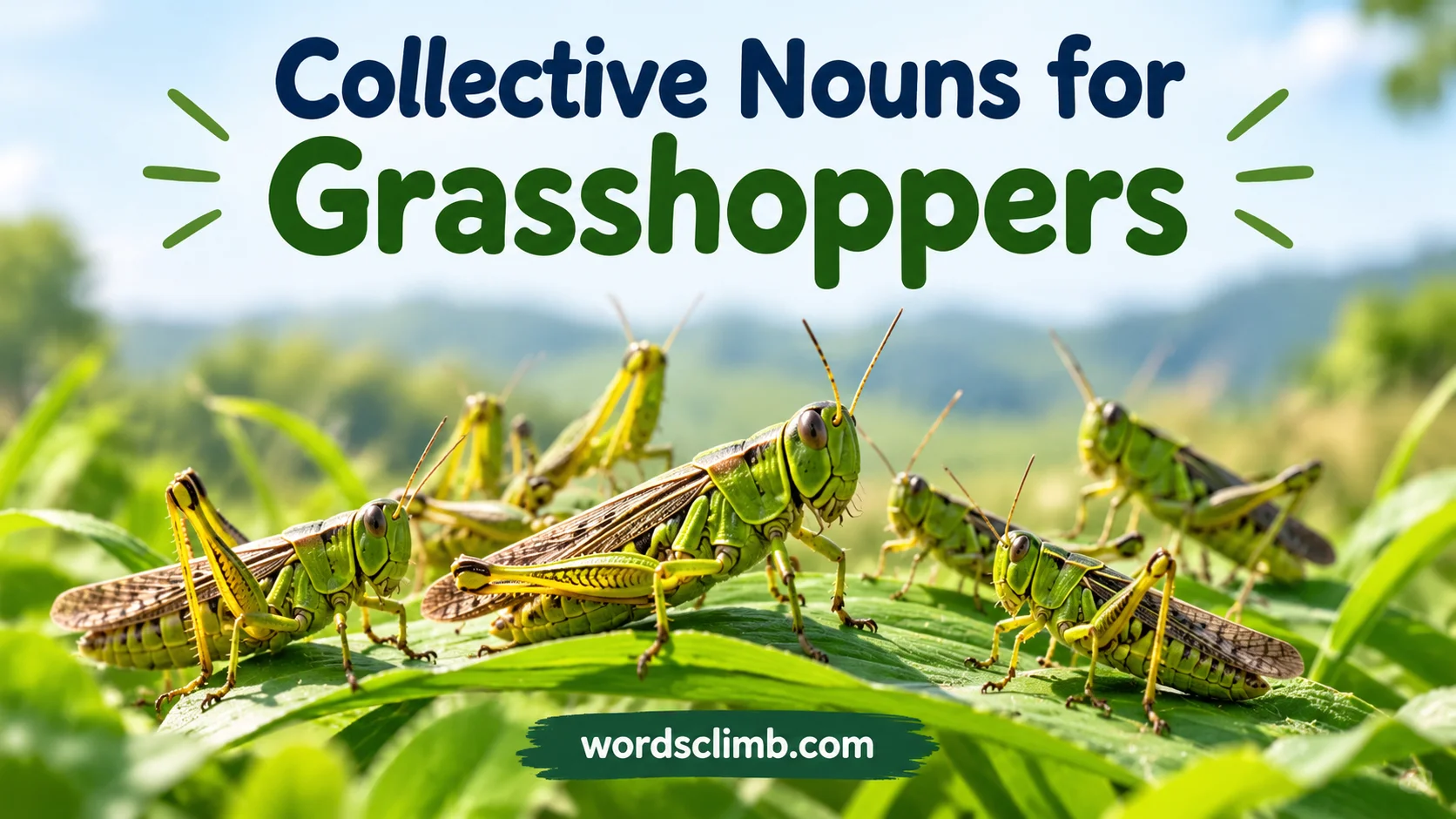
Collective Nouns for Grasshoppers help you describe groups of these lively insects in clear and interesting ways. Common terms include a swarm, cloud, plague, and horde, although the best choice depends on the situation. A collective noun names several people, animals, or things as one unit. When grasshoppers gather across fields or move together in large numbers, these expressions can make your writing more vivid, accurate, and easy to understand in everyday English use.
Many collective nouns for animals sound unusual because they grew from storytelling, observation, or old traditions. Some medieval lists presented special group names as hunting terms, but such expressions were not always widely used. Today, familiar words like flock, herd, and pack are common, while more colorful terms may appear mainly in reference lists. For grasshoppers, swarm is especially useful when describing many insects gathered or moving together across grassland, gardens, crops, or other open spaces.
Collective Nouns for Grasshoppers
Here is a simple overview of some terms used for groups of grasshoppers:
| Type | Simple Example |
| Cloud | A cloud of grasshoppers flew over the field. |
| Swarm | A swarm of grasshoppers moved through the grass. |
| Plague | A plague of grasshoppers damaged the crops. |
| Horde | A horde of grasshoppers covered the plants. |
| Locust swarm | A locust swarm crossed the farmland. |
1. A Cloud of Grasshoppers
A cloud of grasshoppers describes a large number of grasshoppers moving through the air together. The expression creates a clear picture of insects filling the sky, especially when they rise from vegetation in large numbers.
Examples:
- A cloud of grasshoppers rose from the meadow.
- We watched a cloud of grasshoppers cross the field.
- A cloud of grasshoppers covered the sky for a moment.
- The farmer noticed a cloud of grasshoppers above the crops.
- A cloud of grasshoppers flew away when we approached.
- The wind carried a cloud of grasshoppers across the valley.
- A large cloud of grasshoppers appeared over the grassland.
- The children saw a cloud of grasshoppers near the farm.
- A cloud of grasshoppers moved toward the nearby field.
- The cloud of grasshoppers quickly disappeared from view.
2. A Swarm of Grasshoppers
A swarm of grasshoppers refers to many grasshoppers gathered or moving together. Although “swarm” is widely associated with insects such as bees, it can also be used descriptively for large groups of grasshoppers, particularly when they move in great numbers.
Examples:
- A swarm of grasshoppers jumped across the field.
- We saw a swarm of grasshoppers near the crops.
- A swarm of grasshoppers moved through the meadow.
- The farmer noticed a swarm of grasshoppers in the garden.
- A swarm of grasshoppers covered the roadside plants.
- The swarm of grasshoppers scattered when we walked closer.
- A large swarm of grasshoppers appeared after the rain.
- The wind disturbed a swarm of grasshoppers in the grass.
- A swarm of grasshoppers crossed the open field.
- The swarm of grasshoppers disappeared into the tall vegetation.
3. A Plague of Grasshoppers
A plague of grasshoppers is used when an unusually large number of grasshoppers gather and cause serious damage to vegetation or crops. This term is especially appropriate when describing a major agricultural infestation.
Examples:
- A plague of grasshoppers destroyed several crops.
- Farmers worried about a plague of grasshoppers.
- The region experienced a serious plague of grasshoppers.
- A plague of grasshoppers moved across the farmland.
- The crops suffered after a plague of grasshoppers arrived.
- The farmer tried to protect his fields from the plague of grasshoppers.
- A sudden plague of grasshoppers affected the vegetable gardens.
- The dry season contributed to conditions favorable for a plague of grasshoppers.
- The village prepared for a possible plague of grasshoppers.
- The plague of grasshoppers left damaged plants behind.
4. A Horde of Grasshoppers
A horde of grasshoppers is an informal and vivid expression for a very large group. The word “horde” emphasizes the impressive number of insects rather than serving as a strict scientific term.
Examples:
- A horde of grasshoppers covered the meadow.
- We watched a horde of grasshoppers move through the field.
- A horde of grasshoppers jumped from the tall grass.
- The garden was filled with a horde of grasshoppers.
- A horde of grasshoppers gathered around the plants.
- The children saw a horde of grasshoppers near the fence.
- A huge horde of grasshoppers crossed the road.
- The farmer noticed a horde of grasshoppers in the pasture.
- A horde of grasshoppers scattered across the field.
- The horde of grasshoppers disappeared into the vegetation.
5. A Locust Swarm
A locust swarm refers specifically to a large, mobile group of locusts. Locusts are grasshoppers belonging to certain species that can change their behavior and form dense groups under suitable environmental conditions. Because locusts can travel long distances and consume large amounts of vegetation, this term is particularly important in agriculture.
Examples:
- A locust swarm moved across the farmland.
- The farmers watched a locust swarm approach.
- A large locust swarm covered the crops.
- The locust swarm traveled across several fields.
- Farmers worked quickly when the locust swarm arrived.
- A locust swarm filled the sky above the valley.
- The crops were threatened by a huge locust swarm.
- The locust swarm moved toward greener vegetation.
- A passing locust swarm damaged many plants.
- The locust swarm eventually moved away from the farming area.
Also Read This: Collective Nouns for Fish
Interesting Facts About Grasshoppers
Grasshoppers are fascinating insects belonging to the order Orthoptera, and their lives are closely connected to grasslands, meadows, fields, and other areas rich in vegetation. Their lifespan varies by species and environmental conditions, but many adult grasshoppers live for only a few months, with their complete life cycle often lasting less than a year. They have several remarkable physiological features, including powerful hind legs designed for jumping, compound eyes that provide a broad field of vision, and antennae that help them sense their surroundings. Their hearing organs are located on the abdomen, an unusual feature among insects.
Grasshoppers are primarily herbivores, feeding on grasses, leaves, stems, and other plant material. Their strong mouthparts allow them to chew vegetation efficiently. Most grasshoppers live alone or in relatively small groups, but some species of grasshoppers can undergo dramatic behavioral changes when environmental conditions promote crowding. Locusts are the best-known example. Under certain conditions, they can become more social, form large groups, and travel long distances in search of food. This behavior explains why expressions such as swarm, cloud, and plague are especially useful when describing enormous gatherings.
Grasshoppers are also important members of many food webs. Birds, frogs, lizards, spiders, small mammals, and other predators feed on them. By eating vegetation and serving as prey for other animals, grasshoppers play an important role in maintaining ecosystem balance.
FAQs:
1. What is the collective noun for grasshoppers?
A swarm is a common collective noun for grasshoppers. Other terms include cloud, plague, and horde, depending on the context.
2. What is a group of grasshoppers called?
A group of grasshoppers is commonly called a swarm. This term is especially useful when many grasshoppers gather or move together.
3. Is swarm the most common collective noun for grasshoppers?
Yes, swarm is a widely understood term for a large group of grasshoppers, particularly when they move together in search of food.
4. Can a group of grasshoppers be called a cloud?
Yes, cloud can describe a large number of grasshoppers flying together, especially when they appear like a cloud in the sky.
5. Why is a group of grasshoppers called a plague?
The word plague describes a large number of grasshoppers that damage crops and vegetation. It is often used when their presence causes serious agricultural problems.
6. Is horde a collective noun for grasshoppers?
Yes, horde can describe a large group of grasshoppers. It emphasizes their numbers rather than a specific pattern of movement.
7. What is the difference between a swarm and a cloud of grasshoppers?
A swarm generally emphasizes a group of insects moving together, while a cloud highlights their appearance when many fill the air.
8. Do grasshoppers always live in groups?
No, grasshoppers do not always live in groups. Many are solitary, but some species gather in large numbers under suitable environmental conditions.
9. What is the difference between grasshoppers and locusts?
Grasshoppers and locusts belong to the same insect group, but certain grasshopper species can become locusts when environmental and population conditions trigger swarming behavior.
10. How can I use collective nouns for grasshoppers in a sentence?
You can write, “A swarm of grasshoppers moved across the field,” or “A cloud of grasshoppers rose above the grass.”
Conclusion:
Collective nouns make writing more descriptive and engaging. For grasshoppers, words such as swarm, cloud, plague, and horde help describe groups in different situations. A swarm is a particularly useful everyday term, while cloud emphasizes appearance and plague highlights crop damage. Learning these expressions can improve your vocabulary, strengthen your grammar skills, and help you describe insects more clearly in schoolwork, articles, and everyday conversations.

Ruby Hart is a passionate writer who creates engaging, relatable, and easy-to-understand content. She loves turning everyday ideas into helpful and enjoyable stories for readers.
1 thought on “Collective Nouns for Grasshoppers”