
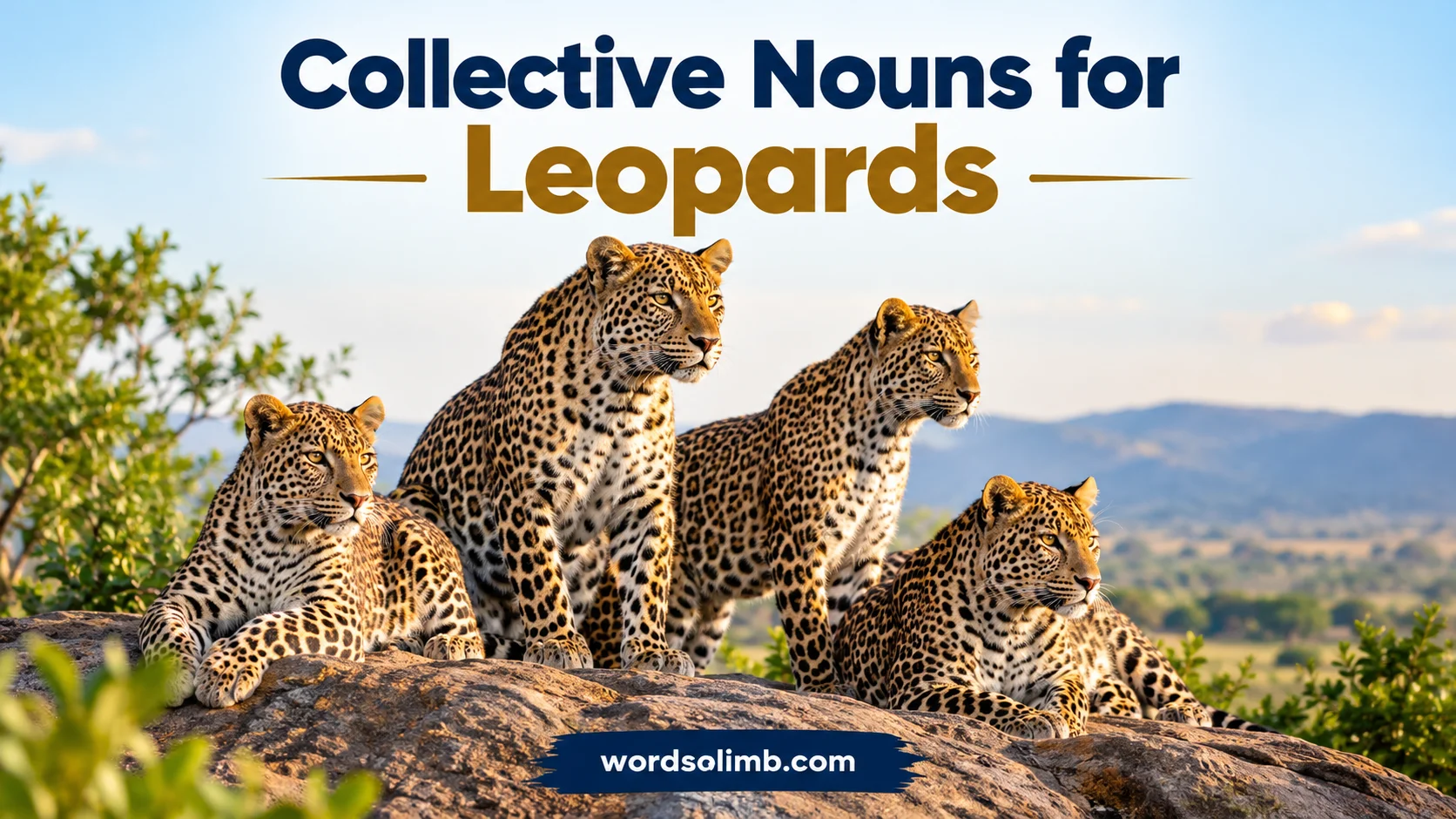
Collective Nouns for Leopards make it easier to describe a group of leopards with vivid and memorable language. The best-known term is a leap of leopards, reflecting their powerful jumping skills and graceful movement. Leopards are stealthy, strong, and mostly solitary, so seeing several together is uncommon. This unusual animal term adds color to everyday English vocabulary and helps students, writers, and animal lovers describe these elusive big cats more precisely in a natural and engaging way for readers today.
The phrase leap of leopards is also an example of a traditional collective noun used for animals. Such expressions are sometimes called terms of venery or nouns of assembly, a naming tradition connected with medieval hunting culture. Many of these terms were created to sound poetic, memorable, or amusing. For leopards, the word leap feels especially fitting because it captures their agility, speed, and ability to move suddenly through their natural surroundings while keeping the meaning clear and to remember.
Collective Nouns for Leopards
Here is a simple table showing some collective nouns that can be used for leopards:
| Type | Simple Example |
| Leap | A leap of leopards |
| Prowl | A prowl of leopards |
| Lepe | A lepe of leopards |
| Lounge | A lounge of leopards |
| Pride | A pride of leopards |
1. A Leap of Leopards
“Leap” is the best-known traditional collective noun associated with leopards. The word is especially fitting because leopards are agile climbers and powerful jumpers. They can move quickly through forests, grasslands, and rocky landscapes.
Examples of “A Leap of Leopards”
- A leap of leopards was spotted near the rocky hills.
- The photographer watched a leap of leopards from a safe distance.
- A leap of leopards moved quietly through the grass.
- The guide told us about a leap of leopards living in the reserve.
- We saw a leap of leopards resting beneath the trees.
- A leap of leopards crossed the dry valley at sunset.
- The documentary showed a leap of leopards hunting in the wild.
- A leap of leopards disappeared into the thick forest.
- The children learned about a leap of leopards in their wildlife lesson.
- A leap of leopards sounds like a fitting name for these agile cats.
2. A Prowl of Leopards
“Prowl” describes the quiet, careful movement of an animal searching for prey. Because leopards are stealthy hunters, a prowl of leopards can be used as a descriptive collective expression, particularly in creative or literary writing.
Examples of “A Prowl of Leopards”
- A prowl of leopards moved silently through the forest.
- We noticed a prowl of leopards near the waterhole.
- The wildlife film showed a prowl of leopards at night.
- A prowl of leopards watched the herd from the bushes.
- The ranger warned us about a prowl of leopards nearby.
- A prowl of leopards quietly crossed the open ground.
- The photographer captured a prowl of leopards moving through the grass.
- A prowl of leopards waited patiently for an opportunity to hunt.
- The story described a prowl of leopards beneath the moonlight.
- A prowl of leopards can make a wildlife scene feel mysterious.
3. A Lepe of Leopards
“Lepe” is an uncommon traditional term that may be encountered in lists of collective nouns for leopards. It is not a term you are likely to hear in everyday conversation, but it can add variety to wildlife vocabulary.
Examples of “A Lepe of Leopards”
- A lepe of leopards was mentioned in the old wildlife book.
- The students learned the unusual term lepe of leopards.
- A lepe of leopards appeared in the author’s description of the jungle.
- The guide explained that lepe is an uncommon collective term.
- The story featured a lepe of leopards resting among the rocks.
- We found the phrase lepe of leopards in a vocabulary lesson.
- A lepe of leopards sounds unusual but memorable.
- The writer used lepe of leopards to make the passage more colorful.
- The class discussed the meaning of lepe of leopards.
- A lepe of leopards is an interesting example of traditional animal vocabulary.
4. A Lounge of Leopards
“Lounge” can be used descriptively for leopards when they are resting or relaxing. Leopards often spend periods resting in trees, shaded areas, or sheltered places after feeding. This makes the word suitable for imaginative wildlife descriptions, although it is not a standard zoological term.
Examples of “A Lounge of Leopards”
- A lounge of leopards rested beneath the trees.
- We watched a lounge of leopards relaxing on the rocks.
- A lounge of leopards slept in the shade during the hot afternoon.
- The photographer photographed a lounge of leopards resting peacefully.
- A lounge of leopards remained hidden from the midday sun.
- The documentary showed a lounge of leopards resting after feeding.
- A lounge of leopards occupied a quiet area near the forest.
- The guide pointed toward a lounge of leopards in the distance.
- A lounge of leopards looked peaceful beneath the old trees.
- The writer described the resting animals as a lounge of leopards.
5. A Pride of Leopards
“Pride” is strongly associated with lions, so it should be used carefully when talking about leopards. Leopards do not normally live in permanent social groups like lions do. However, the expression may appear in creative writing or generalized lists of animal group names.
Examples of “A Pride of Leopards”
- The story described a pride of leopards in the mountains.
- The children wrote about a pride of leopards for their wildlife project.
- The fictional documentary featured a pride of leopards.
- The author imagined a pride of leopards exploring the forest.
- A pride of leopards appeared in the adventure story.
- The illustration showed a pride of leopards near a river.
- The students discussed the phrase a pride of leopards in class.
- The fantasy story introduced a pride of leopards as forest guardians.
- The writer used a pride of leopards as a creative expression.
- The fictional scene showed a pride of leopards moving across the plains.
Read More: Collective Nouns for Asparagus
Interesting Facts About Leopards
Leopards are among the most adaptable big cats in the world. They can live in forests, grasslands, mountains, deserts, and other environments where enough food and cover are available. In the wild, leopards can live for roughly 10–15 years, while individuals in human care may live considerably longer. Their bodies are built for stealth and strength: they have muscular limbs, powerful jaws, retractable claws, and distinctive spotted coats that help them blend into their surroundings. Their coat pattern also varies between individuals, much like a fingerprint. Leopards are excellent climbers and are famous for carrying prey into trees, where their kills can be protected from competitors. Their diet is extremely varied and may include antelope, monkeys, rodents, birds, reptiles, and other animals. This flexible diet is one reason they have been able to survive in such a wide range of habitats.
Faqs :
1. What is a group of leopards called?
A group of leopards is commonly called a leap of leopards. The word “leap” reflects the animal’s impressive agility, strength, and jumping ability.
2. What is the collective noun for leopards?
The most recognized collective noun for leopards is leap. Therefore, you can say a leap of leopards when referring to several leopards together.
3. Why are leopards called a leap?
The term leap is thought to suit leopards because they are powerful and agile animals capable of making remarkable jumps while hunting or moving through their habitat.
4. Do leopards usually live in groups?
No. Leopards are generally solitary animals. Adults usually live and hunt alone, although mothers stay with their cubs for a period while raising them.
5. Is “leap of leopards” a correct expression?
Yes, a leap of leopards is a recognized collective expression. It can be used in writing when describing several leopards as a group.
6. What are collective nouns?
Collective nouns are words that describe a group of people, animals, objects, or other things as a single unit. Examples include herd, flock, pack, and leap.
7. What is a term of venery?
A term of venery is a traditional collective expression for a particular group of animals. Many such terms developed from medieval hunting traditions and were often imaginative or poetic.
8. Can I use “group of leopards” instead of “leap”?
Yes. Group of leopards is perfectly clear and grammatically correct. However, a leap of leopards is more specific and colorful when you want to use a traditional collective noun.
9. Are leopards social animals?
Leopards are mostly solitary rather than highly social. They generally maintain individual territories, although they may interact during mating and when mothers care for their young.
10. What is an easy way to remember the collective noun for leopards?
Think of the phrase “leap of leopards.” Imagine several leopards jumping gracefully across rocks or through grass. This simple mental image makes the term easier to remember.
Conclusion :
A leap of leopards is a vivid collective noun that matches the animal’s power, agility, and graceful movement. Although leopards usually prefer a solitary lifestyle, this traditional expression gives us an interesting way to describe them when several are mentioned together. Learning unusual collective nouns such as leap can make your English vocabulary more expressive while also introducing you to the fascinating history of terms of venery.

Adam West is an English-language writer with a passion for storytelling, culture, and everyday life. His writing focuses on clear ideas, engaging narratives, and thoughtful perspectives that are easy for readers to connect with.
1 thought on “Collective Nouns for Leopards”