
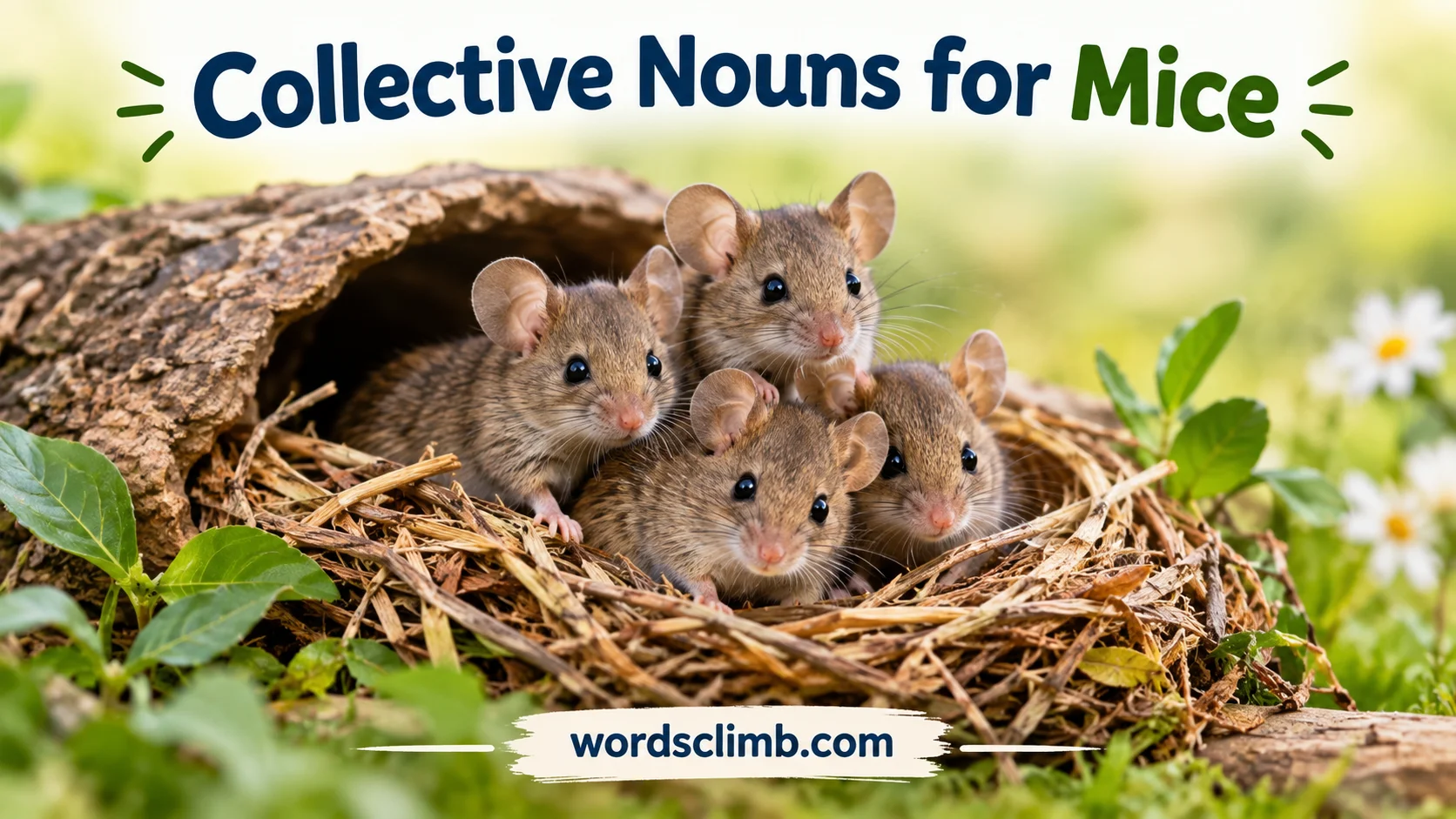
Collective Nouns for Mice make it easier to describe a group of these small rodents. Mice are social mammals known for their quick movements, adaptable nature, and ability to live near people. Learning their group terms can make your English vocabulary more useful and interesting, especially when describing animals in everyday writing.
Mice often gather where they can find food, shelter, and safety, particularly in homes, sheds, garages, and other suitable places. Different animals can have unique collective nouns, and some terms have roots in medieval English. Historical sources, including the Book of St. Albans from 1486, recorded many traditional names for groups of animals.
Collective Nouns for Mice
Several terms can describe a group of mice. Some are commonly recognized, while others are contextual or descriptive. The word mischief is one of the best-known traditional collective nouns for mice.
| Type | Simple Example |
| Mischief | A mischief of mice |
| Nest | A nest of mice |
| Horde | A horde of mice |
| Colony | A colony of mice |
| Group | A group of mice |
1. Mischief of Mice
Mischief is the most famous traditional collective noun associated with mice. It creates a playful image because mice are often portrayed as curious, sneaky, and capable of getting into places where they are not wanted.
Example Sentences:
- A mischief of mice lived behind the old cupboard.
- We saw a mischief of mice near the barn.
- A small mischief of mice searched for food at night.
- The farmer noticed a mischief of mice in the shed.
- A mischief of mice disappeared into a tiny hole.
- The children watched a mischief of mice from a safe distance.
- A mischief of mice was hiding beneath the wooden floor.
- We heard a mischief of mice moving inside the walls.
- The old house seemed to have a mischief of mice.
- A mischief of mice came out after the room became quiet.
2. Nest of Mice
A nest refers to a place where mice live, rest, or raise their young. It can also describe the mice occupying such a nest when the context makes the meaning clear. Mice often make nests from soft materials such as paper, grass, cloth, or shredded fibers.
Example Sentences:
- We found a nest of mice under the wooden box.
- A nest of mice was hidden in the corner.
- The mother mouse protected her nest of mice.
- A nest of mice was discovered inside the shed.
- The farmer carefully checked the nest of mice.
- We noticed a nest of mice beneath the old furniture.
- A nest of mice was made from dry grass.
- The nest of mice was warm and well hidden.
- A nest of mice was tucked behind the storage boxes.
- The young animals stayed close to their nest of mice.
3. Horde of Mice
Horde is a general collective term that can describe a large number of animals moving or gathering together. Although it isn’t a specialized traditional term for mice, it works well when you want to emphasize a large or overwhelming number.
Example Sentences:
- A horde of mice ran across the floor.
- We saw a horde of mice near the grain store.
- A horde of mice entered the barn at night.
- The farmer noticed a horde of mice around the food.
- A horde of mice scattered when the door opened.
- The old building attracted a horde of mice.
- A horde of mice moved through the field.
- The workers discovered a horde of mice in the warehouse.
- A horde of mice searched the area for food.
- The sudden noise sent the horde of mice running away.
4. Colony of Mice
A colony is a useful term when mice live together in an established area or population. It is especially appropriate in scientific, laboratory, or ecological contexts where a group occupies the same environment over time.
Example Sentences:
- A colony of mice lived near the farmhouse.
- Scientists studied a colony of mice in the laboratory.
- A colony of mice occupied the abandoned building.
- The researchers observed a healthy colony of mice.
- A colony of mice found shelter beneath the shed.
- The forest supported a small colony of mice.
- A colony of mice lived among the rocks.
- The researchers carefully monitored the colony of mice.
- A colony of mice can grow quickly when food is plentiful.
- The wildlife team recorded a colony of mice in the area.
5. Group of Mice
Group is the simplest and most universally understandable expression. When you don’t need a specialized collective noun, “a group of mice” is natural, clear, and grammatically correct.
Example Sentences:
- A group of mice crossed the path.
- We saw a group of mice near the garden.
- A group of mice lived inside the old barn.
- The cat watched a group of mice from the window.
- A group of mice searched for food.
- A group of mice ran into the bushes.
- The farmer noticed a group of mice near the grain.
- A group of mice gathered around the food.
- We heard a group of mice moving at night.
- A group of mice hid beneath the wooden floor.
Also Read This: Collective Nouns for Ghosts
Interesting Facts About Mice
Mice are fascinating mammals despite their tiny size. Many wild mice have relatively short lives because they face predators, disease, harsh weather, and limited food, while mice kept in safe conditions can often live considerably longer. One of their most remarkable physiological features is their small, lightweight body, which allows them to squeeze through surprisingly narrow spaces. Mice also have sharp incisors that continue growing throughout their lives, so they constantly gnaw to keep them at a manageable length. Their excellent sense of smell and sensitive whiskers help them explore their surroundings and locate food.
Mice are omnivorous and have flexible diets. Depending on their species and environment, they may eat seeds, grains, fruits, vegetables, insects, and other available foods. Their ability to adapt their diet helps them survive in many habitats, including fields, forests, farms, and human settlements. Mice are also highly reproductive animals, which allows populations to increase rapidly when food and shelter are abundant. Their social behavior, communication, curiosity, and adaptability make them much more interesting than their small appearance might suggest.8
FAQs:
1. What is a group of mice called?
A group of mice is commonly called a mischief. This is one of the most recognized collective nouns used for mice.
2. Why are mice called a mischief?
The term mischief may relate to the troublesome behavior associated with mice, especially when they enter homes, damage materials, or search for food.
3. What are some collective nouns for mice?
Some terms used for groups of mice include mischief, nest, colony, horde, and group. Their usage can vary depending on context and source.
4. Is “mischief of mice” grammatically correct?
Yes. “A mischief of mice” is a traditional collective expression and can be used when referring to a group of mice.
5. Are mice social animals?
Yes, many mice are social animals that live and interact with others. Their social behavior can vary depending on the species and environment.
6. What is the most common collective noun for mice?
Mischief is one of the most commonly recognized traditional collective nouns for mice.
7. Can I use “colony” for mice?
Yes, colony can describe mice living together, particularly in biological or scientific contexts. However, “mischief” is the more traditional collective term.
8. Where do groups of mice usually live?
Groups of mice may live in nests, burrows, fields, barns, sheds, garages, or other places where they can find food and shelter.
9. Why is learning collective nouns useful?
Learning collective nouns improves your English vocabulary and helps you describe groups of animals more naturally and accurately.
10. Is “mischief of mice” used in everyday English?
It is more common in literary, educational, and descriptive writing than in everyday conversation. In normal speech, people often simply say “a group of mice.”
Conclusion:
Collective nouns make English more colorful and give us interesting ways to describe groups of animals. For mice, mischief is the best-known traditional term, while words such as colony, nest, and group can also describe mice together in different contexts. Learning these expressions can expand your vocabulary and make your writing more precise, natural, and engaging.

Ruby Hart is a passionate writer who creates engaging, relatable, and easy-to-understand content. She loves turning everyday ideas into helpful and enjoyable stories for readers.
1 thought on “Collective Nouns for Mice”