
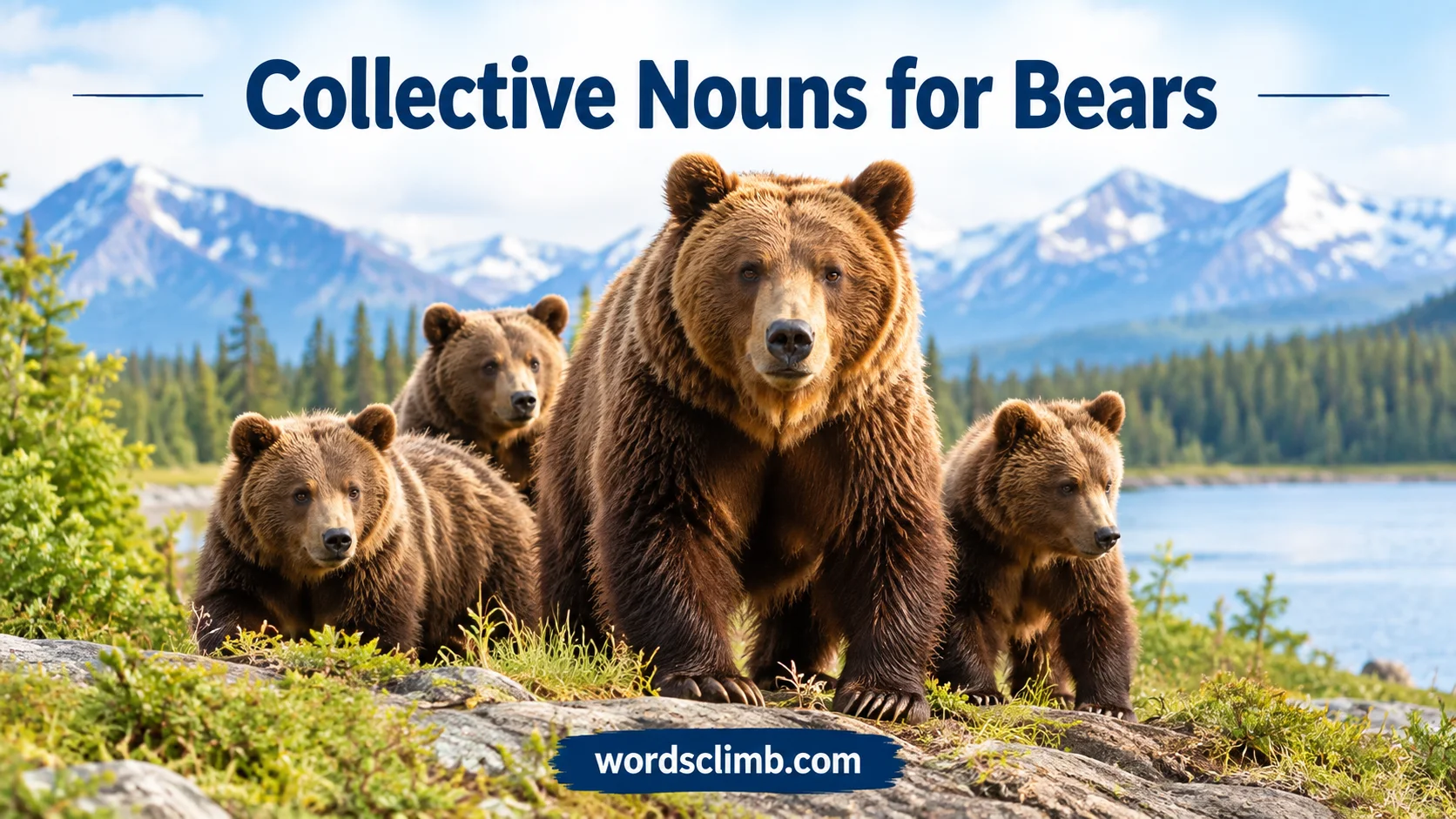
Collective Nouns for Bears can make your English more expressive and help you describe a group of bears naturally. Words such as sleuth and sloth add variety to everyday vocabulary, writing, and speaking. These terms also make it easier to talk about bears as a single unit while learning interesting language connected to animals.
Collective nouns are words that describe a group of people, animals, or things together. Bears are usually solitary animals, but they may gather around food, in suitable habitats, or when mothers stay with their cubs. Learning these special terms connects English vocabulary with animal behavior and gives you more engaging ways to describe the natural world.
Collective Nouns for Bears
Here are some commonly used collective nouns associated with bears:
| Type | Simple Example |
| Sleuth | A sleuth of bears walked through the forest. |
| Sloth | A sloth of bears rested near the trees. |
| Herd | A herd of bears gathered near the river. |
| Pack | A pack of bears moved through the area. |
| Family | A family of bears stayed together near their den. |
A Sleuth of Bears
Sleuth is one of the best-known collective nouns for bears. The word is often used to describe a group of bears and gives your sentence a colorful, traditional feel. It is especially useful when you want to describe several bears moving or searching around the same area.
Examples of a Sleuth of Bears
- A sleuth of bears wandered through the forest.
- We saw a sleuth of bears near the mountain.
- A sleuth of bears searched for food along the river.
- The sleuth of bears moved quietly through the woods.
- A large sleuth of bears gathered near the valley.
- The ranger noticed a sleuth of bears in the distance.
- A sleuth of bears crossed the open field.
- The sleuth of bears disappeared into the forest.
- We watched a sleuth of bears from a safe distance.
- A sleuth of bears explored the area after sunset.
A Sloth of Bears
Sloth is another traditional collective noun associated with bears. It can be used to describe a group of bears, although bears are not always found in large social groups. The term creates an interesting connection between language and the relaxed movements often associated with bears.
Examples of a Sloth of Bears
- A sloth of bears rested under the trees.
- We spotted a sloth of bears near the stream.
- A sloth of bears moved slowly across the meadow.
- The sloth of bears searched for berries.
- A sloth of bears gathered near a food source.
- The photographer watched a sloth of bears from far away.
- A sloth of bears walked along the forest trail.
- The sloth of bears rested after feeding.
- A sloth of bears disappeared behind the bushes.
- The guide pointed out a sloth of bears in the distance.
A Herd of Bears
Herd is a general collective noun that can describe a group of animals. While bears are usually more solitary than many herd animals, the word can sometimes be used descriptively when several bears are together. It is more general than traditional terms such as sleuth.
Examples of a Herd of Bears
- A herd of bears gathered near the river.
- We watched a herd of bears from a safe location.
- A herd of bears moved across the valley.
- The herd of bears searched for food.
- A herd of bears appeared near the forest edge.
- The ranger observed a herd of bears from a distance.
- A herd of bears walked toward the water.
- The herd of bears disappeared into the woods.
- A herd of bears explored the mountain area.
- We noticed a herd of bears near the trees.
A Pack of Bears
Pack is normally associated with animals such as wolves and dogs, but it can be used informally to describe several bears moving together. However, pack of bears is not as traditional or specific as sleuth of bears. When accuracy and traditional usage matter, sleuth is generally the more recognizable choice.
Examples of a Pack of Bears
- A pack of bears moved through the forest.
- We saw a pack of bears near the river.
- A pack of bears searched the area for food.
- The pack of bears walked toward the mountain.
- A pack of bears rested beside the trees.
- The ranger spotted a pack of bears from a distance.
- A pack of bears crossed the meadow.
- The pack of bears disappeared into the forest.
- A pack of bears gathered around the food.
- The photographer observed a pack of bears safely.
A Family of Bears
Family is a natural and easy expression for bears that are related, particularly a mother bear and her cubs. Bears generally live solitary lives, but mothers and their young remain together during the cubs’ early development. This makes family of bears especially useful when describing a mother with her offspring.
Examples of a Family of Bears
- A family of bears lived near the forest.
- We saw a family of bears beside the stream.
- A mother led her family of bears through the woods.
- The family of bears searched for berries.
- A family of bears rested near their den.
- The ranger noticed a family of bears on the hillside.
- A family of bears crossed the forest path.
- The family of bears stayed close together.
- A family of bears explored the area.
- We watched the family of bears from a safe distance.
Also Read This: Collective Nouns for Tigers
Interesting Facts About Bears
Bears are among the most fascinating mammals on Earth, and their lives vary greatly depending on the species. Many bears can live for 20 years or more in the wild, while some individuals can live considerably longer under protected human care. Their bodies have several remarkable physiological adaptations. For example, bears have a strong sense of smell, powerful limbs, large paws, and thick layers of fur that help them survive in different environments. Some species also experience hibernation or winter dormancy, during which their metabolism and activity decrease significantly.
Bears are also omnivores, meaning many species eat both plant and animal foods. Their diets can include berries, fruits, roots, nuts, insects, fish, small animals, and carrion. The exact diet depends on the species and habitat. Polar bears are particularly specialized for eating meat, with seals being an important part of their diet, while giant pandas depend heavily on bamboo. These dietary differences show how adaptable bears can be and why they occupy such a wide range of habitats.
Although bears are often portrayed as highly social animals, many species are actually mostly solitary. Mothers and cubs form important family groups, and bears may gather temporarily when food is abundant. These behaviors help explain why collective nouns such as sleuth are interesting: they give language a memorable way to describe groups of animals whose social lives are often more complicated than a simple “group” suggests.
FAQs:
1. What is a group of bears called?
A group of bears can be called a sleuth or a sloth. These are traditional collective nouns used to describe bears.
2. What is the most common collective noun for bears?
Sleuth is one of the best-known traditional collective nouns for bears. However, in everyday English, people often simply say a group of bears.
3. Is “sloth” a collective noun for bears?
Yes. Sloth is traditionally listed as a collective noun for bears. It should not be confused with the animal called a sloth.
4. Why are bears called a sleuth?
The term sleuth is an old collective noun associated with bears. Like many animal group terms, it comes from traditional English vocabulary rather than being a scientific classification.
5. Do bears usually live in groups?
Most adult bears are generally solitary animals. They may come together when food is plentiful or in other situations where several bears are attracted to the same area.
6. What do you call a group of bear cubs?
There isn’t one universally accepted special collective noun specifically for bear cubs. You can naturally say a group of bear cubs or a litter of cubs when appropriate.
7. Can I use “herd” for a group of bears?
Herd is not the traditional collective noun for bears. Sleuth and sloth are the traditional terms, while group of bears is perfectly clear in ordinary English.
8. Are collective nouns for bears used in everyday English?
Some traditional terms, such as sleuth, are uncommon in everyday conversation. Most speakers simply use a group of bears because it is clear and natural.
9. What sentence uses “sleuth” correctly?
You could write: “A sleuth of bears gathered near the river in search of food.”
10. Why should I learn collective nouns for bears?
Learning these terms can improve your vocabulary, make your writing more descriptive, and introduce you to interesting parts of traditional English.
Conclusion:
Sleuth and sloth are traditional collective nouns for bears, while a group of bears is the most straightforward expression in everyday English. Although bears are often solitary, they can gather when food or other circumstances bring them together. Learning these interesting terms adds variety to your vocabulary and helps you describe the natural world in a more engaging way.

Ruby Hart is a passionate writer who creates engaging, relatable, and easy-to-understand content. She loves turning everyday ideas into helpful and enjoyable stories for readers.
1 thought on “Collective Nouns for Bears”