
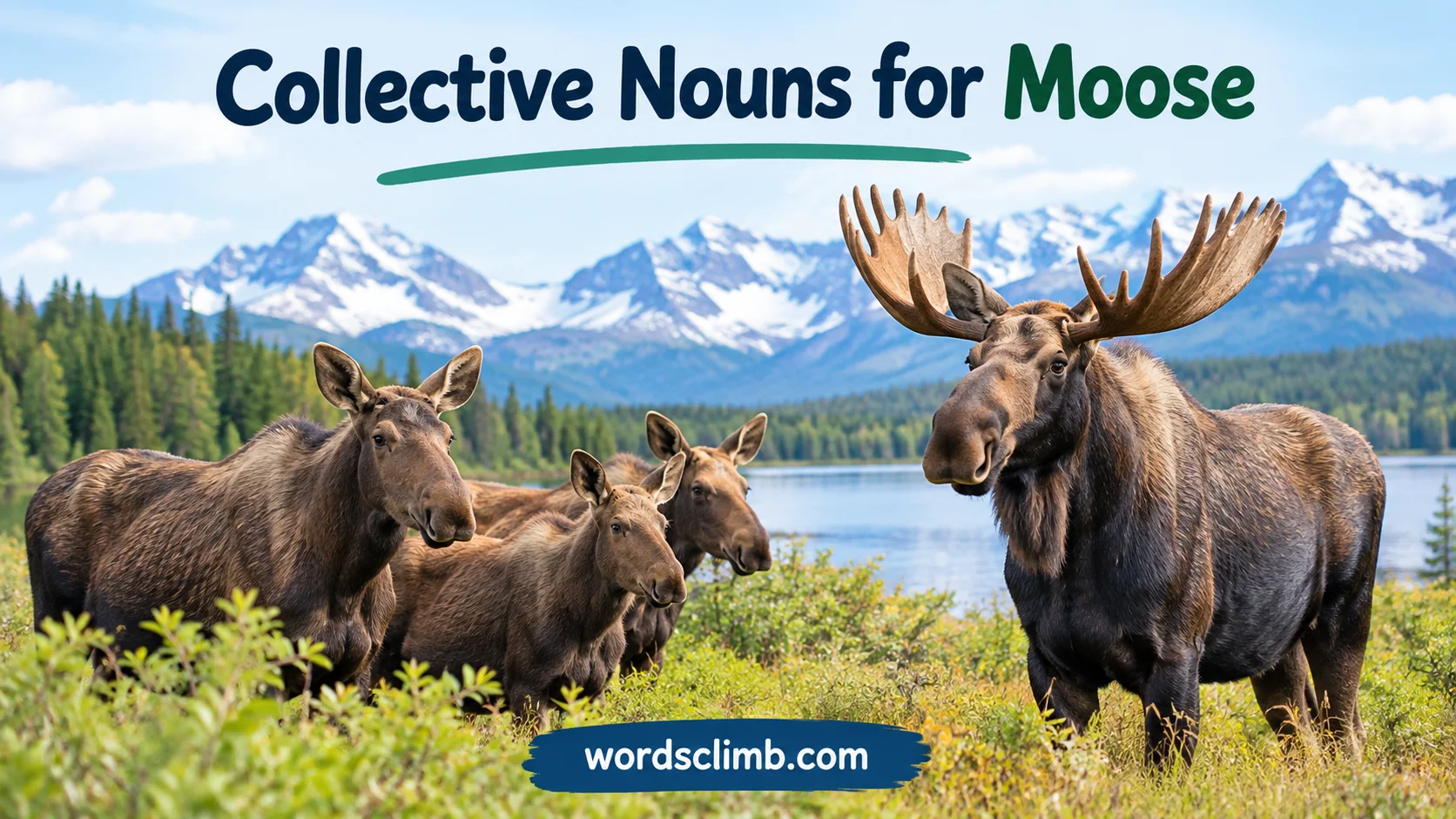
Collective Nouns for Moose describe groups of these large animals with terms such as herd, gang, and group. Learning these names makes your writing more precise and interesting when talking about several moose together in the wild.
A collective noun refers to several individuals as one unit. Many animal group names have roots in medieval hunting traditions, French and English language, poetry, and human imagination. Interestingly, moose has the same spelling in both singular and plural forms, so you can simply say “one moose” or “a group of moose.”
Collective Nouns for Moose
There isn’t one universally required collective noun for moose. In everyday English, herd is the most familiar general term for a group. Some sources and usage guides also use gang for a group of moose. The best choice can depend on the context and the style of writing.
| Type | Simple Example |
| Herd | A herd of moose crossed the road. |
| Gang | A gang of moose moved through the forest. |
| Group | A group of moose gathered near the lake. |
Herd of Moose
A herd of moose is a simple and familiar way to describe several moose together. Moose are not strongly herd-oriented throughout the year, and adults commonly spend time alone. However, several moose may be found in the same area when food and habitat conditions bring them together.
Examples of Herd of Moose
- A herd of moose walked through the snowy forest.
- We saw a herd of moose near the lake.
- A herd of moose moved slowly across the meadow.
- The guide spotted a herd of moose from a distance.
- A herd of moose gathered near the water.
- The photographer watched a herd of moose quietly.
- A herd of moose crossed the open field.
- The children were excited to see a herd of moose.
- A herd of moose disappeared into the trees.
- We noticed a herd of moose while driving through the forest.
A Gathering of Moose
A gathering of moose describes several moose that come together in the same area. Moose are usually solitary, but they may gather where food, water, or suitable habitat is available. This phrase is simple and easy to understand in general wildlife writing.
Examples of A Gathering of Moose
- A gathering of moose appeared near the lake.
- We watched a gathering of moose in the meadow.
- A gathering of moose moved through the forest.
- The ranger noticed a gathering of moose nearby.
- A gathering of moose stood beside the river.
- The photographer captured a gathering of moose.
- A gathering of moose crossed the open field.
- We saw a gathering of moose at dawn.
- A gathering of moose slowly entered the woodland.
- The hikers observed a gathering of moose from afar.
A Group of Moose
A group of moose is a general and straightforward expression for several moose that are together. It doesn’t suggest that moose always live socially or form a permanent group. Instead, it simply describes multiple moose seen in the same place at the same time.
Examples of A Group of Moose
- A group of moose stood near the water.
- We saw a group of moose in the forest.
- A group of moose crossed the road.
- The guide photographed a group of moose.
- A group of moose rested near the trees.
- The tourists watched a group of moose quietly.
- A group of moose moved through the snow.
- We noticed a group of moose beside the lake.
- A group of moose walked across the meadow.
- The camera recorded a group of moose in the wild.
Gang of Moose
Gang is another collective term sometimes used for a group of moose. It has a more informal and colorful sound than herd. You may encounter this term in wildlife writing or lists of animal collective nouns. Because moose often have solitary habits, the word is better understood as a descriptive collective term rather than evidence that moose normally live in permanent groups.
Examples of Gang of Moose
- A gang of moose moved through the woodland.
- We spotted a gang of moose near the river.
- A gang of moose wandered across the meadow.
- The ranger saw a gang of moose in the distance.
- A gang of moose gathered beside the trees.
- The photographer followed a gang of moose from a safe distance.
- A gang of moose walked toward the water.
- The hikers noticed a gang of moose in the valley.
- A gang of moose slowly entered the forest.
- We watched a gang of moose from the viewing area.
Group of Moose
Group is a general collective noun that can be used whenever several moose are together. It doesn’t suggest a particular social structure, so it works well in simple writing. If you’re unsure which specialized collective noun to use, a group of moose is clear, natural, and easy for readers to understand.
Examples of Group of Moose
- A group of moose stood beside the lake.
- We saw a group of moose in the forest.
- A group of moose crossed the road carefully.
- The ranger photographed a group of moose.
- A group of moose moved through the tall grass.
- The tourists watched a group of moose from afar.
- A group of moose rested near the river.
- We noticed a group of moose among the trees.
- A group of moose walked across the open land.
- The wildlife camera recorded a group of moose at dawn.
Read More: Collective Nouns for Turtles
Interesting Facts About Moose
Moose are the largest members of the deer family and have several remarkable physical adaptations. Their long legs help them move through deep snow and wet terrain, while their broad, flat hooves provide support on soft ground. Adult males grow large palm-shaped antlers, which they shed after the breeding season and regrow the following year. Moose also have a long, flexible nose and specialized lips that help them select and grasp vegetation.
Moose can live for well over a decade in the wild, although lifespan varies depending on habitat, disease, predators, hunting pressure, accidents, and other environmental factors. Their size is another striking feature: large adults can weigh hundreds of kilograms, making them among the most massive land mammals in their northern habitats.
Their diet is mainly made up of plants, including leaves, twigs, aquatic vegetation, shrubs, and other woody plants. Moose are particularly well adapted to feeding on vegetation that grows in wetlands and forests. During warmer months, they may spend considerable time feeding on aquatic plants, while in winter they rely more heavily on woody browse such as twigs and branches. Their specialized digestive system allows them to process this fibrous plant material.
FAQs:
1. What is a group of moose called?
A group of moose can be called a herd, gang, or simply a group of moose. “Herd” is one of the most familiar terms.
2. What is the collective noun for moose?
The common collective nouns for moose are herd, gang, and group. These words describe several moose together.
3. Can you say a herd of moose?
Yes, a herd of moose is a natural and widely understood expression for multiple moose gathered together.
4. Is “gang of moose” correct?
Yes, gang of moose is another collective term that can be used for a group of moose.
5. Is the plural of moose “mooses”?
No. The standard plural form is moose. You say one moose and several moose, not “several mooses.”
6. Why do we use collective nouns for moose?
Collective nouns help us describe multiple animals as one group. They make sentences shorter, clearer, and more interesting.
7. Are collective nouns for moose based on history?
Some animal collective nouns have roots in medieval hunting traditions, literature, poetry, and traditional English usage. Different terms developed over time.
8. What is the most common collective noun for moose?
Herd is one of the most common and easily understood terms for a group of moose.
9. Can I use “group of moose” in everyday English?
Yes. Group of moose is completely clear and natural, especially when you don’t want to use a more specific collective term.
10. How should I use a collective noun for moose in a sentence?
You can say, “We saw a herd of moose near the forest,” or “A group of moose crossed the road.”
Conclusion:
Knowing the collective nouns for moose can make your English more accurate, natural, and interesting. The terms herd, gang, and group can all describe several moose together. Remember that the plural of moose is still moose, which makes the word especially interesting. Whether you’re writing an article, studying grammar, or simply talking about wildlife, these collective nouns give you useful ways to describe these impressive animals.

Adam West is an English-language writer with a passion for storytelling, culture, and everyday life. His writing focuses on clear ideas, engaging narratives, and thoughtful perspectives that are easy for readers to connect with.
1 thought on “Collective Nouns for Moose”